How much house can I afford? The lender's number vs. your number
Ask a lender how much house you can afford and you'll get one number: the most they'll lend. That's an answer to a different question. The lender is asking whether you'll repay the loan. You're asking whether you'll still be able to save, travel and fix the roof. Here is how to work out both.
1. How lenders size your loan
Lenders compare your monthly payments with your monthly income before tax. These are the debt-to-income ratios, or DTI. There are two:
- Front-end: the housing payment alone. That's principal, interest, property tax, insurance, HOA dues and mortgage insurance, often shortened to PITI.
- Back-end: the housing payment plus every other debt payment: car, student loans, card minimums.
The limits depend on the loan type:
- Conventional: Fannie Mae sets no front-end limit. All debts can reach 45% of income, and its automated underwriting can approve up to 50%.
- FHA: 31% for housing and 43% for all debts on a manually underwritten loan. Automated approvals often allow more.
- VA: a 41% guideline for all debts, plus a residual-income test.
On $120,000 a year, $10,000 a month, a 45% limit allows $4,500 of monthly debt payments. With a $500 car payment that leaves $4,000 for housing. At 6.5% over 30 years, after taxes and insurance, that supports a home well over half a million dollars.
2. Why that number is too high for most budgets
The lender's ratio leaves out most of what your money actually goes to:
- Taxes and paycheck deductions. $10,000 of gross pay might be $7,800 after tax and retirement contributions. A $4,000 housing payment is 40% of gross but more than half of take-home.
- Saving. Retirement, college and emergency savings aren't debts, so lenders don't count them.
- Maintenance. Plan on 1–2% of the home's value a year. On a $400,000 home that's $330–$670 a month, and no lender includes it.
- Everything else. Childcare, groceries, commuting and the rest of life.
The lender's maximum is a ceiling, not a target.
3. The 28/36 rule of thumb
The old rule says to keep housing at or below 28% of gross income and all debts at or below 36%. It's a rule of thumb, not a lending rule, and it still runs on gross income. It usually lands between a comfortable price and the lender's maximum, which makes it a useful sanity check but not an answer.
4. Your number: start from take-home pay
A budget-based answer works the other way round:
- Start with what reaches your bank each month.
- Take off your debt payments and the savings you're not willing to cut.
- Decide what share of the rest can go to housing, including maintenance. The calculator uses 40% by default, about 30–35% of take-home for most households.
- Find the price whose all-in monthly cost fits.
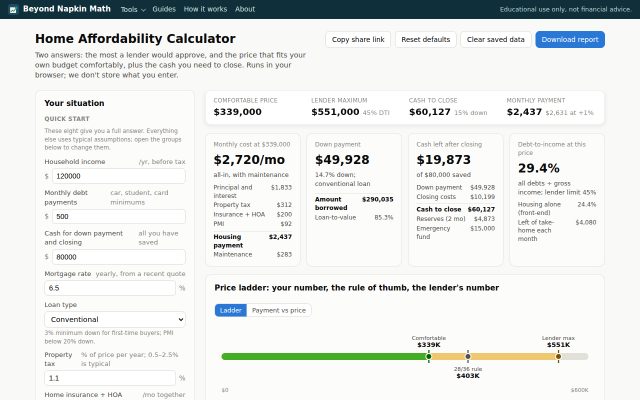
For a $120,000 household with $7,800 of take-home pay, a $500 car payment and $500 of savings, that's about $2,700 a month all-in, for a home of roughly $340,000. The lender would approve about $550,000.
5. Cash to close is its own limit
You need the down payment and closing costs (typically 2–5% of the price) in cash. Many lenders also want a few months of payments left in the bank afterward. A smaller down payment is possible (3% conventional, 3.5% FHA, 0% VA), but below 20% down you pay mortgage insurance:
- Conventional PMI costs roughly 0.2–1.5% of the loan a year, depending on credit score. It ends when you reach 22% equity on schedule.
- FHA charges 1.75% upfront plus 0.5–0.55% a year for most loans. With under 10% down, that lasts the life of the loan.
- VA has no monthly insurance but a one-time funding fee of 1.25–3.3%.
Keep your emergency fund out of the down payment. A house is the place where surprise bills arrive.
6. Stress-test the price before you fall for a house
Run four checks before you shop:
- The rate goes up a point before you lock. On a $300,000 loan that adds about $200 a month.
- The property tax is reassessed. Many places reassess at the sale price, so the seller's tax bill isn't yours.
- Insurance rises. Premiums have climbed sharply in many states.
- One income stops. For a two-earner household, can one income carry the payment for a while?
If the payment only works when nothing goes wrong, the price is a stretch.
Try it with your numbers
The Home Affordability Calculator shows your comfortable price, the 28/36 rule of thumb and the lender's maximum side by side, with cash to close, mortgage insurance and the stress tests. It runs in your browser and we don't store your numbers. If you're weighing whether to buy at all, the Rent vs Buy calculator compares buying at that price with renting and investing the difference.
 Run your own numbers
Home Affordability Calculator
The lender's number vs. your number, with the cash you need to close.
Open the tool →
Run your own numbers
Home Affordability Calculator
The lender's number vs. your number, with the cash you need to close.
Open the tool →