How much do you need to retire early?
The quick answer is "25 times your yearly spending." For an early retirement, that number is usually too low, and it skips the question of whether you can actually reach your money before 59½. Here's how to build a better estimate.
1. Start with spending, not income
What matters is what you'll spend each year in retirement, in today's dollars: living costs, healthcare, and the housing costs that continue after a mortgage is paid off (property tax, insurance, upkeep). If your figure is money to spend, add the tax you'll pay on withdrawals.
2. Divide by a withdrawal rate that fits your retirement's length
"25 times spending" is the 4% rule, which was calibrated on 30-year retirements. Retire at 45 and your money may need to last 50 years, through more market cycles. Lower rates mean bigger targets:
| Withdrawal rate | Savings needed | For $60,000 a year |
|---|---|---|
| 4.0% | 25 × spending | $1,500,000 |
| 3.5% | about 28.6 × spending | about $1,714,000 |
| 3.0% | about 33.3 × spending | $2,000,000 |
That's why the target rises the earlier you retire: a longer retirement needs a lower rate, which means a bigger number.
3. Make sure you can reach the money before 59½
Most retirement savings sit in 401(k)s and IRAs, which generally charge a 10% penalty on withdrawals before 59½. Early retirees need enough accessible money to cover the gap:
- Regular (taxable) investment accounts, usable anytime.
- Roth IRA contributions, which can come out tax- and penalty-free at any time. The growth on them can't, until later. Roth 401(k) money usually needs rolling into a Roth IRA first.
- The Rule of 55: if you leave a job in or after the year you turn 55, that employer's 401(k) can usually be tapped without the penalty.
- A 72(t) plan (substantially equal periodic payments) or a Roth conversion ladder, both of which need planning years ahead.
4. Budget for healthcare before Medicare
Medicare starts at 65. Before that, early retirees usually buy coverage on the ACA marketplace, and premiums depend heavily on income. For many households this is one of the largest costs of retiring early, and it's often left out of rule-of-thumb targets.
5. Count Social Security, but realistically
Benefits are based on your best 35 years of earnings. Stop working at 50 after 25 years and ten zeros go into that average. Claiming at 62 also reduces the benefit permanently, while waiting until 70 raises it by 8% a year past full retirement age. Social Security lowers the savings you need, but less than a full-career estimate suggests. Your actual earnings record is at ssa.gov.
6. Plan for bad timing
The order of returns matters. A weak decade just before or after you retire does far more damage than the same decade earlier, when your balance was smaller. Test your plan against a few bad sequences, not just the average return.
Putting it together
- Estimate yearly retirement spending, including healthcare and ongoing housing costs.
- Divide by a withdrawal rate suited to how long retirement will last.
- Subtract a realistic Social Security contribution.
- Check that accessible money covers the years before 59½ (or your access age).
- Stress-test against bad market sequences.
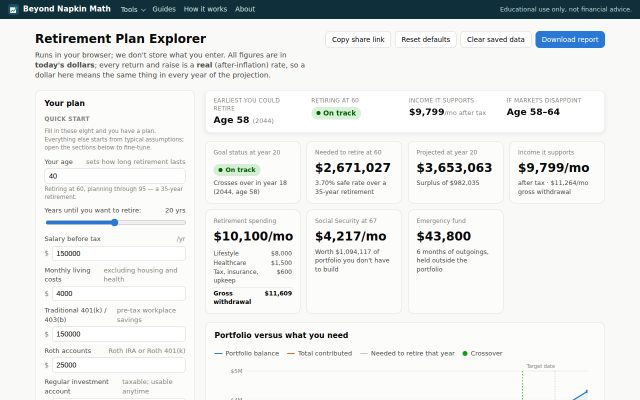 Run your own numbers
Retirement Plan Explorer
When could you retire? 401(k), Roth and taxable savings, in today's dollars.
Open the tool →
Run your own numbers
Retirement Plan Explorer
When could you retire? 401(k), Roth and taxable savings, in today's dollars.
Open the tool →