How to compare two job offers: the total pay math recruiters skip
Recruiters lead with the salary, and most people compare offers the same way. But two offers $20,000 apart on salary can end up close, or flipped, once you count what actually reaches your bank account. Here is the math, line by line.
1. A worked example
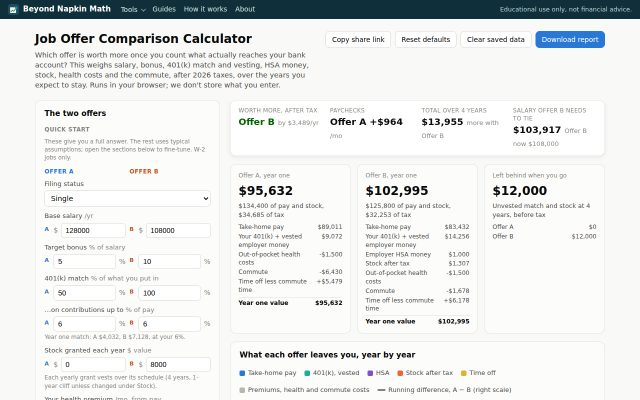
Take two offers for a single filer in a state with a 5% income tax:
- Offer A: $128,000 salary, 5% bonus, a 50% 401(k) match up to 6% of pay that vests over four years, a $220 monthly health premium, five office days a week with a 36-mile round trip.
- Offer B: $108,000 salary, 10% bonus, a 100% match up to 6% that's yours at once, $8,000 of stock granted each year, a $5,000 sign-on bonus, $1,000 a year into an HSA, a $140 premium, two office days a week and 24 miles round trip.
Offer A's paychecks are about $960 a month bigger. Over four years, though, Offer B comes out about $14,000 ahead in today's dollars, roughly $3,500 a year. Offer B would only need a salary of about $103,900 to tie. The rest of this guide walks through where that gap comes from.
2. Start with take-home pay, not salary
Every extra dollar of salary is taxed at your top rate: federal income tax, state tax, and 7.65% of payroll tax. For a single filer earning around $120,000, that's 22% + 5% + 7.65%, so a $20,000 raise is worth about $13,000 in your pocket. Money that isn't paid as salary, like an HSA contribution, is often worth more per dollar because it isn't taxed at all.
Health premiums come out of your pay before tax at most employers, so an $80 a month difference in premiums is worth less than $960 a year after tax. Compare the take-home pay after premiums, not the salaries.
3. The 401(k) match is part of your pay
Match formulas look similar and aren't. In the example, "100% up to 6%" on Offer B's $118,800 of salary and bonus puts $7,128 a year into your account if you contribute at least 6%. "50% up to 6%" on Offer A's $134,400 puts in $4,032. The bigger salary comes with the smaller match.
Two details decide what the match is really worth:
- Vesting. The employer's money may not be yours until you've stayed long enough. A 3-year cliff means you keep nothing if you leave after two years and eleven months. A graded schedule gives you a share each year. Your own contributions are always yours.
- Contributing enough. The match only pays on what you put in. If you contribute 3% to a plan that matches up to 6%, you're leaving half of it behind. If you max out early in the year, ask whether the plan "trues up" the match at year end.
4. Stock: read the schedule, not the headline
"$40,000 a year in stock" can mean a $160,000 grant that vests over four years, or a $40,000 grant each year where each one vests over four years. The second is worth far less in your first years: after one year, only $10,000 has vested. Most grants have a one-year cliff, so leaving at month 11 means none of it vests.
Vested stock is taxed as pay, just like salary. And a share price can fall: a 40% drop takes 40% off everything granted on day one. For a private company, you may not be able to sell at all. Put a haircut on the value if you're not sure.
5. Sign-on bonuses come with strings
A sign-on bonus usually has a clawback: leave within 12 or 24 months and you pay it back. It's real money if you stay, and nothing if you don't. It's also taxed as pay, so a $5,000 bonus nets you about $3,300 at a 34% combined rate.
6. The commute is a pay cut you don't see
Five office days a week on a 36-mile round trip is about 8,500 miles a year. At the IRS business rate of 76 cents a mile, the full cost of driving including wear and depreciation, that's about $6,400 a year, paid from after-tax money because commuting is never deductible. Two office days on a shorter trip is closer to $1,700.
The time matters too. An hour and a quarter a day, five days a week, is close to 300 hours a year, more than seven work weeks. Whether that's worth $0 or $30 an hour to you is your call, but it's worth knowing the number.
7. Time off is pay too
Twenty paid days off instead of fifteen is a week of pay for a week you don't work. At a $108,000 salary that's about $2,000 before tax. It's easy to leave out because it never shows up as a deposit.
8. Ask what happens if you leave early
Run the comparison at the number of years you really expect to stay, and then at less. Unvested match and stock, a clawed-back bonus and a missed year-end bonus can all land at once if you leave in the first year. In the example, leaving at 11 months shrinks Offer B's lead to almost nothing, because its stock hasn't vested and its sign-on bonus would be repaid.
Then stress the offer that's ahead: what if the bonus pays half, the stock falls, the job wants one more office day, or the raises don't come? In the example, a half-paid bonus or no raises at Offer B would flip the answer to Offer A. If the winner only wins under the best case, the offers are closer than they look.
9. What the numbers can't tell you
A spreadsheet can't weigh what you'd learn, the next job the role leads to, how secure the company is, or how much you'd like the work. Use the numbers to see how big the money gap really is, and then decide whether the rest is worth it.
Compare your own offers with the Job Offer Comparison Calculator →
 Run your own numbers
Job Offer Comparison Calculator
Salary is only part of it. Which offer is worth more after tax, vesting and the commute?
Open the tool →
Run your own numbers
Job Offer Comparison Calculator
Salary is only part of it. Which offer is worth more after tax, vesting and the commute?
Open the tool →