Long-term vs. short-term rental: how to compare the numbers
A short-term rental usually brings in more revenue than a long-term lease on the same property. That doesn't mean it earns more. The costs, financing, taxes and risks are different enough that the only fair comparison runs both strategies through the same property, line by line.
1. Revenue is built differently
A long-term rental is simple: monthly rent, plus small extras like pet rent or parking, minus an allowance for vacancy and missed payments (5–8% over a full hold is typical).
A short-term rental is built night by night: average daily rate × nights booked, plus the cleaning fees guests pay. Two things make it harder to estimate:
- Seasonality. A beach town may earn most of its year in three months. Use month-by-month occupancy and rates, not a single annual average.
- Optimistic data. Listing sites and data tools often show the best performers. Lenders typically cut projected short-term revenue by 20–25%, and that's a sensible habit for your own estimate too.
2. Costs are much higher for short-term rentals
| Cost | Long-term rental | Short-term rental |
|---|---|---|
| Management | Typically 8–10% of rent | Typically 20–35% for full service |
| Utilities and internet | Usually paid by the tenant | Always paid by you |
| Cleaning and supplies | Only between tenants | Every stay, so shorter stays cost more |
| Furnishing | None | Often $15,000–$30,000 up front, plus replacements |
| Insurance | Standard landlord policy | Short-term rental policies cost materially more |
| Platform fees and software | None | Booking platform fee, pricing and lock software |
| Wear and tear | Moderate | Higher: budget more for maintenance and replacements |
A useful check is break-even occupancy: the share of nights you need to book just to cover costs and the mortgage. If your expected occupancy is only a few points above it, a soft year turns the property cash-negative.
3. Financing and coverage
Lenders look at debt service coverage (DSCR), net operating income divided by the loan payments, and usually want 1.25 or more. For short-term rentals, many apply a revenue haircut first. A deal that only works on full projected short-term revenue may not get the loan you planned on.
4. Taxes can favor short-term rentals, if you qualify
Rental losses (often created by depreciation) are usually passive: they can't offset your salary, so they carry forward. Under IRS rules, a rental with an average stay of seven days or less isn't treated as a rental activity, and if you also materially participate, losses can offset other income. Combined with a cost-segregation study and 100% bonus depreciation, that can mean a large first-year deduction. Whether you qualify depends on facts a tax professional should confirm.
5. Local rules can end the short-term case outright
No spreadsheet survives a ban. Before running numbers, check whether:
- permits are limited to a primary residence;
- HOA, condo or deed rules prohibit short stays;
- there's a cap on nights per year, or a permit waitlist;
- new restrictions are being debated.
If any of these apply, underwrite the long-term rental too, because that's what you may end up with.
How to compare fairly
- Use the same purchase price, financing and hold period for both.
- Use conservative short-term revenue: month by month, with a haircut.
- Include every short-term cost, especially management, utilities, cleaning and furnishing.
- Compare cash flow, cash-on-cash return, DSCR and break-even occupancy, not just revenue.
- Stress-test both: higher rates, lower revenue, higher costs.
- Look at the after-tax return over the whole hold, including the sale.
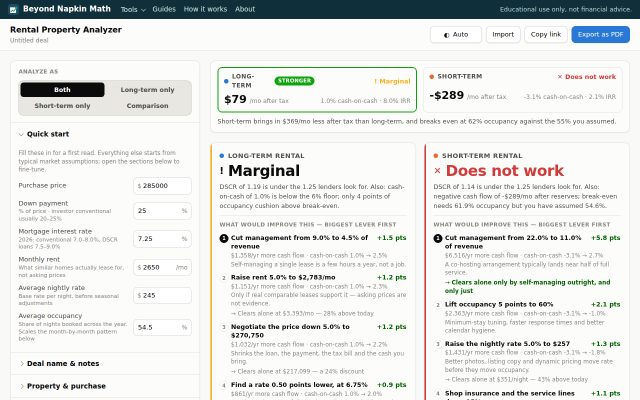 Run your own numbers
Rental Property Analyzer
Long-term vs short-term rental: cash flow, returns and taxes, side by side.
Open the tool →
Run your own numbers
Rental Property Analyzer
Long-term vs short-term rental: cash flow, returns and taxes, side by side.
Open the tool →