Should you pay off your mortgage early?
An extra payment toward your mortgage saves interest. The usual rule of thumb says it's good if your rate is high and bad if it's low. The real answer depends on a few numbers you can check yourself.
1. What an extra payment actually does
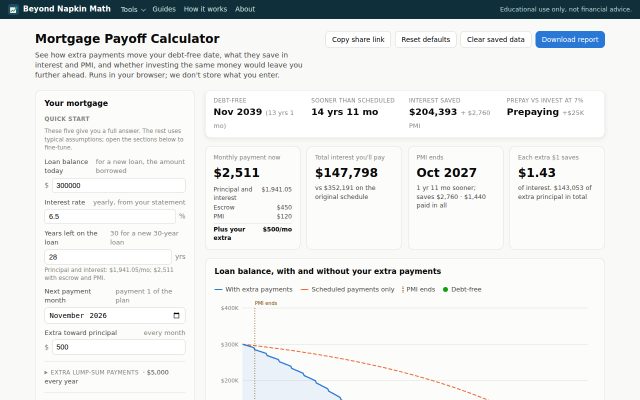
Your required payment stays the same. Each extra dollar goes straight to principal, so every later month's interest is a little smaller and more of the regular payment goes to principal too. That is why small extras early in a loan have an outsized effect: on a $300,000 loan at 6.5% with 28 years left, $500 a month and $5,000 once a year can cut more than half of the remaining interest.
A rough guide: the earlier in the loan and the higher the rate, the more each extra dollar saves. Late in the loan most of the interest has already been paid, so prepaying saves less.
2. Monthly extras versus lump sums
A dollar paid sooner saves more than a dollar paid later, so $500 a month usually beats $6,000 at the end of the year, if only slightly. Lump sums are still worth a lot: a bonus or tax refund sent to principal works the same way. The calculator splits your plan into "monthly only" and "lump sums only" so you can see which part does more.
One practical point: tell your lender the extra is for principal. Some servicers hold unlabeled extra money toward next month's payment, which saves nothing.
3. PMI can be the biggest win, if you ask
If you put less than 20% down on a conventional loan, you probably pay private mortgage insurance. By law it ends automatically when your original schedule reaches 78% of the home's value at purchase, and extra payments don't move that date. You can ask to cancel it once your actual balance reaches 80% of that value, and extra payments do bring that forward. Lenders usually want a written request and a clean payment record. Each month of PMI you skip is money saved on top of the interest.
4. Watch what happens when escrow rises
Property tax and insurance often rise, and with them the escrow part of your payment. Lenders normally raise the payment to cover it. If you instead keep paying the same total, the increase quietly comes out of what you meant as extra principal, and your payoff date slips. When escrow changes, rerun your plan with the new figures.
5. The real question: pay down the loan or invest?
Paying down a 6.5% loan earns 6.5%, guaranteed, with no tax on it. Investing might earn more, but with ups and downs. A fair comparison gives two households the same monthly budget:
- One prepays and, once the loan is gone, invests everything it was paying.
- The other pays on schedule and invests the extras from day one.
Compare what each has when the original loan would have ended, after tax on investment gains. The return where they finish level is the break-even. On a 6.5% loan it comes to roughly 6.7% a year if your gains are untaxed (in a Roth, say) and about 7.4% at a 15% tax on gains. Long-run stock returns have averaged around that, which is why this is a close call at today's rates and an easy one at 3%.
Two things the numbers don't capture: investing comes with risk, and the order of returns matters. And a paid-off home lowers what you must earn each month, which counts if a job is lost.
6. Do these first
- Keep an emergency fund. Money sent to the loan is hard to get back without a new loan.
- Pay off higher-rate debt, such as credit cards and car loans.
- Take any employer 401(k) match: it's an instant return that beats both.
Try it with your numbers
The Mortgage Payoff Calculator shows your debt-free date, interest and PMI saved, and the prepay-versus-invest comparison with its break-even return. It runs in your browser and we don't store your numbers.
 Run your own numbers
Mortgage Payoff Calculator
Extra payments, PMI and the real question: pay it down or invest?
Open the tool →
Run your own numbers
Mortgage Payoff Calculator
Extra payments, PMI and the real question: pay it down or invest?
Open the tool →