Rent or buy in 2026: why the break-even is longer than you think
"Rent is throwing money away" is the most repeated line in personal finance. It's half true. Part of a mortgage payment is thrown away too, buying and selling a home costs a lot, and a renter who invests the difference can build wealth just as fast. Here is how to tell which side you're on.
1. Compare what you don't get back
Rent is gone once you pay it. So is most of an owner's early spending: mortgage interest, property tax, insurance, HOA dues, maintenance and PMI. Only the principal part of the payment builds equity, and in the first years of a 30-year loan that's a small slice. On a $320,000 loan at 6.5%, the first year's payments come to about $24,300, of which roughly $20,700 is interest.
Owning has one more cost that never shows up on a bill: the down payment. Invested instead, $80,000 earning 7% a year would make around $5,600 a year. A fair comparison counts it.
2. Buying and selling cost more than a year of rent
Closing costs run 2–5% of the price when you buy, and agent fees and closing costs take another 5–6% when you sell. On a $400,000 home that's $30,000–$40,000, often more than a year of rent. Price growth and loan paydown have to win that back before buying pulls ahead, which is why short stays nearly always favour renting. If there's a real chance you'll move in 3 years, that matters more than the mortgage rate.
3. The itemizing trap
The mortgage interest deduction only helps if you itemize, and you only itemize if your deductions beat the standard deduction. For 2026 that is $32,200 for a married couple filing jointly, $16,100 single, and $24,150 for a head of household.
A couple with $20,000 of mortgage interest and $12,000 of state and property taxes has $32,000 of itemized deductions, $200 short of the standard deduction. Their mortgage saves them nothing in income tax. Most new buyers are in this position. Even when you do itemize, only the part above the standard deduction counts, and it shrinks every year as the loan's interest falls.
What changed for 2026:
- The cap on state and local tax (SALT) deductions rose to $40,400, phasing down to $10,000 for incomes over $505,000. Under current law it drops back to $10,000 for everyone in 2030, so a long stay should not count on the higher cap.
- PMI is deductible again, but only if you itemize and only for incomes under about $110,000.
- The $750,000 limit on mortgage debt for the interest deduction is now permanent.
4. The renter who actually invests
Renting wins on paper only if the renter invests the down payment and the monthly savings, every month, for years. That's the comparison every honest rent-vs-buy calculator makes, and it's the part people skip in real life. A mortgage is forced savings: the principal gets paid whether you feel like it or not. If you know the difference would drift into spending, buying probably wins for you even when the spreadsheet says otherwise.
Where the renter invests matters too. In a 401(k) or Roth IRA the gains aren't taxed; in a taxable account they are, while up to $250,000 of a home's gain ($500,000 for a married couple) is tax-free after 2 years of living there.
5. What moves the break-even most
- Price to rent. When a home costs more than about 20 times a year's rent, renting usually wins for a long time. Under about 15 times, buying tends to win within a few years.
- How long you stay. Every extra year spreads the transaction costs thinner.
- Home price growth versus investment returns. The house is a leveraged bet on local prices; the renter's portfolio is a bet on markets. A few points either way move the answer a lot.
- Rent growth. Your mortgage payment is fixed; rent isn't. Fast-rising rents favour buying.
6. Stress-test it
Run your numbers again with prices flat for five years, a 10% drop in the first year, a forced move in year three, and a $15,000 repair. If buying still comes out ahead, or close, it's a sturdy decision. If one bad break flips it, you're betting on the market, not just buying a home.
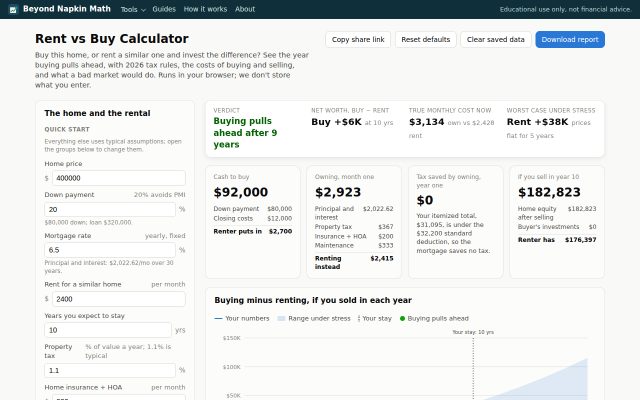
Our Rent vs Buy Calculator does all of this with your figures, in today's dollars, and shows the year buying pulls ahead. If buying wins, the Home Affordability calculator shows what price your budget supports, and the Mortgage Payoff calculator shows what extra payments would save.
 Run your own numbers
Rent vs Buy Calculator
After how many years does buying beat renting and investing the difference?
Open the tool →
Run your own numbers
Rent vs Buy Calculator
After how many years does buying beat renting and investing the difference?
Open the tool →