Rental property depreciation, cost segregation and recapture, in plain English
Depreciation is the tax break most often credited with making rentals "tax-free". It's real, but it's mostly a delay, not a gift: you deduct the building's cost over the years you own it, and much of that deduction is taxed back when you sell. Here's how it works, worked through on one rental, including the cases where it's worth a lot more.
1. What you can depreciate
The IRS treats a rental building as wearing out over 27.5 years, so you deduct an equal slice of its cost each year. Only the building counts: land doesn't wear out, so its share of the price can't be depreciated.
Take the Rental Property Analyzer's example: a $285,000 house with $12,000 of work before renting and $7,125 of closing costs.
- Total cost: $304,125.
- Less 20% for the land: $243,300 of building.
- Divided by 27.5 years: $8,847 a year of depreciation.
The land share varies a lot by place. Your county's property tax assessment, which often splits land and building, is a common starting point.
2. A cash profit, a tax loss
In year one, the example collects $30,174 of rent and spends $9,311 running the house, leaving $20,863 before the mortgage. For tax purposes:
| Year one | |
|---|---|
| Rent less running costs | $20,863 |
| Less mortgage interest | −$15,429 |
| Less depreciation | −$8,847 |
| Taxable result | −$3,413 (a loss) |
Meanwhile the house put $951 of cash in your pocket after the full mortgage payment and a reserve for repairs. You pay no tax on that $951, and you have a $3,413 loss on paper. That's the "tax-free" part.
3. Where the loss goes
Rentals are usually "passive" activities, and passive losses can generally only offset passive income. A loss you can't use is suspended and carried forward. It offsets the rental's own profits in later years, and whatever is left is released when you sell. In the example, later years turn profitable and use the carried losses up.
There are three main ways a rental loss can offset your salary or other income instead:
- The $25,000 allowance. If you actively participate (approving tenants and setting the rent counts), you can deduct up to $25,000 of rental losses a year against other income. It shrinks as your modified adjusted gross income goes from $100,000 to $150,000, and is gone above that.
- Real estate professional status. If more than half your working time, and over 750 hours a year, goes into real estate businesses you materially participate in.
- Short-term rentals, with an average stay of 7 days or less and material participation, are not treated as passive in the first place.
IRS Publication 925 has the details. In the example, using the year-one loss against other income at a 24% bracket saves $819 of tax.
4. Recapture: the bill at the end
Depreciation lowers your cost basis, the figure your gain is measured from. When you sell, the depreciation you took is taxed back at up to 25% ("unrecaptured section 1250 gain"), and the rest of the gain is taxed as a capital gain. In the example, selling after 10 years at 3% yearly appreciation:
| At sale | |
|---|---|
| Sale price | $399,143 |
| Less selling costs (7%) | −$27,940 |
| Less adjusted basis ($304,125 cost − $88,473 of depreciation) | −$215,652 |
| Taxable gain | $155,551 |
| Tax on the $88,473 of depreciation, at 25% | $22,118 |
| Tax on the other $67,078, at 15% | $10,062 |
You can't avoid recapture by not claiming depreciation. It's charged on the depreciation you were entitled to take, whether you took it or not. Skipping the deduction only loses the benefit while keeping the bill.
5. So what is depreciation worth?
Run the same rental with no depreciation at all and compare:
| With depreciation | Without | |
|---|---|---|
| Tax in year one | $0 (a $3,413 loss) | $1,304 |
| Tax when you sell | $32,180 | $10,062 |
| Total profit after tax, 10 years | $96,373 | $97,258 |
| Return after tax (IRR) | 7.98% | 7.58% |
At a 24% bracket, the deductions save tax at 24% and recapture takes it back at 25%, so total profit comes out about the same. The benefit is timing: tax saved now and paid years later, which raises the return. Depreciation is worth considerably more when:
- your tax bracket is above the 25% recapture rate;
- you can use the losses now, through one of the three routes above;
- you swap into another property with a 1031 exchange, which defers the tax again;
- you hold the property until death. Heirs generally receive it at its value on that date, and the recapture never comes due.
6. Cost segregation: front-loading the deduction
A cost segregation study, done by an engineer or specialist firm for a fee, splits out parts of the property that wear out faster than the building: appliances, carpet, fixtures, landscaping and paving. These depreciate over 5, 7 or 15 years instead of 27.5. With 100% bonus depreciation, restored for property acquired after January 19, 2025, they can be deducted in full in year one.
If a study moves 25% of the example's building cost into those shorter lives, year-one depreciation jumps from $8,847 to $67,460. Whether that helps depends entirely on whether you can use the loss:
| No study | Study, losses suspended | Study, losses offset other income | |
|---|---|---|---|
| Year-one depreciation | $8,847 | $67,460 | $67,460 |
| Year-one tax saved | $0 | $0 (carried forward) | $14,886 |
| Recapture tax at sale | $22,118 | $31,795 | $31,795 |
| Return after tax (IRR) | 7.98% | 7.95% | 8.85% |
With losses stuck as passive, the study changes almost nothing and costs a fee. With losses usable against your salary, it adds about 0.8 points a year to the return: 8.85%, against 8.07% for the same offset without a study. That's why cost segregation pairs with real estate professional status and the short-term rental rule, and why it's a poor fit for most owners of one or two long-term rentals.
7. What this leaves out
- State income tax, and the 3.8% net investment income tax that applies at higher incomes.
- Parts reclassified in a cost segregation study are recaptured at ordinary income rates, not the 25% cap. The calculator uses one recapture rate for everything.
- The fee for a cost segregation study, and the rules for improvements made after you buy.
Tax rules have details and exceptions this guide skips. For a real return, use tax software or a tax professional.
Try it with your numbers
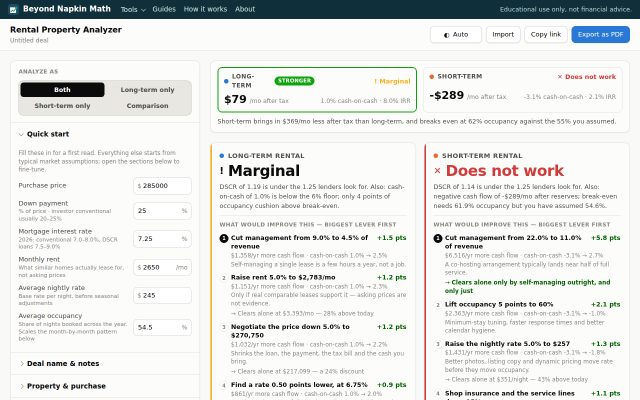
The Rental Property Analyzer opens with this example. Under taxes you can set the land share, your bracket, the recapture and capital gains rates, a cost segregation study, and whether losses offset your other income. The after-tax results and the sale figures update as you go. It runs in your browser and we don't store your numbers.
Educational only, not tax advice.
 Run your own numbers
Rental Property Analyzer
Long-term vs short-term rental: cash flow, returns and taxes, side by side.
Open the tool →
Run your own numbers
Rental Property Analyzer
Long-term vs short-term rental: cash flow, returns and taxes, side by side.
Open the tool →