How much to budget for vacancy, repairs and capex on a rental
A listing shows you the rent, the property tax and maybe the insurance. It doesn't show the four costs that decide most rental deals: empty months, repairs, the big replacements that come every 10 to 25 years, and management. Budget them too low and a mediocre house looks like a great one. Here's how to size each, and what they do to one example.
1. The example
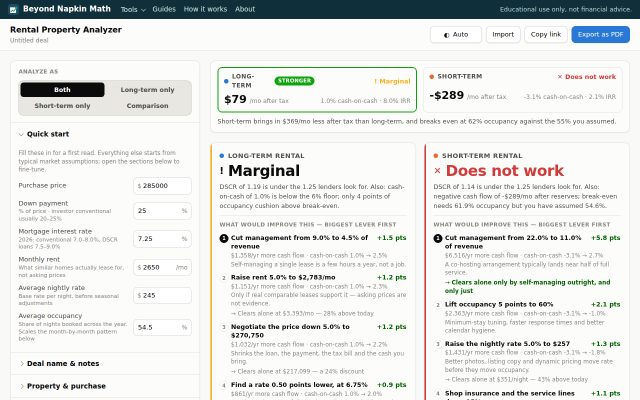
A $285,000 single-family house with $12,000 of work before renting, rented at $2,650 a month, bought with 25% down and a 30-year loan at 7.25%. These are the Rental Property Analyzer's own example numbers. Its starting budgets are:
- Vacancy and unpaid rent: 6% of the rent.
- Maintenance: 6% of the rent collected.
- Reserve for big replacements (capex): 8% of the rent collected.
- Property management: 9% of the rent collected.
With those budgets the house makes $79 a month after the mortgage and every cost.
2. Same house, three sets of budgets
| Optimistic | The tool's starting point | Cautious | |
|---|---|---|---|
| Vacancy | 3% | 6% | 8% |
| Maintenance | 3% | 6% | 8% |
| Reserve for big replacements | 0% | 8% | 10% |
| Management | 0% (do it yourself) | 9% | 10% |
| Cash flow | +$660 a month | +$79 a month | −$85 a month |
| Cash-on-cash return | 8.6% | 1.0% | −1.1% |
| Return over 10 years, after tax (IRR) | 13.8% | 8.0% | 6.3% |
| In the tool's recession scenario | +$6 a month | −$460 a month | −$577 a month |
Same house, same rent, same loan. The optimistic column looks like an excellent deal, with an 8.6% cash return and money left over even in a recession. Almost all of the difference is costs that will come due eventually: the roof doesn't care what you budgeted. Many online deal analyses and seller spreadsheets look like the left column.
3. Vacancy: count the empty months
One empty month a year is 8.3% of the rent. Between tenants you lose rent while you clean, repaint, advertise and screen, and some tenants pay late or not at all. The tool suggests 5–8% across a whole hold: long, steady tenancies at the low end, frequent turnover at the high end.
In the example, each step matters: 3% vacancy gives +$141 a month, 8.3% (a month a year) gives +$32, and 10% gives −$3.
4. Maintenance versus the big-replacement reserve
These are two different costs, and it helps to budget them separately.
- Maintenance is the steady stream of small jobs: a leaking tap, a broken lock, a service call, yard work you pay for. It's spent every year.
- Capital expenditures (capex) are the big items that wear out on a cycle: roof, heating and air conditioning, water heater, flooring, appliances. They're rare and expensive, so you set money aside every month and spend it in lumps.
To size the reserve, add up what each item costs and divide by how long it lasts. With example prices (get local quotes for your own house):
| Item | Example cost | Lasts about | Per year |
|---|---|---|---|
| Roof | $15,000 | 25 years | $600 |
| Heating and air conditioning | $10,000 | 15 years | $667 |
| Water heater | $1,800 | 12 years | $150 |
| Flooring and paint | $6,000 | 8 years | $750 |
| Appliances | $4,000 | 12 years | $333 |
| Total | $2,500 (about 8% of the rent collected) |
That's why the tool's hint calls 8–12% the honest range. An older house, or one where several items are near the end of their life, belongs at the top of it. Leaving the reserve out entirely adds $201 a month to the example's cash flow on paper: +$280 instead of +$79. That money is real only until the first big bill arrives.
For maintenance, 3% of rent gives +$155 a month in the example, and 10% gives −$21.
5. Management: budget it even if you do it yourself
A property manager typically charges 8–10% of the rent for a long-term rental, often plus leasing fees. Managing it yourself saves that ($306 a month instead of $79 in the example), but it isn't free: it's your time, and it limits where you can buy and how many houses you can own. Budget for management anyway, and treat what you save by doing it yourself as pay for your work. That way the deal still works if you later hand it over.
6. A quick check: the 50% rule
Another rule of thumb says that everything except the mortgage (vacancy, taxes, insurance, repairs, reserves and management) takes about half the rent. In the example those costs come to about $13,650 a year, 42.5% of the full rent. With the cautious budgets it's about 49%. It's a decent sanity check: if your budget comes in far below 40%, look for what's missing. It's no substitute for adding up the real costs of a particular house.
7. Then stress-test it
Honest budgets are the base case, not the worst case. The Rental Property Analyzer reruns any deal with the rate 2 points higher, rent 10% lower, vacancy at 15%, costs 20% higher, and all of these at once. At the tool's starting budgets, the example loses $221 a month if the rate rises 2 points, and $460 a month in the combined recession case. The point isn't to reject every deal that fails a stress test. It's to know how much cash you'd need to ride one out.
Try it with your numbers
The Rental Property Analyzer opens with this example. Change the vacancy, maintenance, reserve and management lines and watch the cash flow, the returns and the stress tests move. It runs in your browser and we don't store your numbers.
 Run your own numbers
Rental Property Analyzer
Long-term vs short-term rental: cash flow, returns and taxes, side by side.
Open the tool →
Run your own numbers
Rental Property Analyzer
Long-term vs short-term rental: cash flow, returns and taxes, side by side.
Open the tool →