When does refinancing pay off? The break-even most calculators get wrong
Most refinance calculators divide the closing costs by the drop in your monthly payment and call it the break-even. It's quick, and it's usually too optimistic. Here is what it misses, and how to work out the real answer.
1. The shortcut, and where it goes wrong
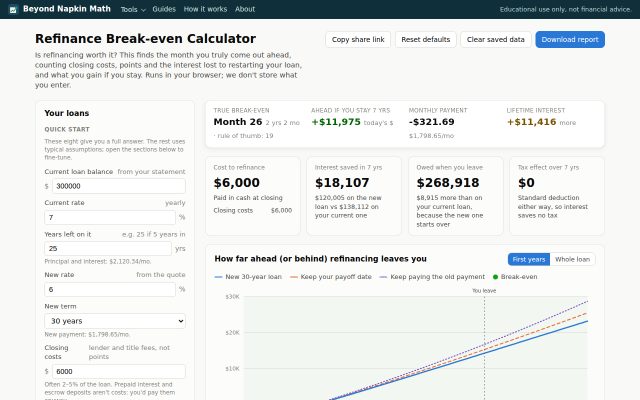
Take a $300,000 balance at 7% with 25 years left. A lender offers 6% on a new 30-year loan, with $6,000 in closing costs. The payment falls from $2,120.34 to $1,798.65, a drop of $321.69 a month. $6,000 ÷ $321.69 is about 18.7, so the shortcut says you break even in month 19.
The catch is that the new loan also stretches the debt over 30 years instead of 25. Part of that $321.69 isn't savings at all: it's principal you're repaying more slowly. You still owe it, and it shows up as a bigger balance when you sell or pay off the loan.
2. The true break-even
A fair test asks: if you sold the home after a given month, would you be better off for having refinanced? Count the monthly savings you've set aside, take away the closing costs, and add the difference between what you'd owe on the old loan and on the new one. In plain terms, that comes to the interest you've saved so far minus the closing costs.
In the example, the first month saves about $250 of interest ($300,000 × 1% ÷ 12), not $321.69. The interest saving shrinks a little each month after that, because the new loan's balance comes down more slowly. Month 24 still leaves you $195 behind; month 25 puts you $38 ahead. The true break-even is month 25, half a year later than the shortcut says. If you would otherwise keep the $6,000 in a high-yield savings account earning 4%, the calculator's default, the break-even moves to month 26.
That gap matters most when it's close. If you expect to move in two years, the shortcut says refinance; the true answer says you'd lose a little.
3. The term-reset trap
A lower rate can still cost you more in total. The current loan in the example has about $336,100 of interest left. The new 30-year loan charges about $347,516 over its life: $11,416 more, even at a lower rate, because you pay interest for five extra years.
Two ways to keep the lower rate without the trap:
- Keep your payoff date. Ask for a term that matches the years you have left, or pay as if you had one. At 6% over 25 years the payment is $1,932.90, still $187 less than today, and you save interest instead of adding it.
- Keep paying your old payment. Take the 30-year loan for its lower required payment, but keep paying $2,120.34. The extra goes to principal and the loan ends well before 25 years. You keep the flexibility to drop back to the lower payment if money gets tight.
The trap only matters if you keep the loan for most of its life. Most people move or refinance again long before that, which is why the break-even and the years you'll stay matter more than lifetime interest.
4. Points, rolled-in costs and no-closing-cost loans
- Points buy a lower rate for an upfront fee: one point is 1% of the loan. They pay off only if you keep the loan long enough. On a refinance, points are generally deducted a little each year over the life of the loan, not all at once (IRS Publication 936). One point on $300,000 is $3,000, deducted at $100 a year on a 30-year loan, and only if you itemize.
- Rolling costs into the loan means nothing out of pocket, but you pay interest on the costs for as long as you have the loan, and the larger balance pushes the break-even later.
- A no-closing-cost loan has the lender pay the costs in exchange for a slightly higher rate. It breaks even almost at once, which makes it a strong choice if you might move or refinance again soon.
5. Taxes: probably less than you think
Lower interest means a smaller mortgage interest deduction, but that only matters if you itemize. For 2026 the standard deduction is $32,200 for a married couple filing jointly, $16,100 for a single filer and $24,150 for a head of household. Many households with a mortgage don't clear that bar, so their interest saves no tax at all, and refinancing changes nothing on the tax side. If you are just over it, lowering your interest can drop you onto the standard deduction, and some of the interest you save is offset by the tax break you lose. The calculator runs that test year by year.
6. What about rates falling again?
If rates fall another point next year, you could refinance again, but you'd pay closing costs twice. Whether that beats waiting depends on how much of the first refinance's costs you've earned back by then. The calculator compares three paths: refinance now, refinance now and again next year, and wait a year and refinance once. Nobody knows where rates will go, so treat it as a sense of the stakes, not a forecast.
7. Compare offers the right way
- Ask at least three lenders for an official Loan Estimate on the same day, so rates are comparable.
- Compare the rate, the points and the lender's own fees (section A of the Loan Estimate). Title and government fees are similar everywhere.
- Ask each lender for a no-points quote and a no-closing-cost quote too, then run each one through the calculator with the number of years you expect to stay.
- Ignore the "skip a payment" pitch. You don't save that month: interest is paid in arrears, so it's collected at closing instead.
Try it with your numbers
The Refinance Break-even Calculator shows your true break-even month, what you gain if you stay, the lifetime-interest warning and the scenarios above. If refinancing doesn't pay off for you, the Mortgage Payoff Calculator shows what extra payments on your current loan would do instead. It runs in your browser and we don't store your numbers.
 Run your own numbers
Refinance Break-even Calculator
The true break-even: closing costs, points and the cost of restarting the clock.
Open the tool →
Run your own numbers
Refinance Break-even Calculator
The true break-even: closing costs, points and the cost of restarting the clock.
Open the tool →