When to claim Social Security: the break-even age is the wrong question
Ask when to claim Social Security and you'll be given a break-even age: live past 80 and waiting wins, die before it and claiming early wins. The arithmetic is right. The question is wrong, and acting on it alone leads people to the worse decision surprisingly often.
1. What the break-even age actually tells you
Take a $2,000 benefit at a full retirement age of 67. Claim at 62 and the cut is 30%: $1,400 a month. Wait to 70 and the credits add 24%: $2,480. The extra $1,080 a month only starts after 96 months of nothing, so it takes about 220 more checks to catch up. In today's dollars with savings earning nothing, the lines cross at age 80 and 4 months.
That number is real, and it's worth knowing. But read what it says: if you knew your date of death, here is the age that would have made waiting worthwhile. Nobody knows that. What you have instead is a distribution — Social Security's 2023 life table gives a 62-year-old man 20.3 more years and a woman 23.1, and half of people live longer than their average. Planning to the average means planning to be wrong half the time, in the direction that hurts more.
Which brings up the asymmetry that break-even hides. If you delay and die early, you lost money you no longer need. If you claim early and live to 95, you spent thirty years on a check 30% smaller than it could have been, at the point in life when you have the least ability to go back to work. Those two mistakes are not the same size. Delaying is less an investment than an insurance premium against the second one, and insurance that pays off exactly half the time would be excellent insurance.
2. The four things that move the decision more
Longevity gets all the attention. In practice these matter at least as much, and unlike your lifespan you actually know something about them.
Taxes on benefits, which rise every year by design
Up to 85% of your Social Security can be taxable, depending on your other income. The thresholds where that starts — $25,000 for a single filer, $32,000 filing jointly — were set in 1984, with the second tier ($34,000 and $44,000) added in 1993, and none of them are indexed for inflation. They have been losing ground for forty years and will keep doing so. Every year, the same real benefit is taxed a little more heavily.
This cuts both ways on claiming. Benefits collected in your 60s alongside a pension or large traditional-IRA withdrawals can be taxed at 85%, while the same benefits later, after you've drawn those accounts down, might be taxed much less. The years between retiring and claiming are also the cheapest years you'll ever have for Roth conversions, because your taxable income is at its lowest. The 2025 tax law's senior deduction — $6,000 per person aged 65 and over — makes those years cheaper still, but only through 2028.
What your savings earn
Delaying isn't free: you live on savings instead. Every dollar of benefit you don't take at 62 is a dollar you withdraw from your own accounts, and those dollars would otherwise have been earning something. At a 0% real return, waiting from 62 to 70 on a $2,000 benefit means spending about $134,000 of savings. If that money would have earned 4% above inflation, waiting costs more and the break-even moves years later. If it sits in cash, waiting costs less.
This is also where delaying becomes impossible for some people regardless of the arithmetic. If you don't have the savings to bridge those years, the answer is already decided, and no amount of break-even analysis changes it.
Your spouse, after you
This is the one most people miss. When one spouse dies, the survivor keeps the larger of the two benefits — and the smaller one stops. A couple's income doesn't halve, but it does drop, usually by a third or more.
The survivor benefit is based on what the higher earner was receiving, including delayed credits. So the higher earner delaying to 70 doesn't just buy a bigger check for their own remaining years; it raises the survivor's income for as long as the survivor lives, which is often the longer of the two lives. The decision belongs to whichever of you lives longest.
The reverse is also true, and it's useful: the lower earner's claiming age barely affects the household long term, because their benefit is likely to disappear at the first death anyway. In many couples the sensible pattern is the lower earner claiming early and the higher earner waiting — not because it maximizes anything on a spreadsheet, but because it hedges both ways.
Whether you're still working
Claim before full retirement age while working and the earnings test holds money back: in 2026, $1 for every $2 you earn over $24,480, or $1 for every $3 over $65,160 in the year you reach full retirement age, after which there's no limit at all. The money isn't lost — your benefit is recalculated upward at full retirement age for the months withheld — but claiming early while earning a full salary mostly means paperwork rather than income.
3. Things people believe that aren't true
- "Claim early before the money runs out." The 2026 Trustees Report projects the combined trust funds run out in 2034, with payroll taxes then covering about 83% of scheduled benefits. That is worth planning around as a scenario, and our calculator runs it as one. But a 17% cut applied to everyone doesn't change which claiming age is best — it scales both sides of the comparison. Claiming early to get ahead of a cut that hasn't been designed yet locks in a 30% cut for certain to avoid a smaller, uncertain one. Congress has also acted before every past shortfall, and past fixes have generally spared people already receiving benefits.
- "8% a year is a guaranteed return." Delayed credits are 8% of your full-retirement-age benefit per year of waiting, not 8% compounded, and only between full retirement age and 70. Before full retirement age the rate is different (about 6.7% a year for the first three years). Past 70 there is nothing: waiting longer gains you exactly zero, and SSA won't pay you retroactively for more than six months.
- "I'll claim spousal now and switch to my own later." Gone for anyone born on or after January 2, 1954. Deemed filing means claiming one benefit claims both. (Survivor benefits are the exception, and can still be coordinated with your own.)
- "My government pension will cut my benefit." Not any more. The Social Security Fairness Act, signed January 5, 2025, repealed the Windfall Elimination Provision and the Government Pension Offset for benefits payable after December 2023. If you held off claiming because of them, the maths has changed.
- "The statement figure is what I'll get." Your statement shows your benefit at full retirement age based on your earnings so far. It's the right starting point — but check the earnings record behind it. A missing year is a permanent reduction, and it's fixable.
4. What to get from your statement first
Sign in at ssa.gov and find three things:
- Your benefit at full retirement age — the "full retirement age" figure, not the age-62 or age-70 estimate. That's the number this calculator is built on.
- Your earnings record, year by year. Check for zeros or obviously wrong years, especially early in your career or around a job change. Benefits use your best 35 years, so a missing one is replaced by a zero.
- Your spouse's figures, the same two. The household answer depends on both.
If you have fewer than 35 years of earnings, another year of work replaces a zero and can raise your benefit more than you'd expect — which is a separate decision from when to claim.
5. How to use the calculator
Put your real figures into the Social Security Claiming Age Calculator and then do this: ignore the single best age, and look at the three life spans side by side. If the best age barely changes between living to 80 and living to 95, the decision is robust and you can stop worrying about it. If it swings from 62 to 70, the honest answer is that nobody can tell you, and you should decide on the grounds a calculator can't price: your health, whether you want to stop working, how much you'd rather spend in your 60s than your 80s, and what your spouse would be left with.
Then check two numbers. The savings you'd spend while waiting — can you actually cover it? The Retirement Plan Explorer models those bridge years against your accounts. And the survivor benefit — is the lower figure one your spouse could live on?
One more thing worth saying plainly: for most people the gap between the best claiming age and a reasonable one is a few per cent of a lifetime total. It's worth getting roughly right and not worth agonizing over. The bigger mistakes in retirement are elsewhere.
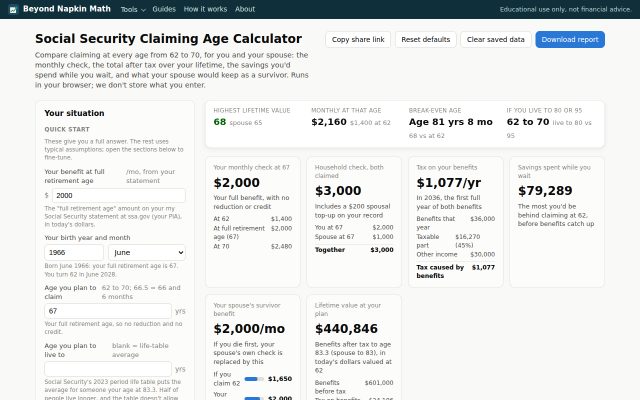 Run your own numbers
Social Security Claiming Age Calculator
62, 67 or 70? Every claiming age compared after tax, for both of you.
Open the tool →
Run your own numbers
Social Security Claiming Age Calculator
62, 67 or 70? Every claiming age compared after tax, for both of you.
Open the tool →