How Car: Buy, Lease or Keep works
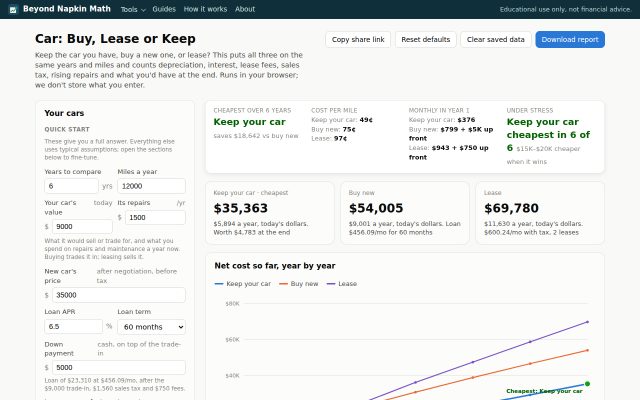
Car: Buy, Lease or Keep runs three households side by side for the same number of years and miles. One keeps its current car, one trades it in and buys, and one sells it and leases. This page explains each step, the formulas, and what the model leaves out.
The same starting point and the same horizon
All three households start out owning the same car and drive the same miles for the same number of years (6 by default). Comparing monthly payments alone misleads: a lease payment buys only the use of a car, while a loan payment also buys part of a car you keep. So the tool asks a different question: after the same years, how much poorer is each household?
At the end of each year, the net cost of an option is:
- every dollar it has paid so far (down payments, loan or lease payments, taxes, fees, fuel, insurance, repairs), grown at your return on cash to that date,
- minus what the car it holds is worth then,
- plus any loan balance still owed,
- plus the current car's value today, grown at the same return (every household started with it: the buyer trades it in, the lessee sells it, and the keeper still holds it, with the money tied up in it),
all divided by inflation to that year, so the figure reads in today's dollars. With a 0% return and 0% inflation this is simply everything paid minus the value of the car at the end, which the test suite checks by hand.
Cost per mile is the net cost over the whole period divided by the miles driven.
Keep
- Repairs and maintenance start at the yearly amount you enter and rise each year with inflation plus the repair growth rate (7% by default), because older cars need more. An optional major repair is added once, in the year you choose.
- The car's value falls by a fixed share each year (10% by default). Its value at the end is credited back.
- Fuel and insurance use your current car's MPG and premium.
Buy
- The deal: the price, sales tax and fees, minus your trade-in and down payment, is the amount financed. In most states sales tax is charged on the price after the trade-in; untick that option if your state taxes the full price.
- The loan uses the standard amortization formula, with the payment rounded to the cent and the last payment trued up to end at exactly zero. A $30,000 loan at 6% for 60 months is $579.98 a month, with $4,799.09 of interest in all. At 0% the payment is the amount divided by the months.
- A loan longer than the period isn't a problem: the balance still owed at the end is counted against the car's value, as if you sold the car and paid the loan off.
- Depreciation: a new car loses 15% of its price in the first year and 12% a year after that by default; a used car 10% a year. Published figures vary widely by model and year (from about 20% then 15% in older studies to about 12.5% then 5% in recent Carfax data), so check your model's resale values and adjust.
- Upkeep on the newer car stays flat (in today's dollars) for the warranty years, then rises at the repair growth rate. A used car's upkeep rises from year 1.
Lease
A lease payment has two parts (standard industry formulas, not official ones):
- Depreciation fee = (adjusted capitalized cost − residual value) ÷ months
- Finance fee (the rent charge) = (adjusted capitalized cost + residual value) × money factor
The money factor is a lease's interest rate in another form: multiply it by 2,400 for an approximate APR. For a $35,000 capitalized cost, a $21,000 residual (60%), 36 months and a money factor of 0.0025: the depreciation fee is $388.89, the finance fee $140.00 and the payment $528.89 before tax, about a 6.0% APR.
- Capitalized cost is the negotiated price of the car (the new car's price unless you enter another). The acquisition fee is added to it and any cash down (cap cost reduction) comes off it. The residual is a percentage of the sticker price, set by the lessor.
- Sales tax: by default it is charged on each payment and on any cash down, as in most states. You can switch to tax on the car's full price up front, or no tax.
- At signing: the first payment, any cash down and its tax, and the doc and registration fees. Your current car is sold for its value the same day.
- At the end: the disposition fee, plus the miles driven over the allowance times the per-mile charge.
- Over the period a new lease starts on the same terms each time one ends, so a 3-year lease over 6 years is two leases. If the period ends partway through a lease, only the months inside it are counted, and the tool says so: ending a lease early usually costs more.
- Lease, then buy: with this option, at the end of the first lease you pay the residual, a purchase option fee and sales tax on the residual in cash, and keep the car. From then on it's worth what any car of its age would be on the new-car depreciation curve, so a residual set above that value shows up as a cost.
Running costs
Fuel is miles ÷ MPG × the gas price, rising with inflation. Insurance is entered separately for each option, because premiums differ by car and lessors require minimum coverage; get real quotes. The tool doesn't give insurance advice. Running costs are spread evenly over each year's months.
The car loan interest deduction (2025–2028)
The 2025 tax law (Public Law 119-21, section 70203) added Internal Revenue Code section 163(h)(4). For tax years 2025 through 2028 you can deduct interest on a loan taken out after 2024 to buy a new car for personal use, with final assembly in the US, secured by a first lien on the car. You claim it on Schedule 1-A whether or not you itemize, and report the car's VIN.
- Up to $10,000 of interest a year.
- The $10,000 is reduced by $200 for each $1,000, or part of $1,000, of modified AGI over $100,000 ($200,000 married filing jointly). At $110,000 single the cap is $8,000; at $150,000 single it is $0. $100,001 counts as one step, so the cap is $9,800.
- Leases, used cars and business vehicles don't qualify.
The tool adds up the loan interest paid in each calendar year (from the month you'd sign), applies the cap for 2025–2028 only, and counts your tax bracket times the deductible amount as a saving at the end of that year. Your income is held at today's level. State income tax effects aren't counted.
Cost of cash and today's dollars
Money spent on a car could have earned something instead. Each cash flow is grown at your return on cash (4% a year by default, after tax) to the end of the year being measured, and the result is divided by inflation (2.5% by default) so every figure is in today's dollars. Enter 0% for both to compare plain cash totals. "Where the money goes" shows the cash totals by category and, on a separate line, what the return on cash and inflation add.
Stress tests
Each row reruns all three options with one change: driving 15,000 miles a year (on a lease that allows your entered allowance), a $3,000 repair on your current car in year 2, resale values 15% lower for every car you'd own at the end, the loan rate 2 points higher (and the lease's money factor raised by the same 2 points), and gas 30% higher. The scoreboard reports how many of these the cheapest option survives.
What this leaves out
- EV credits. The federal credits for new, used and commercial clean vehicles (sections 30D, 25E and 45W) ended for vehicles acquired after September 30, 2025 (Public Law 119-21). State and utility rebates are not modeled; subtract them from the price.
- Business use of the car and its tax deductions.
- Ending a lease early or buying it out before the end, and lease-end wear-and-tear charges.
- Gap insurance, extended warranties and service plans. Add them to insurance or upkeep if you'd buy them.
- Credit-score effects of new credit, and the time and cost of selling a car privately.
- Yearly registration and personal property taxes, which in many states depend on the car's value.
- Loan fees and prepayment, dealer add-ons, and incentives such as cash rebates or subsidized lease rates: enter the price and rates you're actually offered.
- Interest is worked out monthly; lenders charge it daily, so their figures can differ by a few dollars.
Every official figure is listed with its source on the Sources page.
 Try it
Car: Buy, Lease or Keep
Keep, buy or lease: the true cost per mile of each, over the same years.
Open the tool →
Try it
Car: Buy, Lease or Keep
Keep, buy or lease: the true cost per mile of each, over the same years.
Open the tool →