How the Debt Payoff Planner works
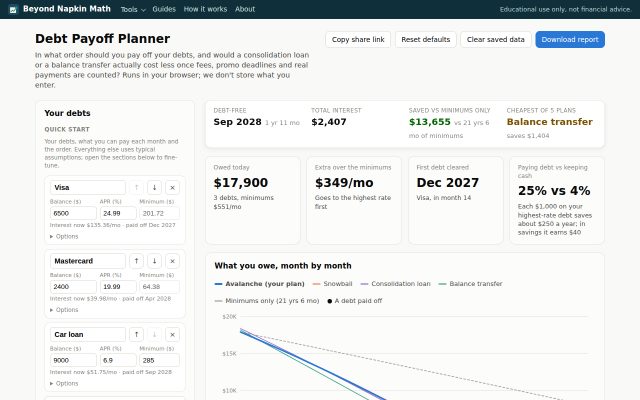
The Debt Payoff Planner runs your debts forward one month at a time under five plans and compares when each one ends and what it costs. This page explains each step, the figures it uses and what it leaves out.
The monthly simulation
Every plan follows the same steps each month:
- Each debt is charged a month of interest: the balance times the APR divided by 12.
- Each debt's minimum payment is worked out from that new balance, using its rule (below).
- Every minimum is paid. Whatever is left of your monthly amount, plus any lump sum that month, goes to one debt at a time in the plan's order. When that debt is cleared, the rest spills over to the next one in the same month.
Balances aren't rounded between months, as in a spreadsheet. Card issuers charge interest daily on the average daily balance, so a statement can differ from these figures by a few dollars a year.
A worked example. $5,000 at 24% with $200 a month: the first month's interest is $5,000 × 2% = $100, so $100 goes to principal. The standard formula, n = −log(1 − rB/P) ÷ log(1 + r), gives 35.003 months: 35 full payments leave $0.55, and the 36th payment of $0.56 clears it. Total interest is $2,000.56. The test suite checks this to the cent.
Minimum payments
Each debt has its own rule, under Options:
- 1% + interest (the default for cards): 1% of the balance plus that month's interest, never below a floor (default $25). This is the most common card rule today, and it always pays the balance down a little.
- % of balance: a flat share, such as 2%, with the same floor. On a high-rate card this can barely cover the interest.
- Fixed amount (the default for loans): the payment you enter, as on a car or personal loan.
These are typical issuer rules, not official ones. Your cardholder agreement sets your card's real rule. A card minimum shrinks as the balance falls, which is why paying only the minimums takes so long.
If your monthly amount is less than the minimums, the planner says so and pays the minimums anyway. Missing them would add late fees and possibly a penalty rate, which the model doesn't try to price.
The order: avalanche, snowball or your own
- Avalanche sends the extra to the highest APR first. With the same monthly amount, this almost always costs the least interest, because each extra dollar removes the most expensive debt first.
- Snowball sends the extra to the smallest balance first. It usually costs more, but it clears a debt sooner, which some people find easier to stick with.
- Your order follows the list as you arrange it with the arrows.
Example. Debt A is $1,000 at 10% (minimum $25) and debt B is $5,000 at 25% (minimum $100), with $400 a month. Avalanche pays B first: B is gone in month 16, A in month 18, and the interest totals $1,042.36. Snowball pays A first: A is gone in month 4 and B in month 19, for $1,229.49 of interest. Here, being able to cross off a debt in month 4 costs $187.
By default, when a debt is paid off its minimum rolls into the next one, so you keep paying the same total. You can turn that off under Behavior to see what stopping those payments costs.
On a single card with several balances, such as purchases and a cash advance, federal rules already decide where extra money goes. Under Regulation Z, 12 CFR 1026.53, any amount above the minimum goes to the highest-APR balance first. In the last two billing cycles of a deferred-interest promotion, it goes to the deferred-interest balance first. The planner treats each card as one balance at one rate.
Consolidation loan
A personal loan at a fixed rate pays off the debts you pick, and its fixed payment replaces their minimums. The origination fee can work two ways:
- Taken from the proceeds (the most common): you receive the loan minus the fee, so to pay off $10,000 with a 5% fee you need to borrow $10,000 ÷ 0.95 = $10,526.32. At 11% over 36 months, that's $344.62 a month.
- Added to the loan: you borrow $10,000 plus 5%, or $10,500.
The fee counts as a cost. If your monthly amount is more than the loan payment and any other minimums, the extra goes to the highest rate first, which can mean paying the loan off early. Most personal loans have no prepayment penalty, but check yours. Typical origination fees run from 0% to about 10% of the loan, depending on credit. That is a typical range, not an official figure.
Balance transfer
A new card takes the debts you pick, in list order, up to its credit limit. The transfer fee is added to the balance on day one and counts against the limit, so a $5,000 limit with a 3% fee holds $4,854.37 of debt. During the promo the card charges the promo rate, then its regular APR. Typical transfer fees are 3% to 5%. That is a typical range, not an official figure.
The plan pays the transferred balance down evenly over the promo so it is gone by the deadline, as far as the budget allows, and sends anything else to the highest rate. Example: $6,000 moved with a 3% fee ($180) is $6,180 at 0%. At $300 a month for 15 months, $1,680 is left when the promo ends, and from month 16 it is charged 22% ($30.80 that first month).
The model treats every promo as a true 0% (or reduced) rate, where interest starts only on what's left after the promo ends. Deferred-interest offers ("no interest if paid in full within 12 months"), common on store cards and medical credit, work differently. If any balance is left at the deadline, they charge all the interest back to the purchase date. The Consumer Financial Protection Bureau has warned about these offers. The planner flags them but doesn't model them.
Minimums only
This plan pays each debt its own minimum and nothing more, with no rollover and no lump sum. It's the baseline for "interest saved". If a minimum doesn't cover the interest, the debt never shrinks, and the plan is shown as never paying off. The planner stops counting at 50 years.
The best of five
The plans are ranked by total cost: interest plus any loan or transfer fee. A plan that never pays off always ranks last. Plans that cost the same are ranked by the earlier debt-free date. Consolidation and transfer plans pay any debts left outside them avalanche-style.
Stress tests
- Budget $100 lower: your plan with $100 less each month.
- Variable APRs rise 3 points: every debt marked "variable rate" (most cards) charges 3 percentage points more from today. Card rates move with the prime rate. Issuers can't raise the rate on an existing balance for other reasons, except in a few cases such as a payment over 60 days late.
- $2,000 emergency in month 6: $2,000 is charged to your highest-rate card (or your highest-rate debt, if you have no cards) and your plan continues.
- Balance transfer, promo missed by 3 months: the transfer plan again, with three fewer months at the promo rate, as if you'd cleared the balance three months after the deadline.
Paying debt vs keeping cash
Paying down a debt saves its APR on that money, with no risk and no tax. Cash in savings earns its rate, and that interest is taxed. The planner shows both rates side by side. It doesn't tell you to empty your savings: a paid-down card's credit line can be cut, so an emergency fund comes first.
What it leaves out
- Credit-score effects of opening a loan or card, closing accounts or using less of your credit.
- Hardship programs, debt settlement and debt management plans.
- Student-loan forgiveness and income-driven repayment. A student loan can be one row in the list, with a fixed payment.
- Deferred-interest promotions (see above), penalty APRs, late fees and annual fees.
- Daily interest, statement timing and grace periods on new purchases. The model assumes no new spending on the cards.
- Taxes. Credit card and personal loan interest isn't deductible.
The figures and rules are listed on the sources page.
 Try it
Debt Payoff Planner
Avalanche, snowball, consolidation or a balance transfer: which costs least?
Open the tool →
Try it
Debt Payoff Planner
Avalanche, snowball, consolidation or a balance transfer: which costs least?
Open the tool →