How the Home Affordability Calculator works
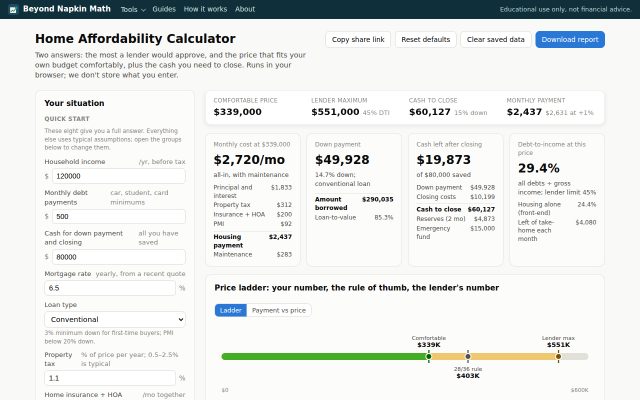
The Home Affordability Calculator works out, for any home price, the down payment your cash allows, the loan, its mortgage insurance, the monthly payment and your debt-to-income ratios. It then searches for the highest price that passes three sets of limits: the lender's, the 28/36 rule of thumb, and your own budget. This page explains each step and what the model leaves out.
The cost of one price
For a given price the model does the following:
- Closing costs are your closing-cost percentage times the price.
- Down payment. You put down as much as your cash allows, up to your "largest down payment" (20% by default, the point where PMI stops). Cash available is what you've saved, less closing costs and the reserves you must keep. For the comfortable answer, your emergency fund is held back too. Reserves are months of the housing payment, which depends on the loan, so the model repeats the calculation until the two agree.
- Minimum down payment. If your cash can't cover the minimum (3% conventional, 3.5% FHA, 0% VA), the price is out of reach.
- The loan is the price minus the down payment. An FHA upfront premium or a VA funding fee is added to the loan, as most buyers do.
- Principal and interest use the standard fixed-rate formula for your rate and term.
- The housing payment (what lenders call PITI) adds property tax (your percentage of the price, divided by 12), insurance and HOA dues, and monthly mortgage insurance.
- The all-in cost adds maintenance (a percentage of the price each year). Lenders ignore it; your budget can't.
Mortgage insurance and fees by loan type
- Conventional. Below 20% down, the model adds private mortgage insurance (PMI). PMI pricing depends on credit score and how much you borrow compared with the price, so the tool uses a table of typical yearly rates for four credit bands and four loan-to-value bands. These are mid-points of published rate cards, not quotes; you can type your own rate. PMI is charged on the original loan and, in the year-by-year table, ends automatically when the scheduled balance reaches 78% of the price (Homeowners Protection Act).
- FHA. An upfront premium of 1.75% of the base loan is added to the loan. The yearly premium follows HUD's table: for a loan over 15 years and up to $726,200, 0.55% above 95% loan-to-value and 0.50% otherwise. Larger loans pay 0.70–0.75%, and 15-year loans pay 0.15–0.65%. With 10% or more down it ends after 11 years; otherwise it lasts the life of the loan. The first year's premium is the rate times the base loan, divided by 12. HUD recalculates it each year on the average balance, and the year-by-year table resets it on each year's starting balance.
- VA. No monthly mortgage insurance. A one-time funding fee is added to the loan: 2.15% with under 5% down on a first VA loan, 3.3% on a later one, 1.5% with 5% down and 1.25% with 10% down. Veterans with a service-connected disability rating and some others are exempt.
The lender's maximum
Lenders limit the housing payment and all debts together as a share of gross (before-tax) monthly income. These are the debt-to-income ratios, or DTI. The defaults depend on the loan type, and you can change them:
- Conventional: no separate housing limit. All debts may be up to 45% of income. Fannie Mae's guide allows 36% for manual underwriting, or up to 45% with strong credit and reserves. Its automated system can approve up to 50%. The tool uses 45% and notes the 50% stretch.
- FHA: 31% for housing and 43% for all debts. These are HUD's limits for a manually underwritten loan with no compensating factors. HUD's automated scorecard often approves more.
- VA: 41% for all debts, as a guideline. VA also checks residual income, the money left each month, against a table by family size and region. The tool doesn't model that table.
The lender's maximum is the highest price where the housing payment and all debts stay within these limits, your cash covers the minimum down payment, closing costs and reserves, and (for FHA) the base loan is within the county's FHA limit. It assumes you'd spend your emergency fund, because a lender would let you.
A conventional loan above the conforming limit ($832,750 in most counties for 2026, up to $1,249,125 in high-cost areas) is a jumbo loan. The tool flags it but doesn't cap the price, because jumbo lenders set their own terms. VA has no loan limit for borrowers with full entitlement.
The 28/36 rule of thumb
The middle marker on the ladder uses the old rule of thumb: housing at most 28% of gross income and all debts at most 36%. It is a rule of thumb, not a lending requirement. It's shown because many people use it, and it often lands between the comfortable price and the lender's maximum.
The comfortable price
Your budget runs on take-home pay, not gross income. The model starts from take-home pay, takes off your debt payments and the monthly savings you won't give up, and sets aside a share of what's left for housing (40% by default). That gives a monthly housing budget that includes maintenance. The comfortable price is the highest price where:
- the all-in cost fits that budget;
- a lender would still approve it; and
- your cash covers the down payment, closing costs and reserves with the emergency fund untouched.
The 40% is a model assumption, not a published rule. For a household with modest debts and savings it works out to roughly 30–35% of take-home pay, in line with common budgeting advice. Change it to fit how you live.
How the price search works
The tool checks prices in $2,500 steps up to $10 million, so it can't be fooled by a jump in mortgage insurance at a loan-to-value band. It then narrows the last step to the dollar. Prices on the page are rounded down to the nearest $1,000. The limit that stops each answer going higher is shown as "Limited by".
Stress tests
Stress tests run at the comfortable price with the loan fixed as bought:
- the rate 1 point higher (if rates rise before you lock);
- property tax 25% higher (many places reassess at the sale price);
- insurance and HOA dues 30% higher;
- loss of the second income. Gross income falls by the second earner's income, and take-home pay falls by the same share, which is an approximation.
The big repair in year 1 is compared with the cash left after closing, emergency fund included.
What this leaves out
- Credit-score pricing (loan-level price adjustments). Your rate is an input; a lower score usually means a higher rate.
- Lender overlays: individual lenders often set tighter limits than the agency guides.
- Down-payment assistance programs, gifts and seller credits.
- County loan limits: the tool uses the 2026 standard limits. In a high-cost county, enter your county's limit.
- VA residual-income tables (shown as a note; the tool uses the ratio only).
- How lenders count student loans in deferment, and income types such as bonuses. Enter the payment and income a lender would use.
- Adjustable-rate loans, interest-only loans and buydowns. The rate is fixed for the whole loan.
- Taxes: no mortgage interest deduction is assumed. Most households take the standard deduction.
Tests
The test suite checks the hand-worked cases this tool was specified with. For example, $120,000 of income with $500 of debts at 28/43 gives a $2,800 housing limit. A $2,200 principal-and-interest budget at 6.5% over 30 years supports a $348,064 loan. The FHA upfront premium on $300,000 is $5,250. A $400,000 home with 10% down and 3% closing needs $52,000 to close. The suite also checks every 2026 figure in the tables, the PMI and MIP end dates, the binding limit in each case, and the edge cases (no income, debts above the limit).
 Try it
Home Affordability Calculator
The lender's number vs. your number, with the cash you need to close.
Open the tool →
Try it
Home Affordability Calculator
The lender's number vs. your number, with the cash you need to close.
Open the tool →