How the Job Offer Comparison Calculator works
The Job Offer Comparison Calculator runs two W-2 job offers side by side, one year at a time, for as long as you expect to stay. For each year it adds up what actually reaches you and takes off what the job costs you. This page explains each step and what the model leaves out.
What counts as value
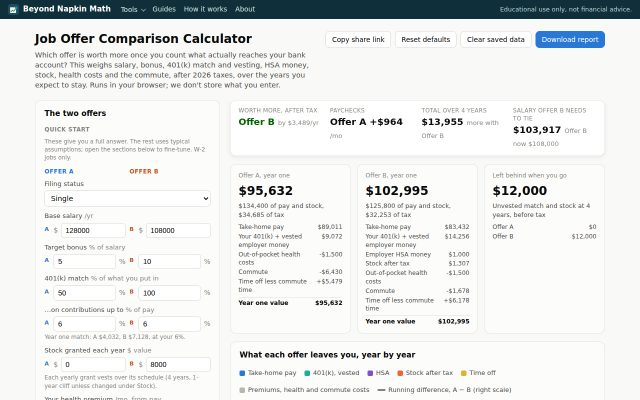
Each year, for each offer, the value is:
- take-home pay: salary, bonus and any sign-on bonus, less your 401(k) contribution, your health premiums and the taxes on that pay; plus
- retirement money: your own 401(k) contribution (always yours) plus the employer money that has vested; plus
- employer HSA money, which is yours from day one and isn't taxed; plus
- stock as it vests, after the tax it adds; less
- expected out-of-pocket health costs and the commute; and, if you choose to count time,
- paid days off at your after-tax daily pay, less commute hours at the value you put on an hour.
The headline is the difference between the two offers' totals over your stay, with later years discounted (default 3% a year) so they're in today's dollars. Year one is not discounted. "Per year" is that total divided by the years you stay.
401(k) money is counted at face value. It will be taxed when you withdraw it, usually at a lower rate than today, and it can't be spent before retirement without a penalty. If you'd rather count only cash, set your contribution and both matches to 0 and compare again.
Taxes
- Federal income tax uses the 2026 brackets and standard deduction (Revenue Procedure 2025-32). If you enter other household wages, such as a spouse's pay when filing jointly, the job is taxed on top of them, so the bracket is right; only the tax the job adds is counted.
- Payroll tax (FICA): Social Security is 6.2% of wages up to the 2026 wage base of $184,500. Medicare is 1.45% of all wages, plus the 0.9% Additional Medicare Tax on wages above $200,000 ($250,000 married filing jointly). Those thresholds aren't indexed for inflation.
- State and local tax is one flat rate per offer, applied to wages after your 401(k) and premiums. There are no state tables: enter the rate you'd really pay (your marginal rate, or a bit less for a progressive state). The "which state" field is a note only.
- Health premiums are taken out of pay before tax, as they are under most employers' cafeteria plans, so they save income tax and FICA. Your 401(k) contribution saves income tax but not FICA. Employer HSA money is free of both.
- Later years index the brackets, standard deduction, wage base and plan limits by the inflation assumption (default 2.5%). The IRS uses chained CPI and rounds; this is close enough for a comparison.
A tax year and a year in the job are treated as the same thing. If you switch jobs mid-year, two employers will each withhold Social Security up to the wage base; any excess comes back when you file, so it doesn't change the comparison.
The 401(k)
- Your contribution is a percentage of salary plus bonus (the same at either job), or the $24,500 limit if you max out. Catch-up contributions for people 50 and over are left out.
- The match is entered as "X% of what you put in, on contributions up to Y% of pay". On a $100,000 salary, a 100% match up to 6% is $6,000 if you put in 6%, and $3,000 if you put in 3%. A 50% match up to 6% is $3,000 at most.
- An employer contribution (non-elective or profit-sharing) is a percentage of pay you get whether or not you contribute.
- Plan limits: only the first $360,000 of pay counts for contributions and match (IRC §401(a)(17)), and your contribution plus the employer's can't exceed $72,000 (IRC §415(c)). If they would, the employer money is cut to fit and the tool says so.
- Vesting: immediate, a cliff (nothing until N full years of service, then everything) or graded (an equal share each full year until N years). By law a plan's match can take at most a 3-year cliff or a 6-year graded schedule; a 6-year graded entry follows that legal schedule exactly: nothing for the first year, then 20% a year from year 2 to 100% at year 6. Only the vested part is counted; when you leave, the rest is forfeited and shown as "left behind".
Many plans match each paycheck. If you max out early in the year, later paychecks get no match unless the plan has a year-end true-up. The model assumes you get the full match; the tool warns you when you max out.
Health and HSA
Your premium is the amount taken from your pay each month. Expected out-of-pocket costs are what you think you'll pay yourself: the deductible, copays and coinsurance, for your usual year. A high-deductible plan often comes with employer HSA money; enter both, so the comparison sees the trade-off. Employer HSA money is capped at the 2026 limit for your coverage, $4,400 self-only or $8,750 family (Revenue Procedure 2025-19). The limit is shared with what you put in yourself; the model only checks the employer's part.
Stock
- Stock granted each year is the dollar value of a grant made on your start date and on each anniversary while you're there. Each grant vests over its own schedule: by default 4 years with a 1-year cliff, then monthly. A $40,000 grant on that schedule has vested $0 after 11 months and $10,000 after 12.
- A one-time new-hire grant vests on the same schedule from your start date.
- Stock is valued when it vests: the grant value times the vested share, times the share-price change since the grant (default 0%). Enter a negative change as a haircut, for a volatile or private company.
- Vested stock is taxed as pay (RSUs): federal and state income tax and FICA. The model counts the tax it adds, not the flat 22% employers usually withhold.
- Because each yearly grant starts a new clock, some stock is always unvested when you leave. The total counts only what vests while you're there; the unvested part is shown as left behind.
Bonus and sign-on bonus
The target bonus is a percentage of that year's salary, times the share you expect to be paid (default 100%). It's paid at the end of each full year, so a partial last year gets none. A sign-on bonus is paid in year one; if you leave before the clawback period ends, the model assumes you repay it in full, so it counts as $0. Some employers pro-rate the repayment; check the offer letter.
Commute and time
- Office days a year = office days a week ÷ 5 × (260 workdays − your paid days off − 10 holidays).
- Commute cost = office days × round-trip miles × cost per mile, plus monthly parking, tolls or transit. The default cost per mile is the IRS 2026 business standard mileage rate, 76 cents from July 1, 2026 (72.5 cents before that). It's the full cost of driving, including wear and depreciation; it's used here for comparison only, because commuting is never deductible. Enter less if you only want to count gas.
- Paid days off, when you count time, are worth your daily salary (salary ÷ 260) after your average tax rate: an extra day off is worth what you'd net for working it.
- Commute hours are counted only if you give an hour a value. The default is $0, so time is left out until you decide what it's worth to you.
Break-even salary
The fourth headline number is the salary Offer B would need, with everything else in Offer B unchanged, for the two offers to tie over your stay. Because the bonus, the match and the taxes all move with salary, it's found by search, not by subtracting: the tool tries salaries until the difference is zero to the cent. The test suite checks that entering the break-even salary back into Offer B gives a $0 difference.
Stress tests
Each row changes one thing and reruns both offers over your stay. Leaving at 11 months applies to both offers. The others apply to the offer that's ahead, because the question is whether its lead holds up:
- You leave at 11 months: before most cliffs, so unvested match and stock are forfeited, and a sign-on bonus with a 12-month clawback is repaid.
- The bonus pays 50% of what you expected.
- The stock price falls 40% and stays down. This hits the grants made on day one; later yearly grants are a dollar value, so they buy more shares at the lower price.
- One more office day a week, up to 5.
- No raises for your whole stay.
What the model leaves out
- State tax nuances. Credits for tax paid to another state, reciprocity agreements, local income taxes beyond your flat rate, and "convenience of the employer" rules that can tax a remote worker where the employer is.
- Equity beyond RSUs. Stock options, incentive stock options (ISOs) and the alternative minimum tax (AMT) are named, not modeled. Employee stock purchase plans (ESPPs) are left out.
- Benefits quality: the health plan's network and out-of-pocket maximum, the 401(k)'s fund fees, life and disability cover, parental leave.
- Career value: what you'd learn, the next job it leads to, job security, and how much you'd enjoy the work.
- Self-employment. W-2 jobs only. Contract (1099) work has different taxes and benefits and isn't covered.
- Catch-up 401(k) contributions, Roth vs traditional contributions, pensions, tuition benefits and other perks. Add a perk's cash value to the bonus if you want it counted.
Sources
Every official figure and its source is listed on the Sources page, along with the model's own assumptions.
 Try it
Job Offer Comparison Calculator
Salary is only part of it. Which offer is worth more after tax, vesting and the commute?
Open the tool →
Try it
Job Offer Comparison Calculator
Salary is only part of it. Which offer is worth more after tax, vesting and the commute?
Open the tool →