How the Refinance Break-even Calculator works
The Refinance Break-even Calculator runs your current loan and the new one side by side, month by month, and tracks how far ahead or behind refinancing leaves you. This page explains each step and what the model leaves out.
The two loans
Both loans use the standard monthly schedule. Each month's interest is the balance times the yearly rate divided by 12, and the rest of the payment goes to principal. The payment is the usual amortization formula, rounded to the cent as lenders do, and the last payment is trued up so the loan ends at exactly zero. Your current payment is worked out from today's balance, rate and years left.
The true break-even
Picture two households in the same home with the same monthly budget. One keeps its loan. The other refinances, pays the closing costs, and sets aside whatever the new payment saves each month. After any month, the refinancing household is ahead by:
- the money it has set aside (payment savings, minus closing costs paid in cash, plus any tax difference, grown at your savings return), plus
- the difference in what the two still owe: the current loan's balance minus the new loan's.
That is what each household would have if it sold the home after that month, so it counts everything. The true break-even is the first month this lead is above zero.
With no tax effect and a 0% return, the lead works out to the interest saved so far minus the closing costs, whether you pay the costs in cash or roll them into the loan. The test suite checks this identity month by month.
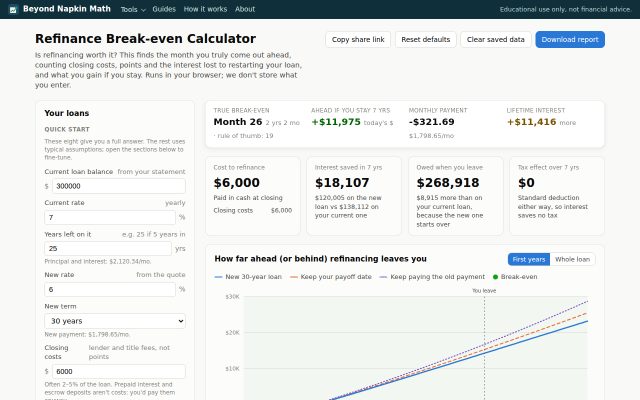
The usual shortcut, closing costs divided by the drop in the monthly payment, comes out too early when the new loan is longer. Part of the lower payment isn't saving: it's principal you repay more slowly, which shows up later as a bigger balance. On a $300,000 loan at 7% with 25 years left, refinanced to 6% over 30 years with $6,000 of costs, the payment drops $321.69, so the shortcut says month 19. The true break-even is month 25 with a 0% return. At the default 4% savings return it is month 26, because the $6,000 paid at closing could have been earning interest too.
The term-reset trap
A new 30-year loan restarts the clock. The lower rate saves interest each month, but the extra years of payments add it back. In the example above, the current loan has about $336,100 of interest left and the new loan charges about $347,516 over its life: $11,416 more, despite the lower rate. When that happens the tool warns you and shows two alternatives:
- Keep your payoff date: take the new rate over the months you have left (6% over 300 months is $1,932.90 a month).
- Keep paying the old payment: take the new loan but keep paying what you pay now. The extra goes to principal and the loan ends early.
The chart shows all three lines. On the whole-loan view the new-term line turns down again in the later years, when the current loan would have been paid off but the new one still has payments to go.
Costs, points and lender credits
- Closing costs are the lender and title fees. Prepaid interest, escrow deposits and the payoff of your old loan's interest aren't counted: you'd pay those amounts on either path.
- Points are a percentage of the new loan. One point on $300,000 is $3,000.
- A lender credit reduces the costs. It can bring them to zero but isn't paid out as cash.
- Rolling costs in adds them to the new loan instead of paying at closing. Because the points are a percentage of a loan that includes them, the loan is (balance + costs − credit) ÷ (1 − points).
Taxes
Mortgage interest only saves tax if you itemize. In the default mode the tool runs the itemizing test for each household, each year: it adds that year's deductible mortgage interest, points deducted that year, and your other itemized deductions (state and local taxes after the cap, charity), and compares the total with the 2026 standard deduction for your filing status. Only the amount above the standard deduction saves tax, at your top rate. You can also say you always itemize, or never do.
- Points on a refinance are generally deducted evenly over the life of the new loan, not in the year you pay them (IRS Publication 936). What's left becomes deductible when the loan ends early, so the lead at any month includes the tax saved by deducting the remaining points if you sold then. If you later refinance with the same lender, the rest is spread over the new loan instead; the model doesn't track lenders.
- The $750,000 limit. Interest is deductible on up to $750,000 of home acquisition debt for loans taken out after December 15, 2017. A refinance keeps that status up to the balance it replaced, so closing costs rolled into the loan are treated as non-deductible debt, and only the share of interest on the first $750,000 is counted.
- The yearly tax saving is spread evenly over the months of that year. The model uses federal tax only.
PMI
PMI on the new loan applies only when it is above 80% of the home's value today. The model assumes you ask to cancel it once the balance reaches 80% of that value, as the Homeowners Protection Act allows (it must end automatically at 78% on the original schedule). PMI on your current loan is measured against the value when you bought. A refinance that drops PMI often breaks even much sooner, and the savings count it. PMI premiums aren't counted in the tax calculation.
Today's dollars and your savings return
The "ahead if you stay" figure is divided by (1 + inflation) raised to the number of years, so it's in today's dollars. The chart and the year-by-year table show the lead before inflation. The savings return (4% by default, a typical high-yield savings rate) grows the money the refinance saves each month and charges the same return on closing costs paid in cash, since that money could have earned it too. Gains on savings aren't taxed in the model.
The scenarios
- You move in year 2: the lead after 24 payments.
- Rates fall 1 point next year: you refinance now, then again after 12 payments at a rate one point lower, paying the same kind of costs a second time on the balance then owed. The next row shows waiting a year and refinancing once at that lower rate. Both are compared with keeping your current loan.
- You don't itemize: no tax saved on interest or points on either loan.
- Costs rolled in or paid in cash: the opposite of your choice.
- No-closing-cost loan at +0.25%: no costs or points, at a rate a quarter point higher. Real offers vary; ask lenders for both.
- Keep your payoff date and keep paying the old payment, as above.
What this leaves out
- Cash-out refinances and home equity lines of credit.
- Adjustable-rate loans and their resets. Both loans are fixed-rate.
- Rate-lock timing, float-downs and how your credit score changes the rate you're offered.
- State mortgage recording taxes and state income tax.
- FHA streamline and VA rate-reduction loans, whose mortgage insurance and funding fees follow their own rules.
- Interest charged by the day. The few days of interest around closing are the same on both paths, so they're left out.
- Grandfathered loans from before December 16, 2017, which have a $1 million limit, and the separate $375,000 limit for married filing separately.
- The income limits on deducting PMI premiums, which became deductible again from 2026.
Tested by hand
The test suite rebuilds the example in a plain month-by-month table and checks the payments ($2,120.34, $1,798.65 and $1,932.90), the rows on either side of the break-even (behind by $194.90 after month 24, ahead by $37.60 after month 25), lifetime interest on both loans, the $3,000 point deducted at $100 a year, the itemizing test against the 2026 standard deduction, the PMI rules, and edge cases: the same rate with no costs never breaks even, and a lower rate with no costs on the same term breaks even in month 1.
 Try it
Refinance Break-even Calculator
The true break-even: closing costs, points and the cost of restarting the clock.
Open the tool →
Try it
Refinance Break-even Calculator
The true break-even: closing costs, points and the cost of restarting the clock.
Open the tool →