Buy, lease or keep your car: the true cost per mile of each
The usual car comparison puts a lease payment next to a loan payment and picks the smaller one. That's the wrong question. A lease payment rents a car; a loan payment buys one you'll still own. And keeping the car you have, which often costs least, isn't on the list at all. Here is how to compare all three properly.
1. Compare the same years and the same miles
A 3-year lease and a 5-year loan don't cover the same thing. To compare them, pick one period, say 6 years, and ask what each choice costs over all of it:
- Keep: 6 years of repairs, fuel and insurance on your current car, and whatever it's still worth at the end.
- Buy: the price, sales tax and fees, the loan interest, 6 years of running costs, minus what the car will be worth after 6 years.
- Lease: two 3-year leases back to back, with their signing costs, payments, end-of-lease fees and running costs. At the end you own nothing.
Divide each total by the miles you drove and you have a cost per mile, a number you can actually compare.
2. A worked example
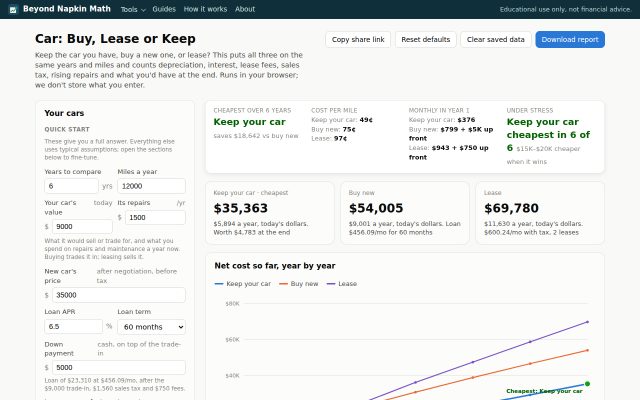
Take a household that drives 12,000 miles a year. Its current car is worth $9,000 and needs about $1,500 a year in repairs. The new car costs $35,000. The loan is 6.5% for 60 months with $5,000 down plus the trade-in. The lease is 36 months with a money factor of 0.0025 and a 58% residual, about $600 a month with tax. Over 6 years, in today's dollars and counting what the cash could have earned:
- Keep: about $35,400, or 49¢ a mile.
- Buy: about $54,000, or 75¢ a mile. Most of that is the roughly $19,000 the new car loses in value.
- Lease: about $69,800, or 97¢ a mile.
Keeping wins here, by a wide margin, even with repair bills rising 7% a year faster than prices. That's typical: the cheapest car is usually the one you already own, until repairs or reliability force the issue. The calculator runs your own numbers and shows the year each line pulls ahead.
3. Depreciation is the biggest cost of a new car
A new car commonly loses 15–20% of its value in the first year and around 10–15% a year after that, though some models hold value much better (recent Carfax data shows smaller drops). Leasing doesn't avoid this: the lease payment's main part is the depreciation the lessor expects, divided by the months. You pay for the steepest part of the curve every time you start a new lease, which is why back-to-back leasing is usually the most expensive way to drive.
Buying spreads the steep years over a longer ownership. The longer you keep a bought car, the cheaper each mile gets, until repairs start to climb.
4. Read a lease like a loan
Every lease payment is built from a few numbers the dealer may not volunteer. Ask for each in writing:
- Capitalized cost: the price you're paying for the car. Negotiate it exactly as you would a purchase price.
- Residual value: what the lessor expects the car to be worth at the end, as a percentage of the sticker price. A higher residual means a lower payment.
- Money factor: the lease's interest rate. Multiply by 2,400 for an approximate APR: 0.0025 is about 6%. Dealers can mark it up above the lessor's base rate, so ask for the base.
- Mileage allowance and the charge per extra mile. Driving 15,000 miles a year on a 12,000-mile lease adds 9,000 miles over three years, $2,250 at 25¢ a mile.
- Fees: an acquisition fee at the start and a disposition fee when you hand the car back.
The payment is then (capitalized cost − residual) ÷ months, plus (capitalized cost + residual) × money factor, plus sales tax in most states. The methodology page works through an example.
5. Get a loan rate before you walk in
A pre-approval from a bank or credit union gives you a rate to beat. On a $23,000 loan over 5 years, 2 percentage points is roughly $1,300 of extra interest. Watch the term too: a 72- or 84-month loan lowers the payment but keeps you owing more than the car is worth for longer, which hurts if the car is totaled or you want to sell early.
6. The 2025–2028 car loan interest deduction
For tax years 2025 through 2028 you can deduct up to $10,000 a year of interest on a loan for a new car bought for personal use, if its final assembly was in the US. You don't need to itemize: it goes on Schedule 1-A. The $10,000 shrinks by $200 for every $1,000 (or part of $1,000) of modified AGI over $100,000, or $200,000 for married couples filing jointly, so it's gone at $150,000 single or $250,000 joint.
It helps less than it sounds. The deduction saves your tax bracket times the interest, not the interest itself: $1,300 of interest in the 22% bracket saves about $290. It ends after 2028, so most of a loan signed in late 2026 falls outside it. And leases and used cars don't qualify at all.
7. Sales tax and the trade-in
In most states, trading in your old car means you pay sales tax only on the difference. On a $35,000 car with a $9,000 trade-in at 6%, that's $540 saved compared with selling the car yourself and paying tax on the full price. A private sale often fetches more than a trade-in, though, so compare the two. Leases are usually taxed on each payment instead of the price, which is one reason the payment looks low.
8. When does each option make sense?
- Keep when the car is reliable and repairs, even rising, cost less than a year of depreciation on a new one. Watch for the year a single repair would cost more than the car is worth.
- Buy when you'll keep the car long enough to get past the steep early depreciation, ideally longer than the loan.
- Lease when you want a new car every few years, drive predictable miles, and value the fixed cost and the lessor carrying the resale risk. If resale values fall, the lessee doesn't pay for it.
9. What changes the answer
Run the stress tests in the calculator: more miles than the lease allows, a big repair on the old car, weaker resale values, a higher loan rate, and pricier gas. If the same option wins in all of them, you can be fairly confident. If the answer flips, the deciding factor is usually how long you'll keep the car and how much you drive.
One thing that's no longer in the mix: the federal EV tax credits ended for cars bought after September 30, 2025, so there's no federal credit to count in 2026. Some states and utilities still offer rebates.
This guide is for education only, not financial advice. Open the calculator to compare your own options.
 Run your own numbers
Car: Buy, Lease or Keep
Keep, buy or lease: the true cost per mile of each, over the same years.
Open the tool →
Run your own numbers
Car: Buy, Lease or Keep
Keep, buy or lease: the true cost per mile of each, over the same years.
Open the tool →