Avalanche vs snowball vs consolidation: which debt payoff plan costs least
Ask how to pay off debt and you'll hear "avalanche" from the spreadsheet crowd, "snowball" from the motivation crowd, and "just consolidate" from lenders. They can all work. Here is what each one costs, using one household's numbers, and the fine print that decides whether a loan or a transfer card actually saves you money.
1. The example
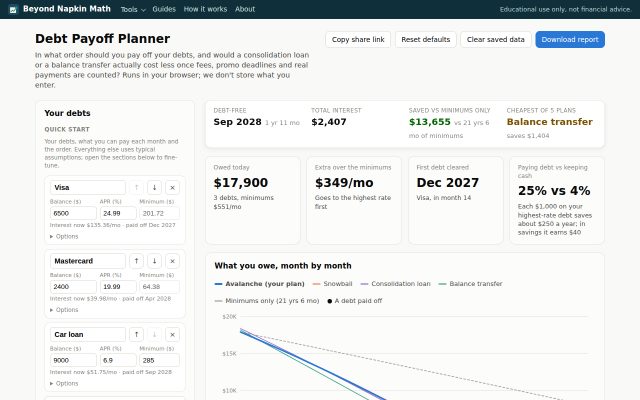
A household owes three debts and can put $900 a month toward them:
- a Visa card: $6,500 at 24.99%
- a Mastercard: $2,400 at 19.99%
- a car loan: $9,000 at 6.9%, $285 a month
The card minimums are 1% of the balance plus interest, so the three minimums come to about $551 this month. That leaves about $349 of extra money. The question is where it should go.
2. Minimums only: the slow way
Card minimums shrink as the balance falls, so paying only the minimums barely gets ahead of the interest. In the example, the Mastercard takes almost 13 years and the Visa takes 21½ years. The interest comes to about $16,060. Every plan below starts by paying all the minimums, so nothing is late, and then aims the extra at one debt at a time.
3. Avalanche: highest rate first
The avalanche sends the extra to the highest APR, here the Visa. When the Visa is gone, its payment rolls into the next-highest rate, and so on. The Visa is cleared in month 14, the Mastercard in month 18 and the car in month 23, for $2,407 of interest. With the same monthly budget, this order almost always costs the least, because each extra dollar removes the most expensive debt first.
4. Snowball: smallest balance first
The snowball sends the extra to the smallest balance, here the Mastercard. It's gone in month 7 instead of month 18. The household is still debt-free in month 23, but the interest is $2,542: $135 more, because the 24.99% Visa waited longer.
That's the usual pattern. The snowball's extra cost is small when the rates are close and larger when a big balance carries the top rate. If an early win is what keeps you going, it can be money well spent. A plan you abandon in month 4 costs far more than $135.
5. A consolidation loan
A personal loan pays off the cards, and you repay it at a fixed rate over a fixed term. Say the offer is 12% over 3 years with a 5% origination fee taken out of the money you receive. To pay off the two cards' $8,900, the household must borrow $8,900 ÷ 0.95 = $9,368, because $468 of it goes to the fee. The payment is $311 a month.
Keeping the $900 budget, the interest falls to about $1,622. With the fee added, the total cost is $2,090, about $317 less than the avalanche. Before you sign, check:
- The APR, not just the rate. The APR includes the origination fee. Compare offers on the APR, and work out what you'd need to borrow after the fee.
- The fee. Personal-loan origination fees typically run from 0% to about 10%, depending on credit. A 0%-fee loan at a slightly higher rate can be the cheaper one.
- The term. A longer term means a lower payment, but if you only pay that payment, it can mean more interest than the cards. Keep paying your full budget.
- The cards afterwards. The loan only helps if the cards stay paid off. Running them back up leaves you with the loan and the card debt.
6. A balance transfer
A transfer card moves your card balances to a new card with a low promo rate, often 0% for 12 to 21 months, for a fee of typically 3% to 5%. Say the offer is 0% for 15 months, a 3% fee, then 23.99%, with a $10,000 limit. Moving $8,900 costs a $267 fee on day one.
The household pays the transfer down evenly, about $612 a month including the minimum, so it's gone by the deadline. The rest goes to the car. Interest falls to about $737. The total cost is about $1,004, the cheapest of the five plans, and the household is debt-free a month sooner.
The catch is the deadline. If they only clear it three months after the promo ends, the cost rises to about $1,081. Paying just the card's minimums during the promo would leave thousands to be charged at 23.99%. Check:
- True 0% or deferred interest? "0% intro APR for 15 months" is a true 0%: interest starts only on what's left after the promo. "No interest if paid in full within 12 months" is deferred interest: if any balance is left at the deadline, all the interest back to day one is added. The Consumer Financial Protection Bureau has warned about these offers, which are common on store cards and medical credit. Only use them if you're sure to clear the balance in time.
- The fee counts against the limit. A $5,000 limit with a 3% fee holds $4,854 of debt, not $5,000.
- New purchases. They may not get the promo rate. Keep spending off the transfer card.
7. Where extra payments go on a single card
If one card has several balances, such as purchases, a cash advance or an old promo, you don't choose where the extra goes. Under federal rules (Regulation Z, 12 CFR 1026.53), anything above the minimum goes to the highest-rate balance first. The exception is the last two billing cycles of a deferred-interest promo, when it goes to that promo balance first. The avalanche-vs-snowball choice is about which card or loan gets your extra money.
8. What could go wrong
A plan that only works when nothing goes wrong is fragile. In the example:
- $100 less a month pushes debt-free from month 23 to month 26 and adds about $470 of interest.
- Card rates up 3 points, which happens when the prime rate rises, adds about $280.
- A $2,000 emergency in month 6 put back on the Visa adds three months and about $750.
9. Keep a small buffer first
Paying down a 24.99% card earns a guaranteed 24.99%. That beats any savings account, so it's tempting to throw every spare dollar at it. But if your cash is gone, the next car repair goes straight back on the card. A small emergency fund in a high-yield savings account breaks that cycle. Even one month of essential spending helps. Once it's in place, put every spare dollar toward the plan.
10. Make the plan stick
- Put every debt on autopay for at least its minimum, so a busy month never means a late fee.
- Send the extra to the debt at the top of your plan on payday, before it gets spent.
- When a debt is paid off, move its payment to the next debt. Don't let it drift into everyday spending.
- Put windfalls such as a tax refund or a bonus straight on the top debt. A one-off lump sum moves the debt-free date more than most people expect.
Run your own numbers
The Debt Payoff Planner runs all five plans on your own debts, with your loan or transfer offer, your card minimum rules and the stress tests above. The methodology page shows how each figure is worked out.
 Run your own numbers
Debt Payoff Planner
Avalanche, snowball, consolidation or a balance transfer: which costs least?
Open the tool →
Run your own numbers
Debt Payoff Planner
Avalanche, snowball, consolidation or a balance transfer: which costs least?
Open the tool →