HSA or PPO? How to pick, and why an HSA can be the best retirement account you have
Open enrollment usually gives you two choices: a high-deductible plan that comes with a health savings account, or a PPO with a higher premium and a lower deductible. The usual advice is "healthy people pick the HSA". That's a start, but the real answer depends on the premiums, your employer's HSA money, your tax rate, and what a bad year would cost. Here is how to work it out, and why the HSA can matter long after this year's bills.
1. Compare whole-year costs, not deductibles
A plan's cost for the year is the premiums you pay plus your share of the bills. The deductible is only part of the second number. Two plans are easiest to compare at three levels of care:
- A light year: only free preventive care. Here the cheaper premium wins, and that's almost always the high-deductible plan.
- Your expected year: your usual doctor visits, prescriptions and anything you know is coming.
- A bad year: a surgery, a birth, a hospital stay. Both plans hit their out-of-pocket max, so the cost is the premiums plus the max.
Then count what each plan gives back. The high-deductible plan usually comes with employer HSA money, and your own HSA contributions save tax. Those two often close most of the gap in deductibles.
2. A worked example
A 35-year-old single filer earning $85,000 in a state with a 5% income tax is offered:
- A high-deductible plan: $60 a month, a $3,000 deductible, a $6,000 out-of-pocket max, and $750 a year from the employer into an HSA.
- A PPO: $180 a month, a $750 deductible, a $4,000 max and $30 copays.
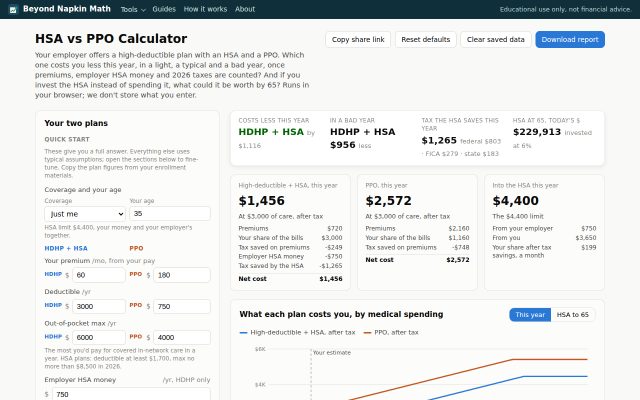
With $3,000 of care in the year, the PPO looks better on the bills: about $1,160 out of pocket against $3,000. But the high-deductible plan saves $1,440 in premiums, adds $750 of employer money, and the $3,650 the person puts in the HSA through payroll saves about $1,265 in tax (22% federal, 7.65% payroll and 5% state). After tax, the high-deductible plan costs about $1,460 for the year against $2,570 for the PPO, about $1,100 less. In a light year it wins by nearly $3,000. In a bad year it still wins by about $950, because the premium and tax savings are larger than the $2,000 gap between the two maximums.
That won't always be true. Try a family plan with no employer HSA money: $220 a month with a $6,000 deductible and a $12,000 max, against a $330 PPO with a $1,500 deductible and a $7,000 max. With $9,000 of care, the high-deductible plan is still about $250 cheaper after tax, but in a bad year the PPO wins by about $1,100. If you pay into the HSA directly instead of through payroll, the PPO wins even in the expected year.
3. The tax savings are bigger than "contribution × your rate"
An HSA is the only account where money goes in untaxed, grows untaxed and comes out untaxed (for medical costs). How much it saves you now depends on how the money goes in:
- Through payroll (your employer's cafeteria plan), it skips federal income tax, state income tax in most states, and the 7.65% Social Security and Medicare tax. $4,400 at a 22% federal rate, 7.65% payroll tax and 5% state tax saves $1,524.60.
- Paid in directly and deducted on your return, it saves income tax only: $1,188 on the same $4,400. If your employer offers payroll HSA contributions, use them.
- California and New Jersey don't follow the federal rules. Contributions, including your employer's, are taxable state income there, and the account's earnings are taxed each year. The federal and payroll savings still apply.
For 2026 you can put in up to $4,400 for self-only coverage or $8,750 for family coverage, including your employer's money, plus $1,000 more if you're 55 or older.
4. The bad-year test
The real risk of a high-deductible plan isn't the yearly average. It's a bad year early on, before the HSA has money in it. Before you pick it, check two things:
- Could you pay the full out-of-pocket max if it happened in January? The HSA fills up through the year with each paycheck.
- How much more does the high-deductible plan cost than the PPO in that bad year, after the premium and tax savings? If it's a few hundred dollars, the risk is small. If it's thousands and you have a known condition or a baby on the way, the PPO may be the safer choice.
5. The receipts strategy: an HSA as a retirement account
Most people spend their HSA on this year's bills. If you can afford to pay those bills out of pocket instead, the HSA becomes something else: an investment account with no tax on the way in, none on the growth, and none on the way out for medical costs.
The rule that makes it work: there is no deadline to repay yourself. A medical bill you paid out of pocket today can be reimbursed from the HSA tax-free in 20 years, as long as the cost came after the HSA was opened and you kept the receipt. Meanwhile the money stays invested.
In the example above, putting the full $4,400 a year into the HSA from 35 to 65 and investing it at 6% a year (2.5% inflation) gives about $230,000 in today's dollars. Spending it on this year's bills as they come instead leaves about $81,000. Left in cash, it's about $114,000.
After 65, the HSA works two ways:
- For medical costs, including Medicare premiums, it's tax-free at any age. Retirees typically spend thousands a year on health care, so most of it can go here.
- For anything else, withdrawals are taxed like a traditional IRA or 401(k), with no penalty. Before 65, a non-medical withdrawal is taxed and hit with a 20% additional tax.
So at worst, after 65 the HSA is as good as a traditional 401(k). For medical costs it's better than any other account. That's why many people put money in the HSA after getting their full 401(k) match.
Two cautions. Receipts are fixed dollar amounts, so inflation shrinks what they're worth. And the strategy only pays if you can cover this year's bills without a credit card.
6. Where to keep an invested HSA
Many workplace HSAs keep the money in a cash account with little interest, and some charge a monthly fee. To invest it, look for:
- low-cost index funds, with no minimum balance before you can invest;
- no monthly account fee, or one your employer pays;
- easy reimbursement and a place to store receipts.
Your employer's payroll contributions usually have to go to its chosen HSA provider. You can still move money from there to another HSA through a trustee-to-trustee transfer, as often as you like, without tax.
7. Rules that trip people up
- Medicare. Once you're enrolled in Medicare, you can't contribute. If you sign up after 65, Part A starts up to six months earlier, which makes contributions for those months excess. Stop six months before you apply.
- FSAs. A general-purpose health FSA, yours or your spouse's, makes you ineligible for an HSA. A limited-purpose FSA for dental and vision is fine.
- Is the plan HSA-qualified? For 2026, an HSA plan needs a deductible of at least $1,700 ($3,400 family) and an out-of-pocket max of no more than $8,500 ($17,000 family). Your enrollment materials will say "HSA-eligible".
- New in 2026. Bronze and catastrophic marketplace plans now count as HSA plans, direct primary care memberships up to $150 a month ($300 family) no longer block an HSA, and telehealth before the deductible is allowed permanently.
8. What the numbers can't tell you
The cheapest plan on paper is the wrong one if your doctor isn't in its network, or if a high deductible would stop you getting care you need. Use the numbers to see how big the gap really is, then weigh the rest.
Compare your own two plans with the HSA vs PPO Calculator →
 Run your own numbers
HSA vs PPO Calculator
Which plan costs less this year, and what an invested HSA is worth by 65.
Open the tool →
Run your own numbers
HSA vs PPO Calculator
Which plan costs less this year, and what an invested HSA is worth by 65.
Open the tool →