How to get rid of PMI: the 78% and 80% rules
If you put less than 20% down on a conventional loan, you're probably paying private mortgage insurance (PMI). It doesn't last forever. By law it ends on its own at 78%, you can ask to cancel it at 80%, and extra payments can bring that date forward by years. The catch: the earlier date only counts if you ask.
1. The three dates that end PMI
The Homeowners Protection Act sets three dates for most conventional loans on a home you live in, closed after July 1999. All three are measured against the home's original value: the lower of the price you paid and the appraisal when you bought. A later rise in your home's value doesn't count here (see section 4 for the route that does use today's value).
- Cancel on request at 80%. Once your balance reaches 80% of the original value, you can ask the lender to cancel PMI. It counts whether you got there on schedule or with extra payments.
- Automatic end at 78%. PMI must stop on the date your original payment schedule reaches 78% of the original value, as long as you're current on payments. Extra payments don't move this date, because it's based on the schedule, not your actual balance.
- Final end at the midpoint. If neither has happened, PMI must stop halfway through the loan's term: after 15 years on a 30-year loan. This mostly matters for loans that pay down slowly, such as ones with an interest-only period.
Your servicer must tell you at closing, and once a year after that, how cancellation works on your loan.
2. A worked example
Take a $400,000 home bought with 10% down: a $360,000, 30-year loan at 6.5%. The principal and interest payment is $2,275.44 a month, plus PMI of $160 a month. (PMI pricing depends on your credit score and down payment; check your own statement.)
- 80% of $400,000 is $320,000. The balance has to fall by $40,000 before you can ask.
- 78% is $312,000.
| What you do | PMI ends after | Total PMI paid |
|---|---|---|
| Nothing: wait for the automatic end at 78% | 109 payments (9 years 1 month) | $17,440 |
| Ask to cancel at 80%, no extra payments | 95 payments (7 years 11 months) | $15,200 |
| Ask at 80% and pay $100 a month extra | 77 payments (6 years 5 months) | $12,320 |
| Ask at 80% and pay $200 a month extra | 64 payments (5 years 4 months) | $10,240 |
| Ask at 80% and pay $400 a month extra | 49 payments (4 years 1 month) | $7,840 |
| Ask at 80% after one $10,000 lump sum in the sixth month | 67 payments (5 years 7 months) | $10,720 |
Simply asking, with no extra money, saves 14 months of PMI ($2,240). Adding $200 a month cuts PMI by $7,200 compared with waiting, and it keeps saving interest after PMI is gone: about $109,000 over the life of the loan.
3. Why extra payments are worth more while you pay PMI
An extra dollar of principal normally "earns" your mortgage rate, here 6.5%, by avoiding interest. While you're paying PMI, it also brings forward the day PMI stops. In the example, the $200 a month adds up to $12,800 of extra principal by the time PMI ends. That avoids $4,960 of PMI compared with asking on schedule, on top of the interest it saves.
So if you're deciding between prepaying the mortgage and investing, the years before you reach 80% are when prepaying looks best. Once PMI is gone, the comparison goes back to your interest rate versus what you'd expect to earn investing. Our guide on paying off a mortgage early walks through that comparison.
4. Using today's value instead
If your home has gone up in value, you may be able to drop PMI sooner by using a new valuation instead of the original value. This isn't part of the federal law; it depends on who owns your loan. Many conventional loans are owned by Fannie Mae or Freddie Mac, whose rules commonly allow it:
- at 75% of today's value once the loan is 2 to 5 years old;
- at 80% of today's value after 5 years;
- with an appraisal or valuation you usually pay for, and a clean payment record.
In the example, after 5 years of regular payments the balance is about $337,000. To be at 80% of today's value, the home would need to be worth at least $421,250, about 5% above the purchase price. After 2 years the balance is about $351,700, so 75% would need a value near $468,900, about 17% higher. Ask your servicer whether this route applies and what it requires before paying for an appraisal.
5. What lenders ask for
To cancel at 80%, expect to need:
- A written request. A letter or the servicer's own form.
- A good payment history. No payment 30 or more days late in the past 12 months, and none 60 or more days late in the 12 months before that.
- Current payments. You can't be behind when you ask.
- Proof the value hasn't fallen. The lender can ask you to show the home is still worth at least its original value, sometimes with an appraisal.
- No second loan on the home. A home equity loan or HELOC can block cancellation.
Tell your servicer the extra payments are for principal, and check your statements. Some servicers hold unlabeled extra money toward the next payment, which doesn't lower the balance.
6. Loans these rules don't cover
- FHA loans charge mortgage insurance (MIP) under HUD's rules, not the ones above. For FHA loans from June 2013 on, MIP lasts 11 years if you put at least 10% down, and for the life of the loan otherwise. Refinancing into a conventional loan once you have enough equity is the usual way out.
- Lender-paid mortgage insurance is built into your interest rate, so there's no separate charge to cancel. Only a refinance removes it.
- VA loans have no monthly mortgage insurance; they charge a one-time funding fee instead.
- Second homes and investment properties aren't covered by the federal rules, though lenders often follow similar ones.
7. A checklist
- Find your original value (your closing papers or appraisal) and work out 80% of it.
- Check your balance and monthly PMI on a recent statement.
- Run your loan through the calculator to see your 80% and 78% dates with and without extra payments.
- A few months before the 80% date, ask your servicer exactly what they need.
- Send the written request when you reach 80%, then check that PMI is gone from the next statement.
Try it with your numbers
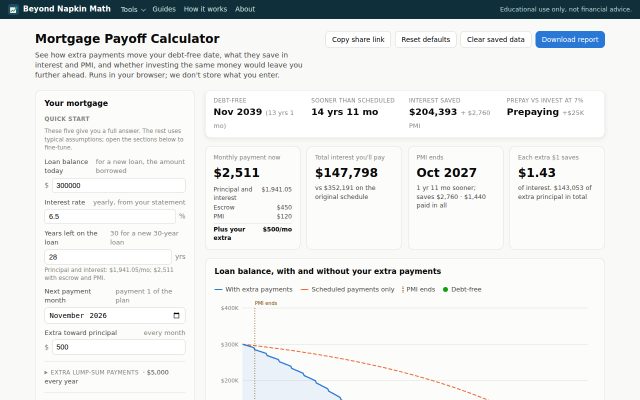
The Mortgage Payoff Calculator opens with this example loaded. Enter your balance, rate, the price you paid and your PMI, and tick "I'll ask my lender to cancel PMI at 80%". It shows when PMI ends with and without your extra payments, and how much it saves. It measures PMI against the price you paid, so it covers the federal 80% and 78% rules but not the current-value route in section 4. It runs in your browser and we don't store your numbers.
Rules differ by loan type and servicer. Your loan documents and your servicer have the final word.
 Run your own numbers
Mortgage Payoff Calculator
Extra payments, PMI and the real question: pay it down or invest?
Open the tool →
Run your own numbers
Mortgage Payoff Calculator
Extra payments, PMI and the real question: pay it down or invest?
Open the tool →