Sell or rent out your old home? The 3-year tax clock most people miss
You're moving, the market feels soft, and your mortgage rate is lower than anything on offer today. Renting the old place out looks like an easy win: the rent covers the mortgage, and you sell later for more. Sometimes it is. But turning a home into a rental starts a tax clock, and most "rent or sell" calculators never show it.
1. The clock starts the day you move out
When you sell your main home, up to $250,000 of gain is tax-free, or $500,000 for a married couple filing jointly. To qualify you must have owned the home and lived in it for 2 of the 5 years before the sale.
Count forward from the day you move out. Three years later, the 5-year look-back no longer holds 2 years of living there, and the exclusion is gone. Move out in July 2026 and you have until about July 2029 to close. A sale in August 2029 fails the test, and the whole gain becomes taxable.
For a couple with a $200,000 gain, that can mean $30,000 to $45,000 of federal and state tax, just from closing a few weeks late. Closings slip, so don't plan to list in the last month.
The good news: renting the home out after you leave doesn't shrink the exclusion, as long as you sell inside the window. (Rental use before you lived there is a different story and can reduce it.)
2. Depreciation is taxed even inside the window
Once the home is a rental, you deduct depreciation each year: the building's value (not the land) spread over 27.5 years. On a $300,000 building that's about $10,900 a year, which often turns a small cash profit into a tax loss.
The catch comes when you sell. The exclusion never covers depreciation. Every dollar taken since you converted the home is taxed at your ordinary rate, up to 25%. Rent for 3 years and sell inside the window, and about $32,700 of the gain is still taxed. It's also taxed if you forgot to claim the depreciation: the rule is "allowed or allowable", so you pay the tax without having had the deduction. Claim it.
One more detail: depreciation starts from the lower of what you paid (plus improvements) and the home's value when you convert it. If prices have fallen since you bought, depreciation is smaller, and only a fall in value after you convert is deductible if you sell at a loss.
3. Rental losses may have to wait
Most converted homes show a tax loss in the early years. Whether it helps you now depends on your income:
- If you actively take part (approving tenants, rents and repairs counts, even with a manager), you can deduct up to $25,000 a year of rental loss against your salary.
- That allowance shrinks by half of your modified adjusted gross income over $100,000, and it's gone at $150,000. At $120,000 of income you can deduct $15,000; at $150,000, nothing.
- Losses you can't use aren't lost. They're carried forward, used against later rental profits, and released in full when you sell.
So for many dual-income households, the tax benefit of the rental arrives in one lump at the sale, not year by year.
4. The real case for renting: the cheap mortgage
The strongest argument for keeping the home is often the loan. A 3% mortgage on the old home is borrowing that costs less than a high-yield savings account pays. Sell, and that cheap debt disappears; if you'd otherwise take a bigger mortgage on the next home at 6% or more, the difference is real money.
The calculator handles this through the return on the sale money. If the cash from selling would go into the next home's down payment, set the return to that new loan's rate and the tax on it to 0%. You'll often find that renting looks much better against a 6.5% loan than against a 4% savings account.
5. Cash flow is not the whole answer
"The rent covers the mortgage" leaves out a lot: vacancy, a property manager (8–10% of the rent), repairs, saving for the roof and furnace, landlord insurance, and the cost of each new tenant. Together those often take 35–45% of the rent before the mortgage. A home that rents for $2,600 can easily cost you $100 a month after the mortgage, before tax.
That might still be fine if the home's price growth and loan paydown more than make up for it. But it should be a decision you make with the numbers in front of you, including the stress cases: a slow first letting, a big repair, a fall in prices.
6. Three ways to play it
- Sell now. Simple, tax-free up to the exclusion, and your cash is free for the next home.
- Rent for up to 3 years, then sell. You keep the low-rate loan for a while, wait out a soft market, and still sell tax-free except for the depreciation. Put the deadline in your calendar.
- Keep it as a long-term rental. You give up the exclusion, so the whole gain is taxed when you eventually sell, unless you defer it with a 1031 exchange into another rental. This only makes sense if you want to be a landlord.
Run your own numbers
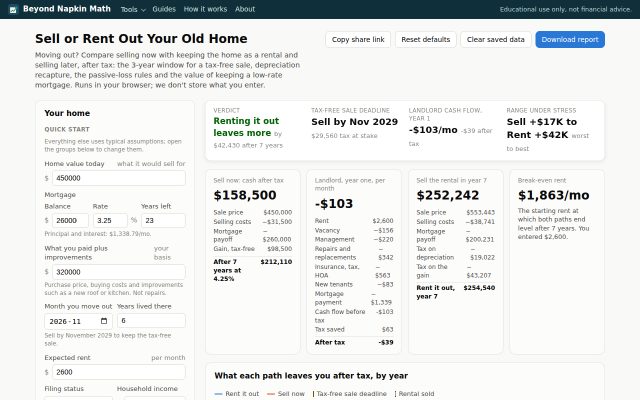
The Sell or Rent Out Your Old Home calculator follows both paths month by month after tax: your landlord cash flow, depreciation and passive losses, the exact month your tax-free sale runs out and the tax at stake if you miss it, the break-even rent, and stress tests. For a deeper look at the home as an investment, try the Rental Property Analyzer.
Educational use only, not financial advice. Tax rules here are federal rules for 2026; state rules differ. Check your own situation with a tax professional before you sell or rent out a home.
 Run your own numbers
Sell or Rent Out Your Old Home
Sell now or rent it out? The 3-year tax clock, recapture and cash flow, after tax.
Open the tool →
Run your own numbers
Sell or Rent Out Your Old Home
Sell now or rent it out? The 3-year tax clock, recapture and cash flow, after tax.
Open the tool →