How the HSA vs PPO Calculator works
The HSA vs PPO Calculator compares two health plans your employer already offers: a high-deductible plan (HDHP) that lets you put money in a health savings account (HSA), and a PPO. It works out what each costs you this year at any amount of medical care, after tax, and then follows the HSA year by year to the age you stop contributing. This page explains each step and what the model leaves out.
It doesn't rate insurers, networks or drug lists, and it doesn't suggest a plan to buy. It compares the costs of two plans you already have.
Your share of the bills
Medical care is entered as one yearly total at the plan's prices (what the insurer has agreed to pay the doctor, not the list price). Free preventive care is left out, as both plans cover it in full. For each plan, your share is:
- everything up to the deductible; then
- the coinsurance (default 20%) of everything above it; until
- you reach the out-of-pocket max, after which the plan pays it all.
Copays (simplified). If you give the PPO a copay, the number of doctor visits and prescriptions you enter, at their typical cost, are paid by copay instead and sit outside the deductible, as they do on most PPOs. Copays still count toward the out-of-pocket max. On the high-deductible plan, visits go toward the deductible: the law lets an HSA plan pay for little but preventive care before the deductible.
Example: a plan with a $3,000 deductible, 20% coinsurance and a $6,000 max costs you $2,000 on $2,000 of care, $4,400 on $10,000 ($3,000 + 20% of $7,000), and $6,000 on anything from $18,000 up.
Each plan's cost this year
Before tax, a plan costs its premiums plus your share of the bills. The calculator then counts what each plan saves or gives back:
- High-deductible plan: premiums + your share of the bills − your employer's HSA money − the tax your own HSA contributions save.
- PPO: premiums + your share of the bills, and if you'd use a health FSA with it, − the tax the FSA saves + any FSA money you'd lose at year end.
- Premiums come out of pay before tax at most employers (a cafeteria plan), so both plans' premiums are counted after the federal, payroll and state tax they save. You can switch this off.
The money you put into the HSA is not a cost: it is still yours. Only the tax it saves is counted. That's why the high-deductible plan can show a cost below zero in a light year: the tax saved and the employer's money can be worth more than its premiums.
The calculator runs this at three levels of care: a light year (no care beyond free preventive care), your estimate, and a bad year, enough care to reach both plans' out-of-pocket max. It also draws each plan's cost from $0 of care to past both maximums and finds the crossover, the amount of care at which the two plans cost the same. Often there is none: one plan is cheaper at every level.
The tax the HSA saves
- Contribution limit, 2026: $4,400 for self-only coverage and $8,750 for family coverage (Revenue Procedure 2025-19). Your money and your employer's count toward the same limit. "Put in the most allowed" means the limit less your employer's money. Employer money above the limit is capped and flagged.
- Catch-up: $1,000 more if you're 55 or older by the end of the year. It's set in the law, not indexed, and belongs to one person: a spouse who is also 55 needs an HSA in their own name to add theirs.
- Federal income tax uses the 2026 brackets and standard deduction (Revenue Procedure 2025-32). The saving is the exact difference between the tax on your income with and without your contribution, so a contribution that straddles two brackets is handled correctly.
- Payroll tax (FICA): money put in through payroll, under your employer's cafeteria plan (IRC section 125), also skips Social Security (6.2% up to the 2026 wage base of $184,500) and Medicare (1.45%, plus 0.9% over $200,000, or $250,000 married filing jointly). Money you pay in directly is deducted on your tax return and saves income tax only (IRS Publication 969).
- State tax is a flat rate you enter. Every state with an income tax follows the federal HSA rules except California and New Jersey. There, your contributions and your employer's are taxable state income, and the account's interest, dividends and gains are taxed by the state each year.
- On Medicare: from the first month you're enrolled, your contribution limit is zero, and your employer can't add money either. The calculator treats you as on Medicare from the age you stop contributing (65 by default).
Example (the case pinned in the tests): $4,400 through payroll at a 22% federal rate, 7.65% FICA and a 5% state rate saves $4,400 × 34.65% = $1,524.60. Paid in directly, it saves $4,400 × 27% = $1,188.
Income is treated as wages for one person's payroll tax. A couple with two earners each has their own Social Security wage base; above it, payroll saves only the Medicare part.
A health FSA with the PPO
A general-purpose health FSA lets you pay medical bills with pre-tax money, up to $3,400 in 2026. It makes you ineligible for an HSA, so it is counted with the PPO only. The FSA saves federal, payroll and state tax on the amount you put in; money you don't spend by the end of the year is lost, except up to $680 that some plans carry over (Revenue Procedure 2025-32). A limited-purpose FSA, for dental and vision only, can sit alongside an HSA; it isn't modeled.
The long run
- Each year until the age you stop, the HSA receives this year's contributions, yours and your employer's, rising with inflation (default 2.5%) as the limits do. The catch-up starts at 55.
- Money goes in at the end of each year, an ordinary annuity, as payroll money arrives through the year. $4,400 a year for 20 years at 5% grows to $145,490.20; an annuity due (start of year) would give 5% more.
- The balance grows at the return you choose (default 6% a year before inflation) if invested, or at a cash rate (default 1%) if not. In California and New Jersey the state tax on the earnings is taken from the growth each year.
- Medical bills: with "keep the receipts", you pay each year's expected bills under the high-deductible plan out of pocket and the HSA stays invested. There is no deadline to repay yourself later for a qualified medical cost incurred after the HSA was opened, as long as you keep the records (Publication 969). Otherwise, each year's bills are paid from the HSA.
- Results are shown in today's dollars: each year's figures are divided by inflation to that year. Receipts are fixed dollar amounts, so inflation shrinks what they're worth.
The HSA's value at the end is shown two ways:
- Spent on medical costs: the full balance, tax-free at any age (including Medicare premiums and long-term care premiums within limits).
- Taken as retirement income: your saved receipts come out tax-free, and after 65 the rest is taxed like a traditional IRA withdrawal, at the rate you enter (default 15%), with no penalty (IRC section 223(f)).
The long-run table also shows: paying bills from the HSA as you go; leaving it in cash; your employer stopping its money; and cashing it out for non-medical use the year before you stop, which costs income tax at today's rate plus the 20% additional tax that applies before 65 (receipts excepted).
Changes from 2026 (Public Law 119-21)
The 2025 tax law (the One Big Beautiful Bill Act) widened who can use an HSA from 2026. IRS Notice 2026-5 explains the details:
- Bronze and catastrophic plans bought through a marketplace (exchange) count as HSA-qualified plans from January 1, 2026, even if their deductible or out-of-pocket max is outside the usual limits.
- Direct primary care: a fixed-fee arrangement with a primary care practice no longer makes you ineligible, if the fee is no more than $150 a month ($300 for family coverage) in 2026, and the HSA can pay that fee tax-free.
- Telehealth: a high-deductible plan can cover telehealth before the deductible without costing you HSA eligibility, now permanently (plan years beginning after December 31, 2024).
The calculator checks your high-deductible plan against the 2026 HSA rules: a deductible of at least $1,700 ($3,400 family) and an out-of-pocket max of no more than $8,500 ($17,000 family). A plan outside those numbers is flagged, unless it is a marketplace bronze or catastrophic plan.
Stress tests
- A bad year in year one, before the HSA has built up, with the cash you'd need from savings after this year's HSA money.
- Your employer stops its HSA money.
- You pay into the HSA directly instead of through payroll, losing the payroll tax saving.
- A non-medical withdrawal before 65, taxed plus the 20% additional tax (in the long-run table).
What the model leaves out
- Choosing between insurers, networks and drug lists. A doctor you need being in one network can outweigh every number here.
- Family plans with embedded individual deductibles, separate drug deductibles and tiers, out-of-network care and services with their own rules. Care is one yearly total.
- Limited-purpose FSAs (named only), and HSA eligibility when you have other coverage, such as a spouse's general-purpose FSA, Medicare, TRICARE or, in some cases, VA care.
- Medicare's six-month look-back. If you sign up for Medicare or Social Security after 65, premium-free Part A starts up to six months earlier, and the HSA limit drops to zero for those months, so money put in for them is an excess contribution. Stop contributing six months before you apply.
- Part-year eligibility and the "last-month rule", which can let someone who starts a high-deductible plan in December contribute for the whole year, if they stay eligible for the next 12 months.
- The slightly lower Social Security benefit that comes from paying less payroll tax, and state rules on taxing a health FSA.
- Changes in your medical costs over the years: the long run assumes this year's expected bills, in today's dollars, every year.
Defaults
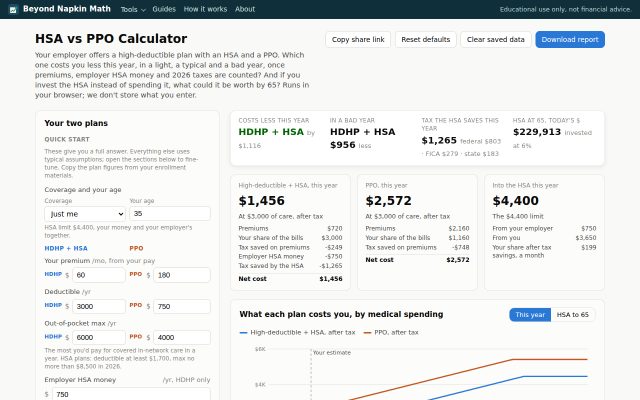
The example is generic: a 35-year-old with self-only coverage, a $60 a month high-deductible plan with a $3,000 deductible and $6,000 max and $750 of employer HSA money, against a $180 a month PPO with a $750 deductible, $4,000 max and $30 copays, $3,000 of care a year, $85,000 of income filed single, and a 5% state rate. Change any of it to match your plans; every figure is an input. The 2026 figures come from IRS sources listed on the sources page, reviewed October 2026.
 Try it
HSA vs PPO Calculator
Which plan costs less this year, and what an invested HSA is worth by 65.
Open the tool →
Try it
HSA vs PPO Calculator
Which plan costs less this year, and what an invested HSA is worth by 65.
Open the tool →