How the Can One Parent Stay Home? calculator works
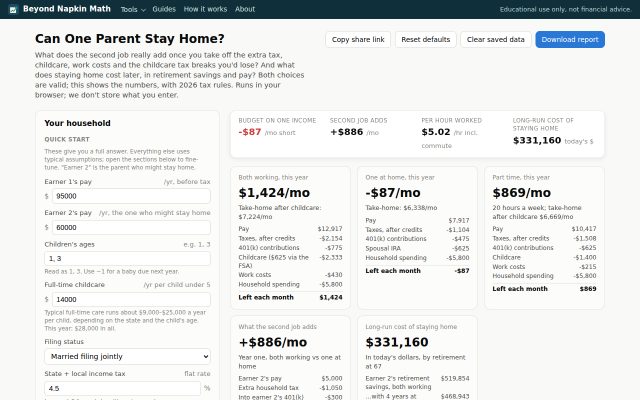
The Can One Parent Stay Home? calculator runs a household year by year, in today's dollars, three ways: both parents working full time, one parent ("earner 2") at home for a number of years and then back at work, and earner 2 working part time for those years. This page explains each step, the 2026 rules it uses and what it leaves out.
The three scenarios
- Both working: both earners keep their jobs, and the children are in paid care until they turn 13.
- One at home: earner 2 has no pay for the years at home (by default, until the youngest child starts kindergarten) and the family pays for no childcare. Then earner 2 goes back at a share of today's pay (default 82%) and the family pays for care again for any child still under 13.
- Part time: earner 2 works fewer hours (default 20 of 40) at a share of today's hourly rate (default 100%), and the family pays a share of the full childcare cost (default 60%; part-time care usually costs more per hour). Then earner 2 goes back full time at the pay you set (default 100% of today's).
Earner 1's pay is the same in every scenario. Both earners' pay grows by the pay-growth assumption (default 1% a year above inflation). Everything is in today's dollars.
Taxes: the second income stacks on the first
A second income isn't taxed on its own. On a joint return it's added on top of the first, so its first dollar is taxed at the household's top bracket. The calculator works out the whole household's tax in each scenario, and the second income's tax is the difference. With earner 1 at $90,000 and earner 2 at $50,000, married filing jointly with the standard deduction and no 401(k):
- With both incomes, taxable income is $140,000 − $32,200 = $107,800, and the tax before credits is $13,140.
- With one income, taxable income is $57,800 and the tax is $6,440.
- So the second income adds $6,700 of federal income tax: 13.4% of its pay, though it's "only" in the 12% and 22% brackets on its own. The test suite pins these figures.
The pieces:
- Federal income tax uses the 2026 brackets and standard deduction (Revenue Procedure 2025-32). Married filing separately uses the separate brackets and $16,100 standard deduction for each spouse, with earner 1 claiming the children.
- Payroll tax (FICA) is each earner's own: 6.2% Social Security on each person's wages up to $184,500, and 1.45% Medicare. The 0.9% Additional Medicare Tax applies to the couple's combined wages above $250,000 ($125,000 each if filing separately).
- State and local tax is one flat rate on wages after 401(k) contributions, the FSA and pre-tax premiums. Enter your marginal rate, or a bit less for a progressive state.
- 401(k) contributions (a percentage of each earner's pay, up to the $24,500 limit) save income tax but not FICA. Earner 2's employer match is counted as retirement savings, not take-home pay.
- Indexed figures (brackets, the standard deduction, the wage base, the 401(k) limit, the Child Tax Credit amount) are held at their 2026 values in today's dollars. Figures the law doesn't index (the FSA limit, the care credit's limits and income thresholds, the Child Tax Credit phase-out and the Additional Medicare threshold) shrink each year by the inflation assumption (default 2.5%).
Childcare
Each child under 5 costs the full-time childcare figure you enter. Each child from 5 to 12 costs the school-age figure (before- and after-school care and summer). From 13, no paid care. Enter a child who isn't born yet as −1 (born next year). Paid care is needed only in a year when both parents work.
The two childcare tax breaks
The 2025 tax law (Public Law 119-21, the "One Big Beautiful Bill Act") changed both for 2026:
- Dependent care FSA (Internal Revenue Code section 129): up to $7,500 a household ($3,750 each if married filing separately), up from $5,000. Money set aside from pay for care escapes income tax, state tax and FICA. It can't exceed the care you pay for or the lower earner's pay, and needs both parents working. It isn't indexed for inflation.
- Child and dependent care credit (section 21): a share of up to $3,000 of care for one child under 13, or $6,000 for two or more, and no more than the lower earner's pay. From 2026 the share is 50%, less one point for each $2,000 (or part) of income (AGI) over $15,000, down to 35% (reached above $43,000); then less one more point for each $2,000 over $75,000 ($4,000 over $150,000 on a joint return), down to 20% (reached above $103,000, or $206,000 joint). It isn't refundable, and married couples filing separately generally can't claim it.
The two can't cover the same dollars: every FSA dollar reduces the credit's $3,000 or $6,000 limit. With one child and a $7,500 FSA, no credit is left; with two children and $6,000 or more in the FSA, none is left either. Because of that, the best choice is all of one or the other: either the FSA for as much as you're allowed, or no FSA and the full credit. By default the calculator works out both and uses whichever leaves less tax; you can force either one.
A worked example (pinned by the test suite): the $90,000 / $50,000 couple above with one child and $15,000 of care. Their AGI of $140,000 gives a 35% credit, so the credit alone is 35% × $3,000 = $1,050. A $7,500 FSA saves $1,600 of federal tax (most of it at 22%) plus $573.75 of FICA, $2,173.75, and leaves no credit. The FSA wins by $1,123.75. At lower incomes the 35% to 50% credit can beat the FSA; in the default example, the part-time scenario uses the credit for that reason.
Child Tax Credit
$2,200 per child under 17 for 2026 (section 24 as amended by Public Law 119-21; Revenue Procedure 2025-32). It falls by $50 for each $1,000 (or part) of AGI over $400,000 on a joint return ($200,000 otherwise). The part that's more than the tax owed is refundable up to $1,700 per child, at 15% of earned income over $2,500. At most incomes it's the same with one income or two, so it doesn't change the answer, but it's in each scenario's tax. The calculator assumes each child has a Social Security number, as the credit requires.
What the second job adds
For each year: the household's take-home pay with both working, less childcare and earner 2's work costs, minus the household's take-home pay with one income. Take-home pay is pay less taxes (after credits), 401(k) contributions and any pre-tax health premium change. So the figure already includes the extra tax, the childcare tax break, and the Child Tax Credit. Earner 2's own 401(k) contributions are counted as savings, not spending: they're in the long-run figures below instead.
- Work costs are the monthly commute, plus the costs that go with a second job: work clothes, lunches, takeout and convenience spending. Part time scales them by hours.
- Health insurance: if the family is covered through earner 2's job, enter what moving to earner 1's plan (or the marketplace) would add each month. It's charged in the years at home, before tax from earner 1's pay, and it's counted as a saving of the second job.
- Per hour: the year's amount divided by hours worked (hours a week × weeks a year) plus commuting time (one round trip per 8-hour day, up to 5 a week).
The scoreboard shows year one. Childcare usually falls as children start school, so the stress table also shows the average over the years at home.
The budget on one income
Take-home pay with one income, less the household's monthly spending (everything except childcare, work costs, taxes and retirement savings) and the spousal IRA if you fund one. A negative number is the monthly gap you'd need to cover from savings or by spending less. The stress table shows the tightest year at home.
The long-run cost
Two parts, both in today's dollars, from now to earner 2's retirement age (default 67):
- Retirement savings: earner 2's 401(k) contributions and match in each scenario, plus the spousal IRA in the years at home, grown at the return you set (default 5% a year after inflation). The cost is the difference in earner 2's balance at retirement.
- Lower pay after going back: the household's take-home pay in each year after earner 2 goes back, with both working throughout, minus the same with earner 2 back at the lower pay. The pay cut is a share of today's pay, and the model assumes the gap doesn't close later. That's a simplification: some people catch up, some never do.
The pay on return is an assumption, not an official figure. The default of 82% is the average from a survey of highly qualified women by the Center for Work-Life Policy (Hewlett and Luce, "Off-Ramps and On-Ramps", Harvard Business Review, March 2005): those who took time out earned 18% less on return on average, 11% less after less than a year, and 37% less after three or more years. Studies of the motherhood wage penalty find smaller, per-child effects, around 4–7% per child. Results vary widely by field; set your own figure.
Spousal IRA
A spouse with no pay can contribute to an IRA based on the working spouse's pay, if they file jointly (IRS Publication 590-A), up to the 2026 limit of $7,500. It's on by default because it's the main way to keep saving while at home. The calculator counts it as savings out of take-home pay and assumes no tax deduction, as with a Roth IRA; a traditional IRA contribution may be deductible, which would make it a little cheaper.
Social Security
Not calculated. The tool shows the number of years with no earnings on earner 2's record. Retirement benefits are based on a person's 35 highest-earning years, so zero years can lower their own benefit. A spouse can get a spousal benefit of up to 50% of the other's benefit at full retirement age, if that's higher than their own. Use the Social Security Claiming Age Calculator and your records at ssa.gov to see both.
Stress tests
Each row changes one thing and reruns every year:
- Part-time instead: compares full time with part time rather than with staying home.
- Childcare costs 20% more, in every year of paid care.
- Earner 1 loses their job for 6 months: half a year's pay in year one. Unemployment benefits and severance aren't counted. It shows what a one-income household has no backup for.
- Back after 5 years at 80% of today's pay.
- Another child arrives in year 2: paid care from year 2 when both work, and a Child Tax Credit from year 2.
What the model leaves out
- State credits for childcare and children, and state tax rules beyond one flat rate.
- The value of a parent's time at home: named, not priced. It's real, and only your family can weigh it.
- Risk: divorce, disability and death matter more to a one-income household. Life and disability insurance are worth considering; this site doesn't cover them.
- Benefits for children with special needs, the earned income tax credit, unemployment benefits, the $500 credit for other dependents, and parental leave pay.
- Rules the tool can't check: a qualifying care provider (not your own child under 19, for example), a child's Social Security number, and the FSA plan's own rules (some plans set a lower limit than $7,500).
- Earner 1's 401(k) match and catch-up contributions; part-time jobs that don't offer a 401(k) or health plan.
Sources
Every official figure and its source is listed on the Sources page, along with the model's own assumptions.
 Try it
Can One Parent Stay Home?
What the second job really adds after tax, childcare and work costs.
Open the tool →
Try it
Can One Parent Stay Home?
What the second job really adds after tax, childcare and work costs.
Open the tool →