How the Sell or Rent Out Your Old Home calculator works
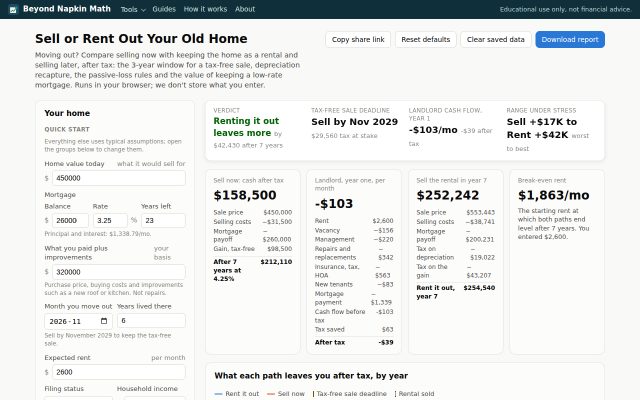
The calculator follows two paths from the month you move out. Path A sells the home now and invests what's left. Path B keeps it, rents it out month by month, and sells it in a year you choose. At the end of each year it works out what each path would be worth after every tax, and compares them. This page explains each step and what the model leaves out.
Path A: sell now
The home sells at today's value. Selling costs (agent commission plus other costs, 6% + 1% by default) and the mortgage payoff come off the price. The gain is the price less selling costs less your basis: what you paid plus buying costs and improvements.
If you have owned and lived in the home for at least 2 of the last 5 years, up to $250,000 of gain ($500,000 married filing jointly) is tax-free. Any gain above that is taxed as a long-term capital gain (see "How sales are taxed" below). A loss on your own home isn't deductible.
The cash is then invested at the return you choose (5% a year by default, compounded monthly). Part of that return is lost to tax each year (15% of it by default). If you'd use the cash to pay down a new mortgage instead, enter that loan's rate and 0% tax.
Path B: rent it out, then sell
Every month the model collects the rent, less vacancy (6%), and pays:
- property management (9% of the rent collected), repairs (6%) and a reserve for big-ticket replacements such as a roof or furnace (8%);
- landlord insurance, property tax and any HOA dues, which rise with your cost-growth rate;
- the cost of finding each new tenant (cleaning, paint, listing), spread over a typical tenant's stay;
- the mortgage payment, on the normal amortization schedule for the balance, rate and years left you enter.
The defaults follow the typical ranges used in our Rental Property Analyzer. Whatever is left over each month (positive or negative) goes into, or comes out of, savings that earn the same after-tax return as path A's cash. So a rental that costs you money every month counts against path B, as it should: that money could have been invested instead.
Rent and the percentage costs grow with your rent-growth rate. The home's value grows with your price-growth rate, compounded monthly.
Depreciation
Once the home is a rental, you deduct depreciation on the building (not the land). The basis for depreciation is the lower of your adjusted basis and the home's value on the day you convert it, less the land share (20% by default; your property tax bill often splits land and building). Residential rental property is depreciated straight line over 27.5 years with the mid-month convention: in the month you start renting and the month you sell, you get half a month.
Example: a $300,000 building placed in service in July gets $300,000 / 27.5 × 5.5/12 = $5,000 in its first calendar year and $10,909.09 in each full year after. The calculator counts depreciation month by month from your move-out; the half months at the start and at the sale add up to one full month, so a sale after 5 years means exactly 5 years of depreciation.
Rental income tax and the passive-loss rules
Each year the model works out the rental's taxable result: rent collected, less every operating cost, mortgage interest and depreciation. Principal repayments aren't deductible. Big-ticket replacements are treated as deducted in the year you set them aside; in real life a new roof is depreciated over 27.5 years, so this slightly speeds up the deduction.
- A profit is taxed at your ordinary rate: your federal bracket (worked out from your income after the standard deduction, or the rate you enter), plus your state rate, plus the 3.8% net investment income tax if your income is over $250,000 married filing jointly ($200,000 single).
- A loss is a passive loss. If you actively take part (you approve tenants, set the rent, approve repairs, even with a property manager), up to $25,000 a year can be deducted from your other income. The allowance shrinks by 50 cents for each dollar of modified adjusted gross income over $100,000 and is gone at $150,000. Married couples filing separately who lived together at any time in the year get none; the model assumes that case.
- Any loss you can't deduct is suspended. It's used first against later rental profits, and whatever is left is released in full when you sell the home in a taxable sale. The model values the release at your ordinary rate.
Tax years in the model run from your move-out month, not from January, and the tax is settled at the end of each year.
The 3-year window
The home-sale exclusion needs 2 years of ownership and use as your main home in the 5 years before the sale. Once you move out, the clock runs: after 3 years, the 5-year look-back no longer contains 2 years of living there. The model assumes you owned the home at least as long as you lived in it.
Renting the home out after you move out doesn't shrink the exclusion. The rule that reduces the exclusion for "nonqualified use" doesn't count any time after the last day the home was your main home (inside the 5-year window). Rental use before you moved in would count, but the calculator assumes the home was your main home until you left.
In months: moving out in July 2026 keeps the exclusion for a sale through July 2029; a sale in August 2029 fails. The real test counts days, so plan to close a few weeks early. The model sells at the end of each year since moving out, so a sale in year 3 is inside the window and a sale in year 4 isn't.
The calculator's "tax at stake" is the extra tax a sale on the deadline would owe if it just missed the window: the same price, depreciation and costs, without the exclusion.
How sales are taxed
For the rental sale, the gain is the price less selling costs less your adjusted basis (basis less the depreciation taken). It's split into:
- Depreciation recapture (unrecaptured section 1250 gain): the part of the gain equal to depreciation since you converted. The exclusion never covers it, even inside the window. It's taxed at your ordinary rates, capped at 25%: the model stacks it on top of your other taxable income and taxes each slice at the lower of its bracket rate and 25%. Depreciation is taxed whether or not you claimed it ("allowed or allowable"), so the model always takes it.
- The rest of the gain: excluded up to $250,000 / $500,000 if the sale is inside the window; otherwise taxed as a long-term capital gain at 0%, 15% or 20%, stacked on top of your other taxable income and the recapture, using the 2026 thresholds.
Both parts also pay your state rate and, where your income plus the gain is over the threshold, the 3.8% net investment income tax on the smaller of the taxable gain and the amount over the threshold. Excluded gain isn't investment income.
A loss on the sale. Only a fall in value after you converted the home is deductible: the basis for a loss is the lower of your basis and the value at conversion, less depreciation. A loss on that basis is deducted at your ordinary rate (federal plus state). A sale between the two bases has neither a gain nor a deductible loss. The model treats the deductible loss simply; in practice it's a section 1231 loss with its own netting rules.
Comparing the paths
For each year, path A's value is its invested cash. Path B's value, until the sale year, is its savings plus what it would net if the home were sold at the end of that year (after selling costs, the loan payoff, recapture, gain tax and released losses). After the sale year, path B's cash is invested at the same after-tax return as path A's. Both paths start equal on the day you move out.
The headline is the difference after your chosen number of years. The break-even rent is the starting monthly rent at which both paths end level, found by searching over rents with everything else held at your inputs.
All amounts are in future dollars, not adjusted for inflation. Tax brackets, thresholds and your income are held at their 2026 levels, which is the same as assuming they rise together; the home-sale exclusion, the $25,000 allowance, its $100,000 phase-out and the NIIT thresholds are fixed in law and don't rise with inflation.
Stress tests
- Sell a year after the window closes: the rental sells in year 4 instead of your sale year, losing the exclusion.
- Rent 10% lower, and empty for 2 months in year 1.
- Prices fall 10% over 2 years (about 5.1% a year), then grow at your rate again. Path A has already sold, so only path B feels it.
- A $15,000 repair in year 2, paid from savings and deducted as a repair.
- No $25,000 allowance (income too high, or not actively involved): every loss waits for the sale.
The scoreboard's range is the worst and best of your numbers and these cases.
What it leaves out
- 1031 exchanges. Once the home is held as a rental, a like-kind exchange into another rental can defer the gain and the recapture. Some sellers combine one with the home-sale exclusion. That needs a qualified intermediary and strict deadlines, so it isn't modeled.
- State-specific rules: landlord-tenant law, rental licences, state treatment of recapture, and property tax reassessment or the loss of a homestead exemption when the home stops being your main home.
- Short-term rentals, which follow different loss rules.
- The partial exclusion for a sale forced by a job move, health or another unforeseen event.
- The nonqualified-use rule for rental periods before you lived in the home.
- Mortgage lender rules: many loans require you to live in the home for at least a year, and your lender and insurer may need to know it's now a rental.
- The rest of your tax return: itemized deductions, the senior deduction, credits and the alternative minimum tax. Your income and tax bracket are held level.
Sources
Every official figure is listed with a link on the sources page: the home-sale exclusion and its look-back (IRC section 121, IRS Publication 523), the rule that time after you move out isn't nonqualified use (section 121(b)(5)(C)(ii)(I)), depreciation that can't be excluded (section 121(d)(6)) and its 25% rate (section 1(h)), depreciation basis and the 27.5-year mid-month schedule (Publications 527 and 946), the $25,000 allowance and the release of suspended losses (section 469, Publication 925), and the 2026 capital gains thresholds (Revenue Procedure 2025-32).
 Try it
Sell or Rent Out Your Old Home
Sell now or rent it out? The 3-year tax clock, recapture and cash flow, after tax.
Open the tool →
Try it
Sell or Rent Out Your Old Home
Sell now or rent it out? The 3-year tax clock, recapture and cash flow, after tax.
Open the tool →