Can we afford for one parent to stay home? The math beyond salary minus daycare
The usual napkin math is "the second salary minus daycare". It's a start, but it leaves out most of what decides the answer: the tax the second income pays on top of the first, the childcare tax breaks, the cost of going to work, and what time out does to retirement savings and pay later. Both choices are valid. Here is how to see the real numbers.
1. A worked example
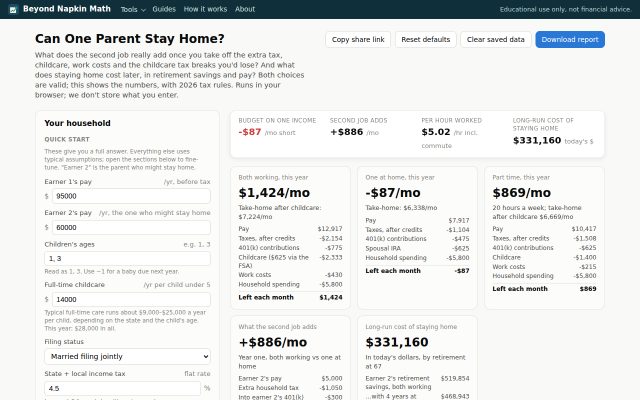
Take a married couple filing jointly in a state with a 4.5% income tax. Earner 1 makes $95,000. Earner 2, the parent who might stay home, makes $60,000 and puts 6% into a 401(k) with a 50% match. They have two children, aged 1 and 3, in full-time care at $14,000 each. They spend $5,800 a month on everything else.
- Salary minus daycare says the second job is worth $60,000 − $28,000 = $32,000 a year.
- After the extra household tax, the 401(k) contribution and $430 a month of work costs, it adds about $10,600 a year, or $886 a month.
- Spread over 48 weeks of 40 hours plus 50 minutes of commuting a day, that's about $5 an hour.
- On one income the household would be about $87 a month short of its spending, counting a $7,500 spousal IRA for the parent at home.
That sounds like a clear case for staying home, until you look at the next few years and the long run. Both are below.
2. The second income is taxed at the top
On a joint return the second income isn't taxed on its own: it sits on top of the first, so its first dollar is taxed at the household's highest bracket. In the example, the household pays about $13,200 of tax on one income and $25,800 on two. The second income adds $12,600 of tax, about 21% of its pay, though on its own a $60,000 salary would pay much less income tax.
Payroll tax is different. Social Security and Medicare (7.65%) are charged on each person's own wages, so they don't stack. The methodology page has a smaller example worked to the dollar.
3. Childcare and the 2026 tax breaks
The 2025 tax law made both childcare tax breaks bigger for 2026, and you can't use both on the same dollars:
- The dependent care FSA now takes up to $7,500 a household from pay before income tax, state tax and FICA (up from $5,000).
- The child and dependent care credit is now 50% of up to $3,000 of care for one child or $6,000 for two or more at the lowest incomes, falling to 35% above $43,000 and to 20% above $206,000 for joint filers. It isn't refundable.
Every FSA dollar shrinks the credit's limit, so it's usually one or the other. For a couple in the 22% bracket the FSA generally wins: in the example it saves about $2,560 against $2,100 for a 35% credit. For a family in the 10% or 12% bracket, the credit often wins. The calculator works out both.
The Child Tax Credit ($2,200 per child under 17 in 2026) usually doesn't change the answer: it's the same on one income or two until joint income passes $400,000.
4. The cost of going to work
A job costs money: the commute, parking, work clothes, lunches, and the takeout and paid help that come with two busy jobs. In the example that's $430 a month. If the family's health insurance comes through the second job, moving to the other parent's plan can cost more, and that counts in favor of keeping the job.
Dividing what's left by the hours worked and commuted gives the second job's hourly rate. A low number isn't a verdict, but it's a fair way to ask whether the job is worth the time it takes.
5. The budget on one income
The second question is simpler: can the household live on one paycheck? Take earner 1's take-home pay and subtract what you spend, leaving out childcare and the work costs that would go away. In the example the gap is under $100 a month, small enough to close by trimming spending.
A one-income household has no backup. If earner 1 lost their job for six months, the example household would be about $2,900 a month short across that year. Two incomes would be short too, but by less than half as much. An emergency fund matters more on one income.
6. The long run: retirement savings and pay
This is where the napkin math misses the most. In the example, staying home until the youngest starts kindergarten (four years) costs:
- about $51,000 of retirement savings by 67, in today's dollars, even with the spousal IRA; and
- about $280,000 of take-home pay over the rest of a career, if earner 2 goes back at 82% of today's pay and never catches up.
The second figure rests on an assumption. One well-known survey found people who took time out came back earning 18% less on average: 11% less after under a year, 37% less after three or more years. Studies of the motherhood wage penalty find smaller effects, around 4–7% per child. Your field matters more than the average, so try your own figure. Social Security is affected too: years with no earnings can lower your own benefit, though a spousal benefit of up to half the other parent's may make up for it.
The picture also changes with time. Childcare is most expensive for babies and toddlers. In the example, the second job adds $886 a month this year but about $1,290 a month on average over the four years, as the older child starts school.
7. The middle path: part time
Part time often looks better than either extreme. In the example, earner 2 working 20 hours a week at the same hourly rate needs only part-time care and keeps the career going. The household has about $870 a month left over on that budget, and the long-run cost falls from $331,000 to about $119,000 compared with working full time, if part time keeps their pay on track. At part-time income the 35% care credit beats the FSA.
8. What the numbers leave out
The biggest thing isn't on any spreadsheet: the value of a parent's time at home, for the children and for the family. The numbers can tell you what it costs. Only you can decide what it's worth. Also worth weighing: the risk of depending on one income and one person's health, state credits, and benefits for children with special needs.
Run your own numbers in the Can One Parent Stay Home? calculator. It shows the household's tax both ways, picks the better childcare tax break, and stress-tests part time, higher childcare costs, a job loss, a longer break and another child.
 Run your own numbers
Can One Parent Stay Home?
What the second job really adds after tax, childcare and work costs.
Open the tool →
Run your own numbers
Can One Parent Stay Home?
What the second job really adds after tax, childcare and work costs.
Open the tool →