Refinancing into a 15-year loan: does it make sense?
A 15-year refinance is the fastest way to cut the interest on a mortgage: a lower rate, and half the time for interest to build up. The price is a higher required payment for 15 years. Whether it's worth it depends on how big the rate discount is and how much you value being able to pay less in a bad month.
1. The example
A $300,000 balance at 7% with 25 years left, paying $2,120 a month in principal and interest. The household is offered a 15-year loan at 5.4% or a 30-year loan at 6%, each with $6,000 of closing costs. 15-year rates are usually lower than 30-year rates; the 0.6-point gap here is an assumption, so use your own quotes.
2. The numbers
| Keep current loan | 15-year at 5.4% | 30-year at 6% | |
|---|---|---|---|
| Monthly payment | $2,120 | $2,435 (+$315) | $1,799 (−$322) |
| Debt-free in | 25 years | 15 years | 30 years |
| Total interest | $336,100 | $138,365 | $347,516 |
| Interest saved vs keeping | – | $197,735 | −$11,416 (more) |
| Ahead after 7 years | – | $32,203 | $14,234 |
| Ahead after 15 years | – | $94,739 | $37,367 |
The 15-year loan saves almost $200,000 of interest and finishes ten years sooner than the current loan, for $315 a month more. The tool's "ahead" figure counts the difference in payments as money that would have earned 4% a year, plus the difference in what you owe. On that measure, the 15-year loan pulls ahead in 16 months and keeps widening the gap.
3. How much is the lower rate worth?
You could take the 30-year loan at 6% and pay $2,435 a month anyway, the same as the 15-year payment. That pays it off in 16 years with $167,300 of interest. The 15-year loan at 5.4% costs $138,365, about $29,000 less, and finishes a year sooner. That $29,000 is the value of the rate discount.
What the 30-year route buys you is flexibility. If income drops, the required payment is $1,799, not $2,435. On the 15-year loan, missing the higher payment is a default.
If the 15-year rate is no lower than the 30-year rate (6% for both), the 15-year payment is $2,532 and the interest saved is $180,417. A 30-year loan with extra payments then gives the same result with more safety.
4. When a 15-year refinance fits
- The higher payment fits comfortably, with an emergency fund and retirement saving untouched.
- The rate discount over a 30-year loan is meaningful, roughly half a point or more.
- You want the loan gone by a date, such as before retirement or before college costs.
- Your job and income are stable.
It's a poor fit if the higher payment would squeeze retirement saving or the employer match, or if your income swings from year to year.
5. Check the break-even too
Any refinance has closing costs to recover. Here the 15-year loan breaks even in 16 months; if you might move within a year or two, the costs may not come back. Our guide When does refinancing pay off? covers the true break-even, and lower payment or same payoff date covers the options on a 30-year loan.
Try it with your numbers
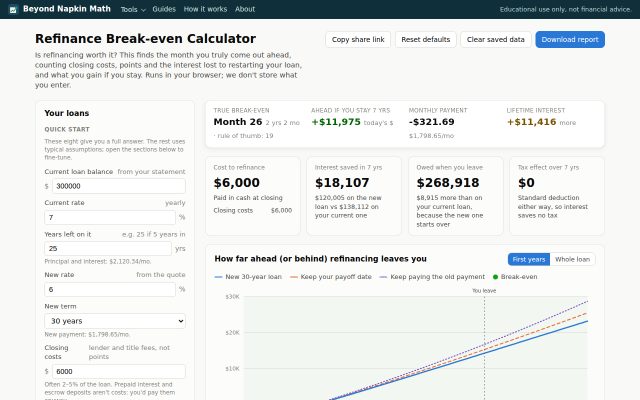
The Refinance Break-even Calculator opens with the 15-year example. Set the new term to 15 or 30 years and enter your quoted rates. It shows the payment, total interest, the true break-even, and how far ahead you'd be at any point. It runs in your browser and we don't store your numbers.
More guides for this tool
- After a refinance: take the lower payment or keep your payoff date?
- When does refinancing pay off? The break-even most calculators get wrong
 Run your own numbers
Refinance Break-even Calculator
The true break-even: closing costs, points and the cost of restarting the clock.
Open the tool →
Run your own numbers
Refinance Break-even Calculator
The true break-even: closing costs, points and the cost of restarting the clock.
Open the tool →