After a refinance: take the lower payment or keep your payoff date?
A refinance that drops your rate a full point lowers the payment, and it's tempting to take the whole drop. But a new 30-year loan also restarts the clock. Take the lower payment on a fresh 30 years and you can end up paying more interest in total than if you'd never refinanced. Here are three ways to use the same new rate, side by side.
1. The example
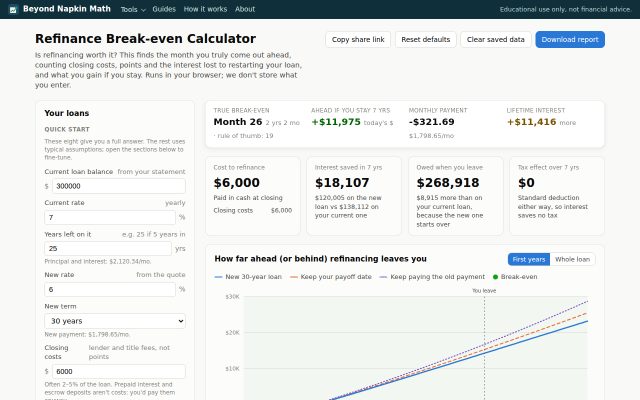
A $300,000 balance at 7% with 25 years left: $2,120 a month in principal and interest, and $336,100 of interest still to come. A new loan at 6% costs $6,000 to close, paid in cash. The household expects to stay at least seven years and doesn't itemize deductions.
2. Three ways to use the new rate
| New 30-year loan | Keep your payoff date (25-year loan) | Keep paying $2,120 | |
|---|---|---|---|
| Monthly payment | $1,799 (−$322) | $1,933 (−$187) | $2,120 (no change) |
| Debt-free in | 30 years | 25 years | 20 years 7 months |
| Total interest | $347,516 | $279,873 | $222,510 |
| Compared with not refinancing | $11,416 more interest | $56,227 less | $113,590 less |
| True break-even | 2 years 2 months | 2 years 2 months | 2 years 1 month |
| Ahead after 7 years | $14,234 | $15,251 | $16,669 |
All three pay back the $6,000 of closing costs in a little over two years, and all three leave you ahead after seven. The difference is the long run. The new 30-year loan spreads the balance over five extra years, so even at a lower rate its total interest is higher than the loan it replaced. Keeping the old payment uses the whole rate cut to pay down principal, finishing more than four years early.
"Ahead after 7 years" counts the lower payments as savings earning 4% a year, plus the difference in what you owe. It's similar for all three, because each option trades a lower payment for a higher balance or the reverse.
3. Which to choose
- Take the lower payment if your budget is tight, or if you'll invest the difference and expect to earn more than 6% on it. Or take it as a safety margin, and pay extra in months when you can.
- Keep your payoff date if you want to be debt-free on schedule, say by retirement, while still lowering the payment.
- Keep the old payment if you were comfortable with it. It's the biggest interest saving and the earliest payoff, and you keep the option to drop to the lower required payment if money gets tight.
You don't need a 25-year loan to keep your payoff date. Most lenders let you pay extra principal on a 30-year loan with no penalty. That gives you the same result with a lower required payment to fall back on. The trade-off: 30-year loans sometimes carry a slightly higher rate than shorter terms.
4. Two traps to avoid
- The quick break-even. Dividing closing costs by the payment drop ($6,000 ÷ $322) says 19 months. The true break-even, counting the interest restart and what you still owe, is 26 months. Our guide When does refinancing pay off? explains why.
- Moving sooner than planned. If you sell in year 2, you're slightly behind ($387) in this example, because you haven't yet earned back the costs.
Try it with your numbers
The Refinance Break-even Calculator opens with this example. Enter your balance, rate, years left and the offer you've been quoted. It shows all three options, the true break-even, and scenarios like moving early or rates falling again. Our guide to a 15-year refinance covers going shorter still. It runs in your browser and we don't store your numbers.
More guides for this tool
- Refinancing into a 15-year loan: does it make sense?
- When does refinancing pay off? The break-even most calculators get wrong
 Run your own numbers
Refinance Break-even Calculator
The true break-even: closing costs, points and the cost of restarting the clock.
Open the tool →
Run your own numbers
Refinance Break-even Calculator
The true break-even: closing costs, points and the cost of restarting the clock.
Open the tool →