How much do you need to retire at 50? A worked example
"Save 25 times your spending" is a fine rule for a retirement that starts at 65. At 50 it understates the number, ignores the money you can't touch until 59½, and says nothing about how far spending, the mortgage or a bad market can push the date. Here is the same question worked through for one example household, so you can see where each piece comes from.
1. The example household
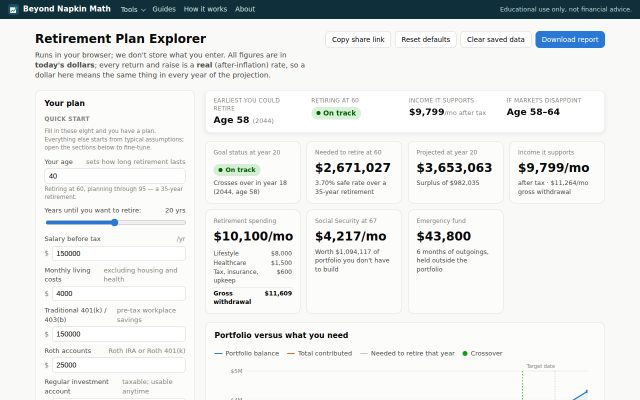
These are the Retirement Plan Explorer's own example numbers, not anyone's real figures. All dollar amounts are in today's dollars, and returns are after inflation.
- Age 40, a $150,000 salary plus a bonus and stock pay, saving about $59,800 in the first year.
- $225,000 saved today: $150,000 in a 401(k), $50,000 in a regular investment account and $25,000 in a Roth IRA.
- A $300,000 mortgage at 6.5%.
- A 6% yearly return after inflation, 13% average tax on retirement withdrawals, and a plan that runs to age 95.
- The retirement goal: $8,000 a month to spend, plus $1,500 a month for health insurance and $600 a month for property tax, insurance and upkeep on the home. That is $121,200 a year.
Retiring at 50 means ten more years of saving and a retirement of 45 years.
2. From the napkin number to the real number
| Step | Savings needed |
|---|---|
| "25 times spending": 25 × $121,200 | $3,030,000 |
| Add the tax you'll pay on withdrawals: you must take out $139,310 to spend $121,200, so 25 × $139,310 | about $3,483,000 |
| Use a lower withdrawal rate for a 45-year retirement: $139,310 ÷ 3.25% (instead of 4%) | about $4,286,000 |
| Subtract the Social Security you can expect from 67 ($3,786 a month in today's dollars) | about $3,417,000 |
The napkin number was about $390,000 too low. Paying tax on withdrawals and planning for 45 years instead of 30 together add about $1.26 million, and Social Security gives back about $870,000. The 4% rule was built around 30-year retirements. A longer retirement has to survive more market cycles, so the tool steps the rate down as the retirement gets longer. Social Security is also smaller than a full-career estimate, because stopping work at 50 leaves seven zero-earning years in the 35-year average the benefit is based on (18 years worked so far, plus 10 more).
3. The target depends on when you stop
| Retire at | Years of retirement | Withdrawal rate | Savings needed | Savings you'd have |
|---|---|---|---|---|
| 45 | 50 | 3.25% | $3.57 million | $0.71 million |
| 50 | 45 | 3.25% | $3.42 million | $1.43 million |
| 55 | 40 | 3.5% | $3.00 million | $2.39 million |
| 58 | 37 | 3.5% | $2.89 million | $3.10 million |
| 60 | 35 | 3.7% | $2.67 million | $3.65 million |
The goal moves down as you wait (a shorter retirement, a higher safe rate, a bigger Social Security check) while the savings move up (more years of contributions and growth). They cross at 58. At $8,000 a month this household can't retire at 50. It is $2 million short.
4. The bridge to 59½
Most of the money is in accounts that charge a 10% penalty before 59½, so retiring at 50 means living on money you can reach for 9½ years. That money is the regular investment account plus the contributions you've put into a Roth IRA (the growth is locked up).
- Spending for 9½ years: about $1.32 million.
- Reachable at 50: about $710,000 ($615,000 in the regular account and $95,000 of Roth contributions).
- Shortfall: about $614,000.
The shortfall shrinks the later you retire: about $149,000 at 52, and nothing at 55. There are ways around it, including the Rule of 55, a 72(t) plan and a Roth conversion ladder, but they need planning years ahead. Our guide to retiring early explains each one. The point here is that a plan can pass the savings test and still fail this one.
5. What moves the date
Earliest year the savings catch the goal, for the same household, changing one thing at a time:
| Change | Earliest retirement age |
|---|---|
| The example as is ($8,000 a month to spend) | 58 |
| Spend $6,000 a month instead | 55 |
| Spend $5,000 a month | 54 |
| Spend $4,000 a month | 52 |
| Spend $3,300 a month | 50 |
| No mortgage (no balance, no payment) | 56 |
| Investments return 7% instead of 6% | 57 |
| Investments return 5% instead of 6% | 59 |
| Fund fees of 1% a year | 59 |
| Health insurance of $1,000 a month in retirement instead of $1,500 | 57 |
| Ignore Social Security altogether | 61 |
Spending is the biggest lever by a wide margin. Cutting the retirement lifestyle from $8,000 to $6,000 a month brings the date forward three years. Getting to 50 takes a lifestyle near $3,300 a month, on top of the health and home costs, or a much higher savings rate than this household has.
6. Bad markets
These dates assume the same return every year, which never happens. In the tool's stress tests, a lost decade of negative returns pushes the age from 58 to 61, and 16 years of zero real return (a 1966-style stagnation) pushes it to 62. Even a plan that spends $5,000 a month slips from 54 to between 56 and 58. If you are aiming at a specific year, plan with the stressed date in mind. Our guide on sequence of returns risk shows why the order of returns matters so much.
7. If 50 is the goal
- Decide what you'd spend in retirement, including health insurance and the costs of the home, before choosing a date.
- Divide by a rate that fits a 45-year retirement, not 4%.
- Subtract a realistic Social Security amount, based on how many working years you'll have.
- Check how much of your savings you can reach before 59½.
- Run the bad-market scenarios and see how many years they add.
Most people who retire at 50 spend a lot less than they did while working, build up a regular investment account, not just a 401(k), or both. If the numbers say 55, that is still 10 years earlier than the usual date.
Try it with your numbers
The Retirement Plan Explorer opens with this example and a retirement date ten years out. Replace the example with your own age, savings, spending and mortgage. It shows the earliest year you reach your goal, whether you can reach the money before 59½, and what the stress tests do to the date. It runs in your browser and we don't store your numbers.
This is an illustration from the tool's example inputs and assumptions, not a forecast or advice. Your own taxes, benefits and returns will differ.
 Run your own numbers
Retirement Plan Explorer
When could you retire? 401(k), Roth and taxable savings, in today's dollars.
Open the tool →
Run your own numbers
Retirement Plan Explorer
When could you retire? 401(k), Roth and taxable savings, in today's dollars.
Open the tool →