Is a 401(k) match worth more than a higher salary?
A 401(k) match is pay. It goes into an account instead of your paycheck, but it's yours once it vests, it isn't taxed until you withdraw it, and on most plans it's a straight percentage of your salary. So a $100,000 job with a generous match can beat a $104,000 job with a thin one. Whether it does depends on two things: whether you save enough to get the match, and whether you stay long enough to keep it.
1. Two offers
- Offer A: $100,000. The employer matches 100% of what you save, up to 6% of pay: $6,000 a year.
- Offer B: $104,000. The employer matches 50% of what you save, up to 4% of pay: $2,080 a year.
Everything else is the same. You're single, save 6% of pay, pay 5% state tax and expect to stay four years.
2. The result
Offer B's paycheck is bigger: about $200 more a month in take-home pay. But Offer A puts $3,920 more a year into your 401(k). Over four years, in today's dollars, Offer A comes out $4,347 ahead. Offer B would need a salary of about $105,492 to tie.
Why the match wins: the extra $4,000 of salary at Offer B is taxed, at roughly 35% for this person: 22% federal, 5% state and 7.65% payroll tax. The match isn't taxed now. So $3,920 of match is worth more than $4,000 of salary.
3. The two things that can flip it
- Vesting. Many plans make you wait before the match is yours. If Offer A's match vested only after a 3-year cliff and you left after two years, you'd forfeit about $12,180, and Offer B would come out $9,827 ahead.
- Your own savings. A match only pays if you save enough to collect it. If you save just 2% of pay, Offer A's match is $2,000 instead of $6,000, and Offer B comes out $7,311 ahead. If you take Offer A, save at least the 6% the match needs.
4. How to read a match formula
- "100% up to 6%" means the employer adds a dollar for every dollar you save, on up to 6% of your pay: a 6% match.
- "50% up to 6%" means 50 cents per dollar on up to 6% of pay: a 3% match. You still have to save 6% to get all of it.
- Non-elective (or "profit-sharing") contributions come whether or not you save.
- Vesting: "immediate", a cliff (all at once after a set number of years), or graded (a share each year). Your own contributions are always 100% yours.
5. What the numbers leave out
The match is retirement money: you can't spend it today without taxes and usually a 10% penalty before 59½. If you need the cash flow now, the higher salary has real value. The calculator values the match at its full amount, as money you keep.
Try it with your numbers
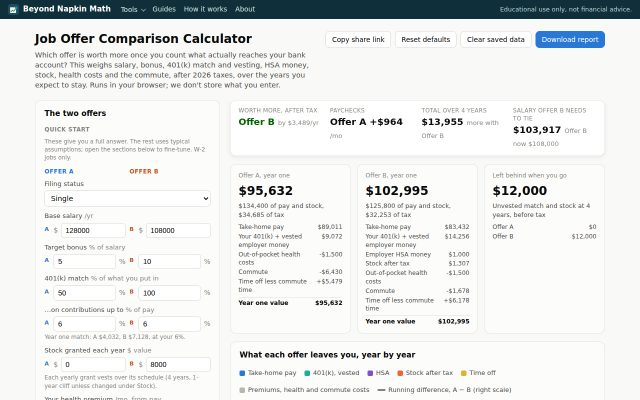
The Job Offer Comparison Calculator opens with these two offers. Enter each offer's salary, match formula and vesting, and your own savings rate. It shows the winner over your stay, what you'd forfeit if you left early, and the salary that would make the offers tie. Our guide to the break-even salary adds bonuses, premiums and the commute. It runs in your browser and we don't store your numbers.
More guides for this tool
- How much more salary do you need to leave? The break-even salary
- How to compare two job offers: the total pay math recruiters skip
- Reading an RSU offer: vesting, tax and what you forfeit if you leave
- Remote job or commute: what a commute really costs
 Run your own numbers
Job Offer Comparison Calculator
Salary is only part of it. Which offer is worth more after tax, vesting and the commute?
Open the tool →
Run your own numbers
Job Offer Comparison Calculator
Salary is only part of it. Which offer is worth more after tax, vesting and the commute?
Open the tool →