Reading an RSU offer: vesting, tax and what you forfeit if you leave
"$130,000 plus $80,000 in RSUs" sounds like $150,000 a year. It isn't, quite. The stock arrives on a schedule, usually nothing for a year, it's taxed as pay when it lands, its value moves with the stock price, and whatever hasn't vested when you leave is gone. Here's how to compare an offer with stock against one paying a higher salary.
1. How RSUs work
- The grant is a dollar amount, converted to a number of shares at the price on the grant date. Here: $80,000.
- Vesting: typically over four years, with a one-year "cliff" (nothing until your first anniversary, then 25%), then a slice every quarter or month.
- Tax: each vest counts as wages at the share price that day, with income and payroll tax, just like salary. Employers usually withhold by selling some shares, often at a flat 22% federal rate that can fall short of what you owe.
- Leaving: unvested shares are forfeited. Vested shares are yours to keep or sell.
2. Two offers
- Offer A: $150,000 salary, no stock.
- Offer B: $130,000 salary plus an $80,000 new-hire grant, vesting over four years with a one-year cliff, then quarterly.
Both have the same 401(k) match and benefits. The stock price is assumed flat.
3. The result, by how long you stay
| If you stay | Stock forfeited at B | Offer A ahead by |
|---|---|---|
| 11 months | All $80,000 | $13,413 |
| 1 year | $60,000 | $1,808 |
| 2 years | $40,000 | $3,982 |
| 4 years (fully vested) | $0 | $9,385 |
Even fully vested, Offer B trails. Its $20,000 a year of stock exactly replaces the $20,000 of salary, but A's higher salary also earns a larger 401(k) match and raises compound on it. And B's paycheck is about $990 a month smaller, because the stock arrives in lumps.
4. The stock price matters more than anything else
| If B's stock price | Over 4 years |
|---|---|
| Falls 40% and stays down | Offer A ahead by $28,635 |
| Stays flat | Offer A ahead by $9,385 |
| Rises 5% a year | Offer A ahead by $3,898 |
| Rises 10% a year | Offer B ahead by $2,056 |
A new-hire grant locks in the share count on day one, so its value follows the stock. With a fast-growing company, B can win. With a falling stock, the offer is worth far less than the headline.
5. Questions to ask about any stock offer
- Is the grant a dollar amount or a number of shares? At what price?
- What's the vesting schedule and cliff? Is there a refresh grant each year, and how big are they typically?
- Is the company public? Private-company stock can't be sold until a sale or IPO, and may never be worth anything.
- What happens to unvested stock if the company is acquired, or if you're laid off?
One rule of thumb is to value stock below its face value, because it's risky and arrives later. The calculator lets you test a price drop directly instead.
Try it with your numbers
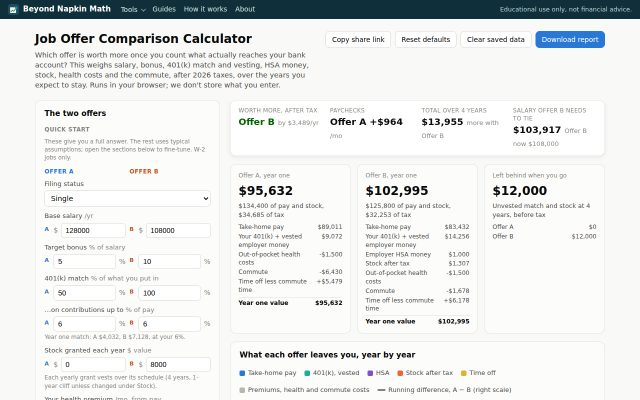
The Job Offer Comparison Calculator opens with these two offers. Enter each offer's grant, vesting schedule, cliff and expected stock growth. It shows the winner over the years you expect to stay, what you'd forfeit if you left early, and what a 40% stock drop would do. Our guide to comparing two job offers covers the rest of the package. It runs in your browser and we don't store your numbers.
More guides for this tool
- How much more salary do you need to leave? The break-even salary
- How to compare two job offers: the total pay math recruiters skip
- Is a 401(k) match worth more than a higher salary?
- Remote job or commute: what a commute really costs
 Run your own numbers
Job Offer Comparison Calculator
Salary is only part of it. Which offer is worth more after tax, vesting and the commute?
Open the tool →
Run your own numbers
Job Offer Comparison Calculator
Salary is only part of it. Which offer is worth more after tax, vesting and the commute?
Open the tool →