How much more salary do you need to leave? The break-even salary
A new offer pays $110,000 against your current $100,000. That's a 10% raise on paper, and the monthly paycheck will be bigger. But salary is only part of what a job pays. Count the bonus, the 401(k) match, health premiums, time off and the commute, and this "raise" leaves you about $12,000 behind over three years. To match your current job, the new one would need to pay about $115,400.
1. The two jobs
| Current job | New offer | |
|---|---|---|
| Salary | $100,000 | $110,000 |
| Bonus | 5% target | None |
| 401(k) match | 100% of the first 5% you save, yours immediately | 50% of the first 6%, yours after 3 years |
| Your health premium | $150 a month | $300 a month |
| Paid time off | 20 days | 15 days |
| Office | Remote | 3 days a week, 30 miles round trip |
The person is single, saves 6% in the 401(k), pays 5% state tax and expects to stay three years.
2. What each job is really worth in year one
| Current job | New offer | |
|---|---|---|
| Take-home pay, after tax, premiums and 401(k) | $71,672 | $73,544 |
| Into your 401(k), including the match | $11,550 | $6,600 plus $3,300 of match you keep only if you stay 3 years |
| Value of paid time off | $5,844 | $4,831 |
| Commuting costs | $0 | −$3,215 |
Take-home pay is higher at the new job, by about $410 a month, which is why offers like this feel good. But the current job puts much more into the 401(k), gives five more days off and costs nothing to get to. Over three years, valued in today's dollars, the current job comes out $11,922 ahead, about $4,000 a year.
The commuting cost uses the IRS standard mileage rate, which covers fuel, wear and depreciation. It doesn't count your time. Value the 141 hours a year at $25 an hour and the gap doubles to about $22,000.
3. The break-even salary
Holding everything else in the new offer the same, it would need to pay $115,389 to tie the current job over three years. That's a 15.4% raise just to stand still. Counting commute time at $25 an hour, it's $120,031.
At $120,000 the new offer pulls ahead by about $10,200 over three years. That's the starting point for a counteroffer or a negotiation.
4. What changes the answer
- How long you'll stay. Leave before the match vests and you lose it. If you left either job at 11 months, the current job would still be ahead, by about $3,400.
- Whether the bonus pays. If the current job's bonus paid only half its target, its lead would shrink to about $6,600.
- Raises. With no raises at the current job, its lead falls to about $4,900.
- Things the numbers miss: career growth, the work itself, the manager, job security. Use the break-even salary to know what you're giving up, not to decide.
5. How to use this in a negotiation
- Write down every part of your current pay, not just salary: bonus history, match and vesting, premium, days off, commute.
- Work out the break-even salary for the new offer.
- Ask for the gap, or for the pieces that close it: a sign-on bonus, more PTO, remote days, or faster vesting.
Try it with your numbers
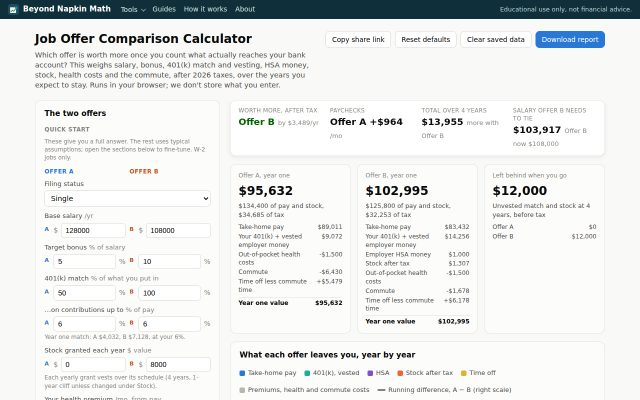
The Job Offer Comparison Calculator opens with this example. Enter your current job as Offer A and the new one as Offer B. It shows each one's take-home pay, retirement money, time off and commute cost, the winner over your stay, and the salary that would make Offer B tie. Our guide to comparing two job offers covers each piece in more depth. It runs in your browser and we don't store your numbers.
More guides for this tool
- How to compare two job offers: the total pay math recruiters skip
- Is a 401(k) match worth more than a higher salary?
- Reading an RSU offer: vesting, tax and what you forfeit if you leave
- Remote job or commute: what a commute really costs
 Run your own numbers
Job Offer Comparison Calculator
Salary is only part of it. Which offer is worth more after tax, vesting and the commute?
Open the tool →
Run your own numbers
Job Offer Comparison Calculator
Salary is only part of it. Which offer is worth more after tax, vesting and the commute?
Open the tool →