How long should you finance a car? 60, 72 or 84 months
Stretching a car loan from 60 to 84 months cuts the payment by about a fifth. It also nearly doubles the interest once the higher rate on longer loans is counted, and leaves you owing more than the car is worth for years. That last part is the one that bites, if the car is totaled or you need to sell it early.
1. Three loans on the same car
A $35,000 car with 6% sales tax and $750 of fees, no trade-in and nothing down: $37,850 to finance. Lenders usually charge more for longer terms, so the example uses a slightly higher rate for each:
| Term | Rate | Monthly payment | Total interest |
|---|---|---|---|
| 60 months | 6.5% | $741 | $6,585 |
| 72 months | 7.0% | $645 | $8,612 |
| 84 months | 8.0% | $590 | $11,705 |
Going from 60 to 84 months saves $151 a month and costs $5,120 more in interest. At the same 6.5% rate, the 84-month loan would still cost about $2,800 more in interest than the 60-month one.
2. Owing more than the car is worth
A new car loses value fastest at the start: here about 15% in the first year and 12% a year after that. A long loan pays down slowly at the start. The gap between the two is negative equity, often called being "upside down":
| End of year | Car's estimated value | Owed, 60 months | Owed, 72 months | Owed, 84 months |
|---|---|---|---|---|
| 1 | $29,750 | $31,228 | $32,589 | $33,647 |
| 2 | $26,180 | $24,163 | $26,948 | $29,095 |
| 3 | $23,038 | $16,625 | $20,899 | $24,165 |
| 4 | $20,274 | $8,582 | $14,413 | $18,826 |
The 60-month loan is upside down for about a year. The 84-month loan is upside down for about three, by as much as $3,900. If the car is totaled in that time, insurance pays its value, not the loan; you'd owe the rest unless you have gap insurance. If you trade it in, the shortfall usually rolls into the next loan, and the next car starts further behind.
3. A down payment does more than a short term
The same car with a $9,000 trade-in and $5,000 down finances $23,310. Even over 84 months at 8%, that loan is never upside down in this example, because the down payment covers the first year's drop in value. Putting 20% down, or trading in a car with equity, protects you more than the term does.
4. When a longer loan can make sense
- A 0% or very low promotional rate. Then the long term costs little or nothing, and the cash you keep can earn more elsewhere. Check whether taking the promotional rate means giving up a cash rebate.
- You'll pay it off early anyway. A long term as a safety net, with extra payments when you can, gives you a lower required payment. Check for prepayment penalties first.
- You'll keep the car well past the loan. Negative equity matters only if you sell, trade or total the car while you're upside down.
If the 60-month payment doesn't fit the budget, that's often a sign the car costs too much, not that the loan is too short. A common guideline is to keep all car payments under 10–15% of take-home pay.
5. What this leaves out
Real depreciation varies widely by model; some trucks and popular models hold value much better than this example. The 2025–2028 car loan interest deduction trims a little of the interest for US-assembled new cars; see the car loan interest deduction.
Try it with your numbers
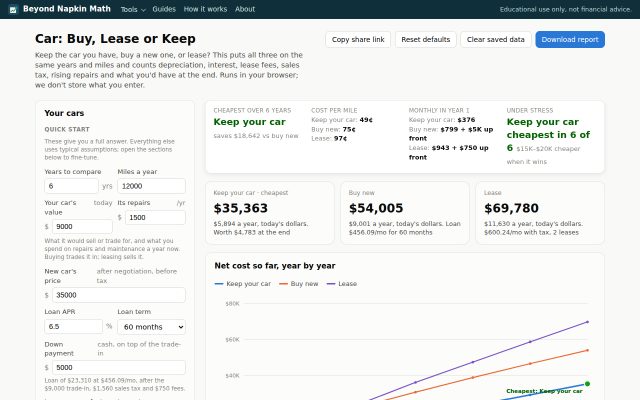
The Buy, Lease or Keep Calculator opens with the 84-month loan. Enter the car's price, your down payment and trade-in, the loan rate and term. It shows the payment, the total interest and, year by year, what the car is worth against what you owe, alongside the cost of leasing or keeping your current car. It runs in your browser and we don't store your numbers.
More guides for this tool
- Buy, lease or keep your car: the true cost per mile of each
- Reading a car lease: the money factor, residual and fees
- The car loan interest deduction (2025 to 2028): who qualifies and what it's worth
- When to stop repairing an old car and replace it
 Run your own numbers
Car: Buy, Lease or Keep
Keep, buy or lease: the true cost per mile of each, over the same years.
Open the tool →
Run your own numbers
Car: Buy, Lease or Keep
Keep, buy or lease: the true cost per mile of each, over the same years.
Open the tool →