When to stop repairing an old car and replace it
A big repair bill makes replacing an old car feel urgent. But a new car's first years cost thousands in depreciation, and a used one isn't free either. The fair question isn't "is this repair worth more than the car?" It's "over the next several years, which costs less: this car's repairs, or a newer car's depreciation, interest and insurance?"
1. The example
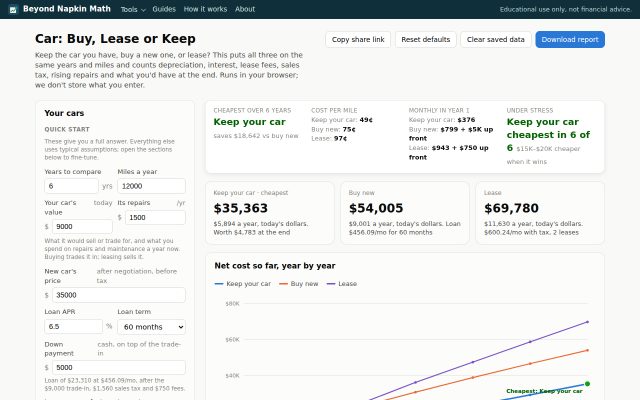
A car worth $9,000 that needs about $1,500 a year in repairs and maintenance, rising 7% a year faster than prices. The alternative is a $35,000 new car with a $5,000 down payment plus the trade-in, financed at 6.5% over 60 months. 12,000 miles a year, over six years, in today's dollars and counting what the cash could have earned:
| Keep the old car | Buy new | |
|---|---|---|
| Total cost over 6 years | $35,363 | $54,628 |
| Per mile | 49¢ | 76¢ |
The new car's biggest cost is depreciation: about $19,000 over six years. Repairs on the old car would have to be very large to match that.
2. Rising repairs: where the new car pulls ahead
| Repairs on the old car this year | Keep, 6 years | Buy new, 6 years |
|---|---|---|
| $1,500 | $35,363 | $54,628 |
| $3,000 | $46,388 | $54,628 |
| $4,500 | $57,413 | $54,628 |
In this example, buying new wins only once the old car needs about $4,100 a year in repairs, rising from there. Against a $22,000 used car, the line is lower, about $2,500 a year, because a used car has already taken the steepest depreciation.
3. One big repair
A single repair is different from steadily rising bills. With the usual $1,500 a year plus one $5,000 repair now, keeping costs $40,713 over six years, still far below buying new. Even an $8,000 repair on this $9,000 car costs less than replacing it, at $43,922. The one-off repair would have to pass about $18,000 before a new car came out ahead, or about $6,900 against the used car.
The "don't spend more than the car is worth" rule ignores that a replacement also costs money. What matters is whether the repair fixes the problem and the rest of the car is sound.
4. Signs it really is time
- Repairs are climbing every year, not one bad bill: several systems failing at once, or the same problem coming back.
- Reliability, not cost: a breakdown would cost you a job shift, a missed appointment or a tow from the highway. That's worth something even when the math says keep.
- Safety: rust in the frame or brake lines, or a car that lacks safety features you now need, such as for a teenage driver.
- Needs have changed: a bigger family, a longer commute, or a car that costs much more to fuel.
5. If you keep it
- Get a second quote on any large repair, and ask an independent mechanic how the rest of the car looks.
- Set aside the money a car payment would cost. When the time comes, it becomes the down payment, which keeps the next loan short. See 60, 72 or 84 months.
- Check whether you still need collision coverage on a car worth a few thousand dollars.
6. What this leaves out
Repair costs are hard to predict, and the calculator uses your estimate with a steady rise. It doesn't count the value of a newer car's comfort, safety features or lower stress, which are real but personal. A $5,000 repair might also raise what the old car would sell for, which the example ignores.
Try it with your numbers
The Buy, Lease or Keep Calculator opens with this car and a $5,000 repair now. Enter what your car is worth, its repair costs and any big repair you're facing, then the newer car you're considering, new or used. It shows the cost of each choice over your timeframe, the year each pulls ahead, and a stress test with another $3,000 repair. See also buy, lease or keep. It runs in your browser and we don't store your numbers.
More guides for this tool
- Buy, lease or keep your car: the true cost per mile of each
- How long should you finance a car? 60, 72 or 84 months
- Reading a car lease: the money factor, residual and fees
- The car loan interest deduction (2025 to 2028): who qualifies and what it's worth
 Run your own numbers
Car: Buy, Lease or Keep
Keep, buy or lease: the true cost per mile of each, over the same years.
Open the tool →
Run your own numbers
Car: Buy, Lease or Keep
Keep, buy or lease: the true cost per mile of each, over the same years.
Open the tool →