Reading a car lease: the money factor, residual and fees
A lease quote usually arrives as one number: a monthly payment. Behind it are a price, a guess about the car's future value, an interest rate written in an odd format, and a few fees. Once you can see those parts, you can check the quote, compare it with buying, and know which number to push on.
1. The parts of a lease
- Capitalized cost: the price of the car in the lease, plus fees rolled in, such as the acquisition fee. Negotiate it exactly as you'd negotiate a purchase price.
- Residual value: what the leasing company expects the car to be worth at the end, as a percentage of the sticker price. It's set by the lessor, not negotiated.
- Money factor: the interest rate, written as a small decimal. Multiply by 2,400 to get an approximate APR: 0.0025 is about 6%.
- Term and mileage: usually 36 months and 10,000 to 15,000 miles a year, with a charge per extra mile.
- Fees: an acquisition fee at the start and a disposition fee when you return the car.
2. How the payment is built
A $35,000 car, a $650 acquisition fee, a 58% residual and a 0.0025 money factor over 36 months:
| Part | Formula | Per month |
|---|---|---|
| Depreciation fee | ($35,650 − $20,300) ÷ 36 | $426.39 |
| Finance fee | ($35,650 + $20,300) × 0.0025 | $139.88 |
| Payment before tax | $566.26 | |
| With 6% sales tax on the payment | $600.24 |
The finance fee looks odd: it charges interest on the capitalized cost plus the residual. That's a shortcut for the average balance over the lease, and it's why the money factor times 2,400 gives roughly the APR.
3. What each number is worth
| Change | Payment before tax | Over 36 months |
|---|---|---|
| The quote above | $566 | |
| Price negotiated $1,500 lower | $521 | $1,635 less |
| Money factor 0.0015 (about 3.6%), a promotional rate | $510 | $2,015 less |
| Money factor marked up to 0.0029 (about 7%) | $589 | $805 more |
| Residual 52% instead of 58% | $619 | $1,911 more |
Dealers can mark up the money factor above the lessor's "buy rate", much as they can mark up a loan rate. Ask for the money factor in writing and compare it with the lessor's published rate for your credit tier. A model with a high residual leases cheaply because you pay for less depreciation.
4. Be wary of a low payment built on cash down
"Cap cost reduction" is cash down on a lease. It lowers the payment, but you're prepaying the depreciation. If the car is stolen or totaled early, gap coverage pays the leasing company, and the cash you put down is usually lost. Many people keep cash down to the first payment and fees.
5. The end of the lease
- Return it: pay the disposition fee (often $300–$400), any excess miles and any damage beyond normal wear.
- Buy it: pay the residual plus a purchase fee. If the car is worth more than the residual, buying it, or selling it to a dealer if the lessor allows, captures the difference.
- Lease again: you start paying for the steepest depreciation again, which is why back-to-back leasing is usually the most expensive way to drive.
6. What this leaves out
States tax leases differently: most tax each payment, some tax the full price up front. Some leases bundle maintenance, which a buyer pays separately. Comparing a lease with buying or keeping needs the whole picture over the same years and miles; our guide to buy, lease or keep does that.
Try it with your numbers
The Buy, Lease or Keep Calculator opens with this lease. Enter the price, residual, money factor, fees and mileage from your quote, or enter the quoted payment directly. It shows the payment, the equivalent APR and the lease's full cost against buying and keeping your car. It runs in your browser and we don't store your numbers.
More guides for this tool
- Buy, lease or keep your car: the true cost per mile of each
- How long should you finance a car? 60, 72 or 84 months
- The car loan interest deduction (2025 to 2028): who qualifies and what it's worth
- When to stop repairing an old car and replace it
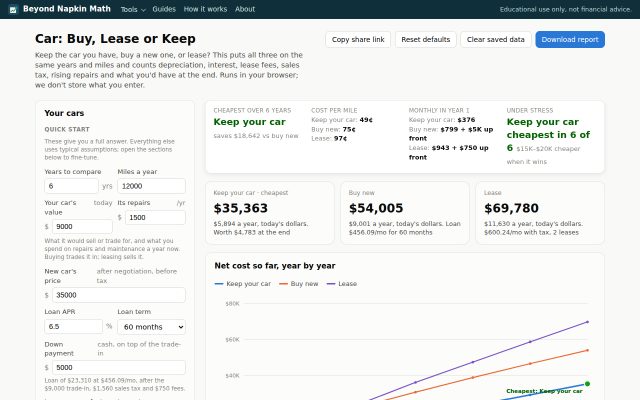 Run your own numbers
Car: Buy, Lease or Keep
Keep, buy or lease: the true cost per mile of each, over the same years.
Open the tool →
Run your own numbers
Car: Buy, Lease or Keep
Keep, buy or lease: the true cost per mile of each, over the same years.
Open the tool →