Dependent care FSA or the child care tax credit? 2026 rules
If you pay for daycare so both parents can work, the tax code gives you two ways to save: a dependent care FSA that takes childcare money out of pay before tax, and a credit for part of what you spend. Both got bigger for 2026. You can't use both on the same dollars, and with $7,500 now allowed in the FSA, it's usually one or the other. Which one wins depends mostly on your tax bracket.
1. The two breaks for 2026
| Dependent care FSA | Child and dependent care credit | |
|---|---|---|
| How it saves | Pay set aside before federal income tax, most state income tax, and the 7.65% Social Security and Medicare tax | A credit against federal income tax |
| How much | Up to $7,500 a household ($3,750 married filing separately), up from $5,000 | A percentage of up to $3,000 of care for one child, $6,000 for two or more |
| Rate | Your own tax rates | 50% at the lowest incomes, falling to 35% above $43,000 of joint income and to 20% above about $206,000 |
| Who offers it | Your employer, if it does; you sign up at open enrollment | Anyone who qualifies, on the tax return |
| Refundable? | Not relevant: it lowers taxable pay | No: it can only cut tax you owe |
Every FSA dollar comes off the credit's $3,000 or $6,000 limit. With two children, a $6,000 FSA or more leaves no room for the credit at all.
2. Which saves more
A married couple filing jointly, two children aged 1 and 3 in full-time daycare at $14,000 each, 4.5% state income tax, 6% of each salary into a 401(k):
| Couple's pay | Credit rate | Credit | $7,500 FSA saves | Better choice |
|---|---|---|---|---|
| $60,000 + $40,000 | 35% | $2,100 | $1,811 | Credit, by $289 |
| $95,000 + $60,000 | 35% | $2,100 | $2,561 | FSA, by $461 |
| $150,000 + $100,000 | 20% | $1,200 | $2,561 | FSA, by $1,361 |
The pattern: in the 12% federal bracket, the credit's 35% beats the FSA's roughly 24% (12% + 7.65% + 4.5%). In the 22% bracket, the FSA saves about 34 cents a dollar on $7,500, which beats 35% on $6,000. Above about $206,000 the credit drops to 20% and the FSA wins easily.
With one child the credit covers only $3,000 of care, so the FSA pulls ahead sooner. At $95,000 + $60,000, the credit is worth $1,050 and the FSA $2,561.
At lower incomes the credit's rate is higher, but it isn't refundable, and it's used before the Child Tax Credit, so it can crowd out part of that credit's refundable amount. At $40,000 + $25,000 the credit still comes out ahead, by about $230. At $30,000 + $20,000 the family owes too little income tax for the credit to help much, and the FSA, which also saves payroll tax, comes out ahead by about $910.
3. Rules for both
- Both parents must work, look for work, be full-time students, or be unable to care for themselves. If one parent stays home, neither break applies. That's one reason the second income is worth more than its paycheck.
- The child must be under 13 (or a dependent who can't care for themselves).
- What counts: daycare, preschool, before- and after-school care, a nanny, and summer day camp. Overnight camp, kindergarten tuition and private school don't.
- Paying a relative counts unless it's your own child under 19, your spouse, or someone you claim as a dependent.
- The lower earner's pay caps both. You can't claim more care costs than the lower-earning spouse made.
- You report the provider's name and tax ID on Form 2441 for either one.
4. FSA catches
- Use it or lose it. Money not spent on care by the plan's deadline is lost. Childcare is predictable, so this is less of a risk than with a health FSA, but plan for a move, a job change or a parent staying home mid-year.
- Paid back as you go. Unlike a health FSA, you can only be reimbursed up to what's been taken from pay so far.
- Changing the amount is allowed after a qualifying event, such as a new child, a change in daycare cost or a spouse's job change.
- Couples share one $7,500 limit, even if both employers offer an FSA.
5. What this leaves out
Many states have their own childcare credits, some refundable, and a few follow the FSA rules differently. The figures above count a flat state tax and no state credit. At the incomes in the table, the Child Tax Credit ($2,200 per child under 17) is the same either way; the calculator works out the overlap at lower incomes.
Try it with your numbers
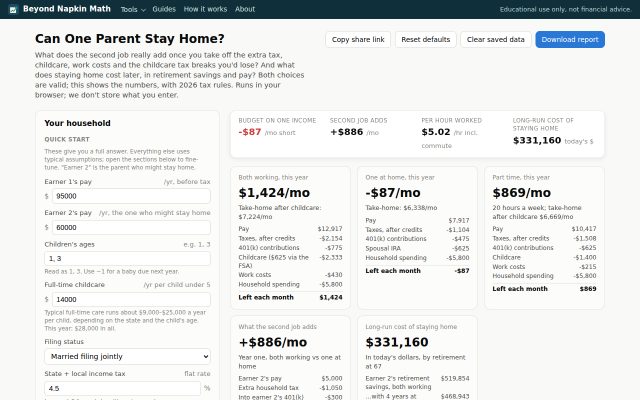
The Stay-at-Home Parent Calculator opens with the $95,000 + $60,000 family and a $7,500 FSA. Enter both salaries, the children's ages, your childcare costs and your FSA amount, and choose "whichever saves more". It shows each break side by side and uses the better one. Our guide to whether one parent can stay home covers the rest. It runs in your browser and we don't store your numbers.
More guides for this tool
- Can we afford for one parent to stay home? The math beyond salary minus daycare
- Staying home with the kids: protecting the at-home parent's retirement
 Run your own numbers
Can One Parent Stay Home?
What the second job really adds after tax, childcare and work costs.
Open the tool →
Run your own numbers
Can One Parent Stay Home?
What the second job really adds after tax, childcare and work costs.
Open the tool →