Staying home with the kids: protecting the at-home parent's retirement
When one parent stops working to stay home with young children, the paycheck stops, and so do that parent's 401(k) contributions, the employer's match and years of Social Security earnings. The cost is easy to miss because it arrives decades later. Here's how big it can be, and the two things that protect the parent at home: a spousal IRA now, and Social Security's spousal and survivor benefits later.
1. The example
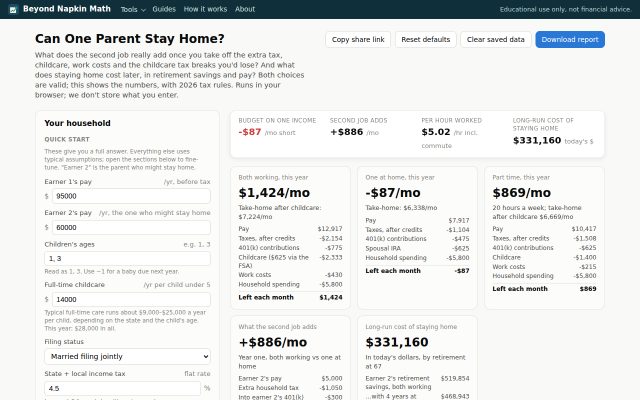
A married couple filing jointly: earner 1 makes $95,000, earner 2 makes $60,000 and puts 6% into a 401(k) with a 50% match, $5,400 a year in total. Earner 2 is 33. Their children are 1 and 3, and earner 2 stays home for four years, until the youngest starts kindergarten. Savings grow at 5% a year after inflation, and all figures are in today's dollars.
2. What four years out costs in retirement savings
| If earner 2... | Retirement savings given up by 67 |
|---|---|
| goes back at the same pay, saving nothing while home | $118,351 |
| goes back at 82% of the old pay, saving nothing while home | $190,622 |
| goes back at 82%, with a $7,500 spousal IRA each year at home | $50,911 |
| goes back at the same pay, with a $7,500 spousal IRA each year | $21,359 more than working throughout |
Four years of $5,400 is $21,600 of contributions. It costs far more than that because each missing dollar would have compounded for 30 years, and because pay that restarts lower means smaller contributions for the rest of a career. Returning at 82% of the old pay also means about $279,000 less take-home pay over that career. That 18% is one survey's average for people who took time out; your field may differ, so test your own figure.
3. The spousal IRA
Normally you need earned income to put money in an IRA. A spousal IRA is the exception: a spouse with little or no pay can contribute based on the working spouse's income.
- Who: married couples filing jointly. The couple's combined pay must cover both spouses' IRA contributions.
- How much: up to $7,500 for 2026 ($8,600 at 50 or older), the same as any IRA. It's in the at-home spouse's name and belongs to them.
- Roth or traditional: either. A traditional IRA deduction can be limited at higher incomes when the working spouse has a workplace plan; a Roth IRA has its own income limits. Check the IRS limits for your year.
- Deadline: the tax filing deadline the following April.
The catch is cash flow. In the example, the family has about $540 a month left on one income. A full $7,500 IRA costs $625 a month, which leaves them about $90 short. $6,000 a year ($500 a month) fits, and still cuts the savings gap from $190,622 to $78,853. Even $4,000 a year cuts it to $116,109.
4. Social Security: years at home and spousal benefits
- Your own benefit is based on your highest 35 years of earnings, adjusted for wage growth. A year with no earnings counts as zero if you have fewer than 35 working years, which lowers the benefit. Four years out matters less if you'll work 35 years anyway.
- You need 40 credits, about ten years of work, for a retirement benefit on your own record.
- The spousal benefit is up to half of the other spouse's full benefit at full retirement age. You get your own benefit or the spousal amount, whichever is higher, not both. Claiming before your full retirement age reduces it.
- The survivor benefit, if a spouse dies, is up to 100% of what that spouse received or was owed. For many couples this matters more than the spousal benefit, and it's a reason for the higher earner to consider delaying their claim.
- Divorce: after at least ten years of marriage, a divorced spouse can claim spousal and survivor benefits on the ex-spouse's record.
Our guide on when to claim Social Security covers the timing.
5. Other protections worth arranging
- Life insurance on both parents. The working parent's income is obvious; the at-home parent's work would cost real money to replace with paid childcare.
- Disability insurance for the working parent, since the household now depends on one paycheck.
- Beneficiaries on the working spouse's 401(k). Federal law generally names the spouse unless they sign a waiver; check IRAs and life policies too.
- A larger emergency fund. One income has no backup.
6. What this leaves out
The calculator doesn't estimate Social Security benefits, and it assumes savings grow at a steady rate. It counts retirement savings only for earner 2; earner 1's 401(k) keeps going in both cases. The money is the couple's in a lasting marriage, but in a divorce or a death, whose name an account is in matters, which is why the spousal IRA is worth stretching for.
Try it with your numbers
The Stay-at-Home Parent Calculator opens with this family and a $7,500 spousal IRA. Enter both salaries, the children's ages, how long you'd stay home and the pay you'd expect on return, then turn the spousal IRA on or off and change its amount. It shows the retirement savings gap at 67, the pay given up, and whether the budget on one income covers the IRA. See also can one parent stay home? It runs in your browser and we don't store your numbers.
More guides for this tool
- Can we afford for one parent to stay home? The math beyond salary minus daycare
- Dependent care FSA or the child care tax credit? 2026 rules
 Run your own numbers
Can One Parent Stay Home?
What the second job really adds after tax, childcare and work costs.
Open the tool →
Run your own numbers
Can One Parent Stay Home?
What the second job really adds after tax, childcare and work costs.
Open the tool →