HSA contribution limits and rules for 2026
For 2026 you can put up to $4,400 into a health savings account with self-only coverage, or $8,750 with family coverage, plus $1,000 more from age 55. Those are the headline numbers. The rules around them decide who can contribute at all, what counts toward the limit, and what happens when you join a plan mid-year, turn 65 or put in too much.
1. The 2026 numbers
| Self-only coverage | Family coverage | |
|---|---|---|
| HSA contribution limit | $4,400 | $8,750 |
| Extra "catch-up" at 55 or older | $1,000 | $1,000 per eligible spouse, in each one's own HSA |
| Plan's minimum deductible | $1,700 | $3,400 |
| Plan's maximum out-of-pocket | $8,500 | $17,000 |
The limits come from IRS Revenue Procedure 2025-19. The $1,000 catch-up is set in the tax code and doesn't rise with inflation.
2. Who can contribute
You can put money into an HSA for any month in which, on the first day of the month:
- you're covered by an HSA-qualified high-deductible plan (it meets the deductible and out-of-pocket limits above, and your enrollment papers say "HSA-eligible");
- you have no other health coverage that pays before the deductible. A general-purpose health FSA counts as other coverage, including your spouse's FSA if it can pay your bills. A limited-purpose FSA for dental and vision is fine;
- you're not enrolled in Medicare;
- nobody can claim you as a dependent.
New for 2026: bronze and catastrophic marketplace plans count as HSA plans, and a direct primary care membership of up to $150 a month ($300 for a family) no longer blocks contributions.
3. Employer money counts toward the limit
The limit covers everything going into the account: your payroll contributions, money you deposit yourself, and your employer's contributions. If your employer puts in $750 on self-only coverage, you can add $3,650. A 56-year-old in the same plan can add $4,650.
How you put it in matters. Through payroll, your contributions skip federal and most state income tax and the 7.65% Social Security and Medicare tax. Paid in directly, you deduct them on your tax return and skip income tax only. For a single filer earning $85,000 with a 5% state tax who adds $3,650:
| How it goes in | Tax saved, age 35 ($3,650) | Tax saved, age 56 ($4,650) |
|---|---|---|
| Through payroll | $1,265 | $1,611 |
| Paid in directly | $986 | $1,256 |
California and New Jersey tax HSA contributions, including the employer's, as state income. The federal and payroll savings still apply there.
4. Joining mid-year, and the last-month rule
The limit is set month by month: if you're eligible for only part of the year, you normally get that fraction of the limit. Seven months of self-only coverage gives 7/12 of $4,400, about $2,567.
The exception is the last-month rule. If you're eligible on December 1, you can contribute the full year's limit. The catch is a testing period: you must stay eligible through December 31 of the next year. If you don't (say you switch to a PPO), the extra amount becomes taxable income and adds a 10% penalty. Use the full-year amount only if you expect to keep an HSA plan through the following year.
5. Married couples
- If either spouse has family coverage, the couple shares one family limit of $8,750, split between their HSAs however they choose.
- Each HSA belongs to one person; there are no joint HSAs. A spouse who is 55 or older adds the $1,000 catch-up to their own HSA, so two spouses over 55 need two accounts to get both.
- If one spouse has a general-purpose FSA that covers the family, neither spouse can contribute.
6. Turning 65 and Medicare
Turning 65 doesn't end contributions; enrolling in Medicare does. If you sign up for Medicare after 65, Part A coverage starts up to six months earlier, which makes contributions for those months excess. Stop contributing six months before you apply. Social Security benefits also enroll you in Part A automatically.
7. Deadline, and putting in too much
- Deadline: you can make 2026 contributions until the tax filing deadline in April 2027. Tell the HSA provider which year a deposit is for. Extensions don't extend this deadline.
- Too much: excess contributions are taxed at 6% for every year they stay in the account. Withdraw the excess and its earnings before your filing deadline and you avoid the 6%; the earnings are taxable.
8. Spending the money
- Medical costs: withdrawals for qualified medical costs are tax-free at any age, including bills from years ago, if they came after you opened the HSA and you kept the receipts.
- Anything else before 65: income tax plus a 20% additional tax.
- Anything else after 65: income tax only, like a traditional 401(k).
- The money is yours. Unlike an FSA, nothing is lost at year end, and the account stays with you when you change jobs. Our guide to HSA vs FSA compares the two.
Try it with your numbers
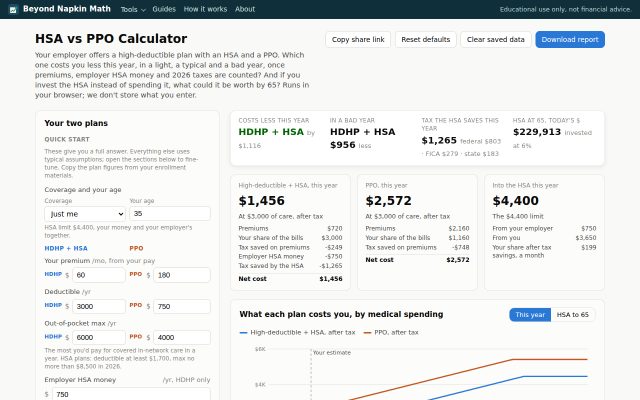
The HSA vs PPO Calculator opens with a 35-year-old putting in the full $4,400, counting the employer's $750. Enter your coverage, age and employer money, and choose payroll or direct contributions. It shows how much you can still add, the tax it saves this year, and what the account could grow to by 65. See also HSA or PPO? It runs in your browser and we don't store your numbers.
More guides for this tool
- HSA or PPO? How to pick, and why an HSA can be the best retirement account you have
- HSA vs FSA: which account to use, and how much to put in
 Run your own numbers
HSA vs PPO Calculator
Which plan costs less this year, and what an invested HSA is worth by 65.
Open the tool →
Run your own numbers
HSA vs PPO Calculator
Which plan costs less this year, and what an invested HSA is worth by 65.
Open the tool →