HSA vs FSA: which account to use, and how much to put in
Both accounts let you pay medical bills with money that skipped income tax and payroll tax, so on a dollar of medical spending they save exactly the same. The differences are everything else: which health plan you need, what happens to money you don't spend, and whether the account stays yours. For most people the choice is made by the health plan they pick, so here's how to compare the whole package.
1. The two side by side
| HSA | Health FSA | |
|---|---|---|
| Health plan needed | An HSA-qualified high-deductible plan | Any plan your employer offers it with |
| 2026 limit | $4,400 self-only, $8,750 family, including employer money; $1,000 more at 55 | $3,400 per employee |
| Money you don't spend | Stays yours, every year | Lost, unless the plan allows a carryover (up to $680 into 2027) or a grace period of up to 2½ months |
| When you can spend it | Only what's been deposited so far | The full year's amount from the first day of the plan year |
| If you leave your job | The account goes with you | Usually ends; unspent money is lost |
| Can it be invested? | Yes, in most HSAs | No |
| Can you change the amount? | Any time | Only at open enrollment or after a life event |
You can't contribute to an HSA while you, or your spouse's plan covering you, have a general-purpose health FSA. A limited-purpose FSA, for dental and vision only, works alongside an HSA.
2. The tax saving is the same
Through payroll, a dollar into either account skips federal income tax, state income tax in most states, and the 7.65% Social Security and Medicare tax. For a single filer earning $85,000 with a 5% state tax, that's about 35 cents on the dollar: $1,000 in either account saves $347.
3. A worked comparison
A 35-year-old earning $85,000 chooses between two employer plans:
- A high-deductible plan with an HSA: $60 a month, a $3,000 deductible, $750 a year of employer HSA money. They put in $2,000 through payroll.
- A PPO with a health FSA: $180 a month, a $750 deductible and $30 copays. They put $1,000 in the FSA.
The year's cost after premiums, bills, employer money and tax:
| Medical care in the year | High-deductible plan + HSA | PPO + $1,000 FSA | PPO, no FSA |
|---|---|---|---|
| None | −$972 (the HSA money and tax saving exceed the premiums) | $2,065 ($1,000 of FSA money lost) | $1,412 |
| $3,000 | $2,028 | $2,225 | $2,572 |
| $8,000 | $3,028 | $3,225 | $3,572 |
The FSA saves $347 whenever it's fully spent. In a year with no care, it costs $653 more than having no FSA at all. And the HSA's $2,750 that wasn't spent on care stays in the account.
4. How much to put in an FSA
Size an FSA to what you'll pay under that plan, not to the total cost of your care. In the example, $3,000 of care costs $1,160 out of pocket on the PPO, after its lower deductible and copays. An FSA of $1,160 is fully used; one of $1,500 would lose $340.
- Start with what's predictable: copays for regular visits, prescriptions, glasses or contacts, planned dental work.
- Check whether your plan has a carryover or a grace period. With the $680 carryover, the $1,000 FSA in a year with no care loses $320, not $1,000.
- Spend down before the deadline on eligible items: many over-the-counter medicines, sunscreen, first-aid supplies, and menstrual products qualify.
- If you might leave your job, remember the FSA's full amount is available on day one. Spending it early and leaving doesn't require paying it back.
5. Why an HSA can be worth much more
Money in an HSA can be invested and stays yours. If this person paid their bills out of pocket, kept the receipts, and invested the $2,750 a year (their $2,000 plus the employer's $750) at 6% a year until 65, the HSA would hold about $136,600 in today's dollars, assuming 2.5% inflation. Kept in cash at 1% it would be about $65,500. An FSA can't do this: it's built to be spent each year.
6. Don't confuse it with a dependent care FSA
A dependent care FSA is a different account, for daycare, preschool and after-school care for children under 13. It has its own limit and works with any health plan, including one with an HSA. See dependent care FSA vs the child care tax credit.
Try it with your numbers
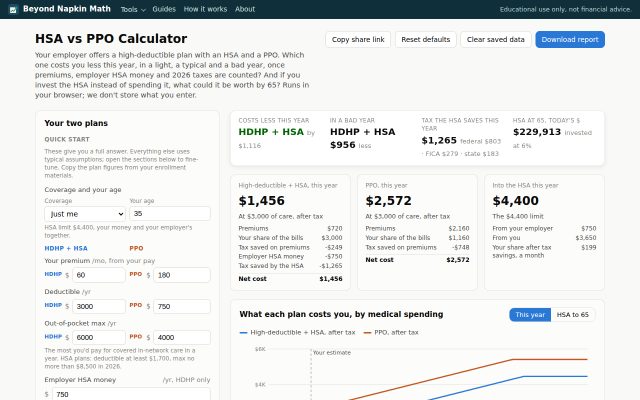
The HSA vs PPO Calculator opens with this example, the PPO paired with a $1,000 FSA. Enter your two plans, your expected care, your FSA amount and its carryover. It shows each plan's cost in a light, expected and bad year, the FSA money at risk, and what the HSA could grow to. See also HSA limits and rules for 2026. It runs in your browser and we don't store your numbers.
More guides for this tool
- HSA contribution limits and rules for 2026
- HSA or PPO? How to pick, and why an HSA can be the best retirement account you have
 Run your own numbers
HSA vs PPO Calculator
Which plan costs less this year, and what an invested HSA is worth by 65.
Open the tool →
Run your own numbers
HSA vs PPO Calculator
Which plan costs less this year, and what an invested HSA is worth by 65.
Open the tool →