"Rent is throwing money away": what the numbers say
"Why pay your landlord's mortgage when you could pay your own?" It sounds right, because rent is money you never see again. But most of an owner's payment in the early years isn't building anything either. The fair comparison is what each household spends that it doesn't get back, and what each ends up owning.
1. The example
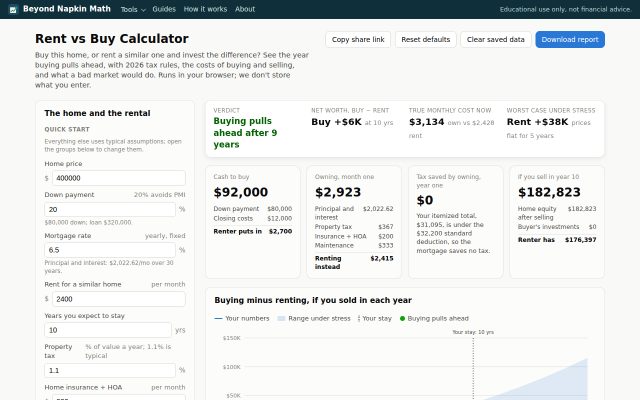
A $400,000 home bought with 20% down and a 6.5%, 30-year loan, compared with renting a similar home for $2,400 a month. The household is married, filing jointly, with $120,000 of income. Both home prices and rents grow 3% a year, investments earn 7%, and the renter invests the down payment and any monthly savings.
2. Year one: money each side doesn't get back
| Owner, per month | Renter, per month | ||
|---|---|---|---|
| Mortgage interest | $1,725 | Rent | $2,400 |
| Property tax | $367 | Renter's insurance | $15 |
| Maintenance (1% of value a year) | $333 | ||
| Insurance and HOA | $200 | ||
| Total gone | $2,625 | Total gone | $2,415 |
The owner also pays about $298 a month of principal. That's the part of the payment that builds equity in year one, about 15% of the $2,023 mortgage payment.
There's a hidden cost too. The owner's $92,000 of down payment and closing costs could have been invested. Counting what that money would have earned after tax, the owner's true monthly cost in year one is about $3,134, against the renter's $2,428. Mortgage interest doesn't save this household any tax: its itemized deductions ($31,095) fall short of the $32,200 standard deduction.
3. So when does owning win?
Owning pulls ahead because the home grows in value, the loan is paid down, the payment stays fixed while rent rises, and the gain on sale is mostly tax-free. Those effects build over time, against the upfront hit of closing costs and the selling costs at the end.
| If you sell after | Owner ahead by (today's dollars) |
|---|---|
| 3 years | −$24,880 (the renter is ahead) |
| 5 years | −$16,849 |
| 7 years | −$8,112 |
| 10 years | +$6,427 |
| 15 years | +$34,974 |
In this example owning breaks even in year 9, and only if the renter actually invests the difference. A renter who spends it loses the comparison much sooner.
4. What moves the answer
- The rent for a comparable home. At $2,800 a month, owning breaks even in year 5. At $2,000, renting stays ahead for decades.
- Home price growth. At 4% a year, the break-even is year 5. At 2%, it's year 18.
- The mortgage rate. At 5.5%, the break-even is year 6.
- What investments earn. If they earn 5% instead of 7%, owning breaks even in year 6, because the renter's alternative is weaker.
5. The real answer
Rent isn't throwing money away; it's paying for housing, just like an owner's interest, tax and upkeep. Renting wins for short stays, or where rents are low relative to prices. Owning wins for long stays, in places where rents are high compared with prices, and for people who wouldn't invest the difference anyway. Owning also brings things the numbers miss: stability and control over your home. Renting brings flexibility and no surprise repair bills. Our guide Rent or buy in 2026 goes further into the costs and taxes.
Try it with your numbers
The Rent vs Buy Calculator opens with this example. Enter the home you're looking at and the rent for a similar place. It shows the year buying pulls ahead, the true monthly cost of each path, and stress tests: flat prices, a price drop, a forced early sale. It runs in your browser and we don't store your numbers.
More guides for this tool
- Does buying a home save tax in 2026? The itemizing test
- Rent or buy in 2026: why the break-even is longer than you think
- Should you buy a home if you'll only stay five years?
 Run your own numbers
Rent vs Buy Calculator
After how many years does buying beat renting and investing the difference?
Open the tool →
Run your own numbers
Rent vs Buy Calculator
After how many years does buying beat renting and investing the difference?
Open the tool →