Should you buy a home if you'll only stay five years?
The old advice says don't buy unless you'll stay at least five years. The math behind it is real: buying and selling a home costs 8–10% of the price, and in five years a home rarely grows enough to cover that. Here's how far behind a five-year owner usually ends up, and what would have to be true for buying to win.
1. The example
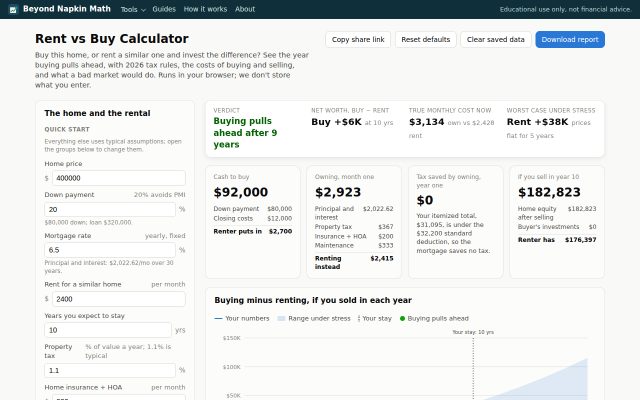
A $400,000 home with 20% down and a 6.5% loan, against renting a similar home for $2,400 a month. Prices and rents grow 3% a year, investments earn 7%, and the renter invests the down payment and the monthly difference.
2. Where the owner stands after five years
Selling after five years, the owner is about $16,800 behind the renter in today's dollars. After three years it's about $24,900 behind; after seven, about $8,100. Here owning only breaks even in year 9.
The reason is transaction costs. Buying costs about 3% in closing costs ($12,000 here), and selling about 6% in agent fees and seller costs (about $28,000 on the home's value after five years). Together that's roughly $40,000 the owner has to make back before coming out ahead. Early in a loan, most of the payment is interest, so equity grows slowly: about $20,000 of principal paid off in the first five years.
3. When five years can work
Each of these, on its own, brings the break-even to about five or six years:
- Rent is high for the price. At $2,800 a month instead of $2,400, owning breaks even in year 5.
- Prices grow faster. At 4% a year instead of 3%, the break-even is year 5.
- A lower mortgage rate. At 5.5% instead of 6.5%, it's year 6.
- A weaker alternative. If the renter's investments earn 5% instead of 7%, it's year 6.
Without one of those, a five-year stay is usually a bet on the local market rather than a sure win.
4. The risks of a short stay
The tool's stress tests on the same home show how fragile a short stay is:
- A forced sale in year 3: about $24,900 behind.
- Prices fall 10% in year one, then grow again: over 10 years the owner ends about $31,800 behind instead of $6,400 ahead.
- Prices flat for five years: about $38,200 behind after 10 years.
The shorter the stay, the less time a bad start has to recover.
5. Tax rules for a short stay
If you sell your main home after owning and living in it for at least 2 of the last 5 years, up to $250,000 of gain ($500,000 for a married couple) is tax-free. Sell sooner and the gain may be taxable, though partial exclusions exist for job moves, health and some other reasons. Our guide to selling or renting out your old home covers what happens if you keep it as a rental instead.
6. If you're unsure how long you'll stay
- Rent first in a new city, then buy once you know the area and your job is settled.
- Buy below your budget, so a sale in a soft market doesn't wipe out your savings.
- Check what the home would rent for. If renting it out covers the costs, a move doesn't force a sale.
Try it with your numbers
The Rent vs Buy Calculator opens with this example and a five-year stay. Change the years you expect to stay, the home and the rent, and it shows who is ahead at that point, the year buying pulls ahead, and the stress tests. Our guide "Rent is throwing money away" explains the costs on each side. It runs in your browser and we don't store your numbers.
More guides for this tool
- "Rent is throwing money away": what the numbers say
- Does buying a home save tax in 2026? The itemizing test
- Rent or buy in 2026: why the break-even is longer than you think
 Run your own numbers
Rent vs Buy Calculator
After how many years does buying beat renting and investing the difference?
Open the tool →
Run your own numbers
Rent vs Buy Calculator
After how many years does buying beat renting and investing the difference?
Open the tool →