Is Social Security taxable? How the 85% rule works
Some retirees pay no tax on their Social Security, and some pay tax on 85% of it. Nobody pays tax on all of it. Where you land depends on your other income, through a formula written in 1983 whose dollar thresholds have never been raised for inflation, so each year more retirees cross them.
1. The test: "provisional income"
Add up:
- your other taxable income: pensions, IRA and 401(k) withdrawals, wages, interest, dividends, capital gains;
- tax-exempt interest, such as from municipal bonds (yes, it counts here);
- half of your Social Security benefits.
Then compare the total with two thresholds:
| Provisional income | Single or head of household | Married filing jointly |
|---|---|---|
| No benefits taxed | Below $25,000 | Below $32,000 |
| Up to 50% taxed | $25,000 to $34,000 | $32,000 to $44,000 |
| Up to 85% taxed | Above $34,000 | Above $44,000 |
"Up to 85% taxed" means up to 85% of your benefits are added to taxable income, then taxed at your normal rates. It doesn't mean an 85% tax. Married people filing separately who lived together during the year generally have 85% of benefits taxable from the first dollar.
2. What it looks like at different incomes
A single retiree, 65 or older, receiving $24,000 a year ($2,000 a month), in 2026:
| Other income | Benefits taxable | Share taxable | Federal tax the benefits add |
|---|---|---|---|
| $10,000 | $0 | 0% | $0 |
| $20,000 | $3,500 | 15% | $0 |
| $30,000 | $11,300 | 47% | $1,225 |
| $40,000 | $19,800 | 83% | $2,376 |
| $60,000 | $20,400 | 85% | $3,104 |
A married couple, both 65 or older, receiving $36,000 a year between them, has none taxable with $10,000 of other income, 26% with $30,000 (no tax added in 2026), 50% with $40,000 ($1,040 of tax) and the full 85% from about $60,000.
3. The "tax torpedo": a 22% rate in the 12% bracket
In the range where benefits are becoming taxable, each extra dollar of other income also makes 50 or 85 cents of Social Security taxable. For the single retiree above, with $30,000 to $40,000 of other income and in the 12% bracket, each extra $1,000 of IRA withdrawal adds about $222 of federal tax: a 22.2% rate. Above the range, once 85% of benefits are taxable, it drops back to 12%.
That matters for planning:
- Roth money doesn't count. Withdrawals from a Roth IRA aren't in provisional income. Roth conversions in the years before claiming Social Security can lower the tax on benefits later.
- Delaying Social Security and living on IRA withdrawals first can mean less of the larger benefit is taxed later.
- Timing big withdrawals or capital gains into one year, rather than spreading them, can keep other years below the thresholds.
4. The 2025–2028 senior deduction
The 2025 tax law added a deduction of $6,000 per person 65 or older for 2025 through 2028, whether or not you itemize. It phases out by 6% of modified AGI above $75,000 ($150,000 joint). It doesn't change how much of your benefit is taxable, but it lowers the tax on it, which is why the couple above owes nothing extra with $30,000 of other income. From 2029, when the deduction is due to end, the same couple would owe about $390 more. It's sometimes described as "no tax on Social Security"; it isn't, but for many middle-income retirees it has the same effect for four years.
5. State tax
Most states don't tax Social Security. A handful do, usually with their own exemptions by age or income. Check your state's rules; the calculator lets you enter a flat state rate on the taxable part.
6. Paying the tax
Nothing is withheld unless you ask. File Form W-4V with Social Security to have 7%, 10%, 12% or 22% withheld from each payment, or make quarterly estimated payments. Otherwise a tax bill and possibly an underpayment penalty arrive in April.
What this leaves out
The figures use the 2026 federal brackets and standard deduction, the extra deduction for those 65 and older, and the senior deduction, with no other deductions or credits. Medicare premiums are a separate issue: higher incomes pay more for Parts B and D, based on income from two years earlier.
Try it with your numbers
The Social Security Claiming Calculator opens with a single retiree with a $2,000 benefit at 67 and $30,000 of other income. Enter your benefit, your other income, any tax-exempt interest and your state's rate. It shows the tax on your benefits for each claiming age, after the tax, so you can see how the timing changes it. Our guide on when to claim Social Security covers the claiming decision. It runs in your browser and we don't store your numbers.
More guides for this tool
- Claiming Social Security while still working: the earnings test
- Social Security spouse and survivor benefits: what your spouse gets, and keeps
- When to claim Social Security: the break-even age is the wrong question
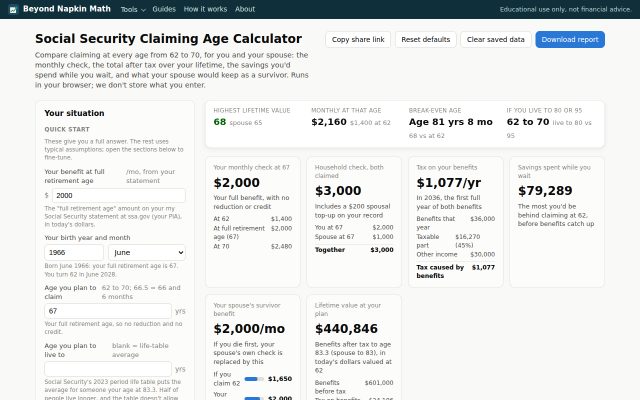 Run your own numbers
Social Security Claiming Age Calculator
62, 67 or 70? Every claiming age compared after tax, for both of you.
Open the tool →
Run your own numbers
Social Security Claiming Age Calculator
62, 67 or 70? Every claiming age compared after tax, for both of you.
Open the tool →