Social Security spouse and survivor benefits: what your spouse gets, and keeps
For a married couple, Social Security is really two decisions that affect each other. The lower earner may get a spousal benefit based on the higher earner's record, and whichever spouse outlives the other keeps the larger of the two benefits. That second rule makes the higher earner's claiming age a decision about the survivor's income, possibly for decades.
1. The example
Two spouses with full retirement age 67. One has a full benefit (the "primary insurance amount") of $2,000 a month; the other worked fewer years and has $800. All figures are monthly, in today's dollars.
2. The spousal benefit: up to half
A spouse can receive up to 50% of the other spouse's full benefit, here $1,000. It isn't added on top of their own benefit: they get their own $800 plus a top-up of $200. Rules that shape it:
- The other spouse must have claimed before the spousal top-up can start.
- It's reduced for claiming early, by 25/36 of 1% a month for the first 36 months and 5/12 of 1% after that. It gets no increase for waiting past full retirement age.
- You file for both at once. Since 2015 rules, applying for one is treated as applying for both ("deemed filing"). You can't take the spousal benefit and let your own grow.
| Lower earner claims at | Own benefit | Spousal top-up | Total |
|---|---|---|---|
| 62 | $560 | $130 | $690 |
| 64 | $640 | $150 | $790 |
| 67 | $800 | $200 | $1,000 |
Delaying past 67 raises only the lower earner's own $800, so for a spouse whose own benefit is small, waiting beyond full retirement age adds little.
3. The survivor benefit: up to all of it
When one spouse dies, the survivor keeps the larger of the two checks. The smaller one stops. If the higher earner dies first, the survivor's income depends on when the higher earner claimed:
| Higher earner claimed at | Their benefit | Survivor receives |
|---|---|---|
| 62 | $1,400 | $1,650 |
| 67 | $2,000 | $2,000 |
| 70 | $2,480 | $2,480 |
A survivor at full retirement age gets what the deceased was receiving, but never less than 82.5% of their full benefit; that's why claiming at 62 still leaves $1,650. Waiting to 70 gives the survivor $830 a month more than claiming at 62, for life.
Two more rules: a survivor can claim as early as 60 at a reduced 71.5% (survivor full retirement age is slightly earlier than for retirement benefits), and can take the survivor benefit while letting their own grow, or the other way round, because deemed filing doesn't apply to survivor benefits.
4. So who should wait?
The higher earner's benefit lasts as long as either spouse is alive. That's why couples often have the higher earner delay and the lower earner claim earlier. In the calculator, with average life expectancies (about 83), the best combination for this couple is the higher earner at 68 and the lower earner at 65. If both expect to live to 95, it's both at 70; if both expect to die around 80, it's both at 62.
Claiming early can still make sense: poor health for the higher earner and a much younger, healthy spouse point opposite ways, and only your own numbers settle it. But a higher earner who claims at 62 "because I might not live long" is often shrinking the survivor's income, not just their own.
5. Divorced, widowed and remarried
- Divorced spouses married at least 10 years can claim spousal and survivor benefits on an ex-spouse's record without affecting the ex or a new spouse. If the ex hasn't claimed, a divorced spouse can still claim once divorced at least two years.
- Remarriage before 60 generally ends survivor benefits from a previous spouse; remarrying at 60 or later doesn't.
- Government pensions: the Social Security Fairness Act of 2025 repealed the rules that reduced spousal and survivor benefits for people with pensions from work not covered by Social Security.
What this leaves out
The example assumes both spouses have full retirement age 67 and the higher earner claims before the lower earner starts the spousal top-up. Disability, children's benefits and the one-time $255 death payment aren't covered. The calculator shows what each claiming pair is worth over your expected lifespans, after tax.
Try it with your numbers
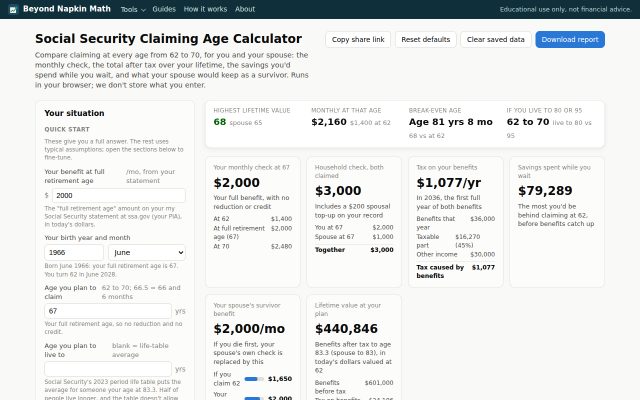
The Social Security Claiming Calculator opens with this couple. Enter both benefits from your Social Security statements (at ssa.gov/myaccount), birth dates and expected lifespans. It finds the best claiming age for each of you, shows what the survivor would receive under each plan, and how the answer changes if you live to 80 or 95. Our guide on when to claim Social Security covers a single claimer. It runs in your browser and we don't store your numbers.
More guides for this tool
- Claiming Social Security while still working: the earnings test
- Is Social Security taxable? How the 85% rule works
- When to claim Social Security: the break-even age is the wrong question
 Run your own numbers
Social Security Claiming Age Calculator
62, 67 or 70? Every claiming age compared after tax, for both of you.
Open the tool →
Run your own numbers
Social Security Claiming Age Calculator
62, 67 or 70? Every claiming age compared after tax, for both of you.
Open the tool →