Claiming Social Security while still working: the earnings test
If you claim Social Security before your full retirement age and keep working, Social Security may hold back some of your checks. It feels like a penalty, and it's often described as one. It isn't, quite: the months held back are added back to your benefit once you reach full retirement age. But it can make claiming early while working nearly pointless, and it catches people by surprise.
1. The 2026 limits
| When | Earnings limit | Benefits held back |
|---|---|---|
| Years before the year you reach full retirement age | $24,480 | $1 for every $2 you earn above it |
| The year you reach full retirement age, until the month you reach it | $65,160 | $1 for every $3 above it, counting only earnings before that month |
| From the month you reach full retirement age | No limit | Nothing |
Only wages and self-employment income count. Pensions, IRA withdrawals, investment income and rental income don't. Full retirement age is 67 for anyone born in 1960 or later.
2. How the holding back works
Social Security doesn't trim each check. It works out the year's total to hold back, then withholds whole monthly checks starting in January until that total is covered. Anything over-withheld comes back the following January.
Take someone with a $2,000 full benefit who claims at 62, getting $1,400 a month, and earns $40,000 a year until 66:
- Earnings over the limit: $40,000 − $24,480 = $15,520. Held back: half, $7,760.
- That's covered by six checks of $1,400 ($8,400). The other $640 comes back the next January.
- So instead of $16,800 a year, they receive $8,400 in the first year and about $9,040 in each of the next three.
| Earnings while working (62 to 66) | Checks held back | Benefit from 67 |
|---|---|---|
| None | None | $1,400 a month |
| $30,000 a year | 8 in total | $1,467 a month |
| $40,000 a year | 24 in total | $1,600 a month |
| $60,000 a year | All 48 | $1,867 a month |
3. Why it isn't lost money
At full retirement age, Social Security recalculates your benefit as if you'd claimed later by the number of months held back. In the $40,000 case, 24 months were held back, so from 67 the benefit is worked out as if claimed at 64: $1,600 a month, for life, instead of $1,400. At $60,000, every check from 62 to 66 was held back, so it's as if they'd claimed at 66.
Whether that's a fair trade depends on how long you live. The recalculation pays back the withheld money over about 12 to 15 years after full retirement age. But if every check is held back anyway, claiming early gave you nothing except a smaller benefit than waiting would have, and the early claim also locks in a lower survivor benefit for a spouse.
4. The first-year exception
In the first year you claim, there's a monthly test as well as the yearly one. For any month you earn no more than $2,040 (one twelfth of $24,480) and don't do substantial work in your own business, you get the full check, whatever you earned earlier in the year. It helps people who retire mid-year after a full salary.
5. What to do
- If you'll keep earning well above the limit, claiming before full retirement age mostly just shrinks your benefit. Waiting is usually simpler and better.
- If you'll earn a little over the limit, claiming early can still make sense; the withholding is modest and returns at full retirement age.
- Tell Social Security your expected earnings when you claim, and update them if they change, so the withholding is right and you don't get an overpayment notice later.
- Spousal and family benefits on your record are held back too. A spouse's own earnings only affect their own benefits.
What this leaves out
The limits rise each year with average wages. The example ignores cost-of-living increases and tax. Social Security's rules for self-employment income, and for when you're considered retired in your first year, have more detail than fits here.
Try it with your numbers
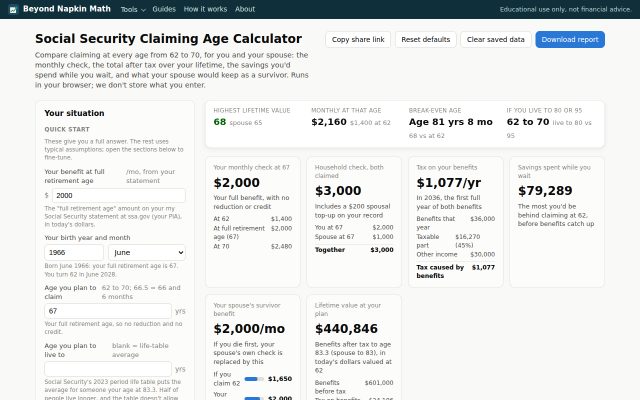
The Social Security Claiming Calculator opens with this example: a $2,000 benefit claimed at 62 while earning $40,000 until 66. Enter your benefit, your earnings and when you'll stop working. It shows the checks held back each year, the recalculated benefit at full retirement age, and how working changes the best age to claim. Our guide on when to claim Social Security covers the rest. It runs in your browser and we don't store your numbers.
More guides for this tool
- Is Social Security taxable? How the 85% rule works
- Social Security spouse and survivor benefits: what your spouse gets, and keeps
- When to claim Social Security: the break-even age is the wrong question
 Run your own numbers
Social Security Claiming Age Calculator
62, 67 or 70? Every claiming age compared after tax, for both of you.
Open the tool →
Run your own numbers
Social Security Claiming Age Calculator
62, 67 or 70? Every claiming age compared after tax, for both of you.
Open the tool →