The 1% rule is napkin math. What to check instead
The 1% rule says a rental is worth a look if the monthly rent is at least 1% of the price: $1,500 a month for a $150,000 house. It's quick, and that's its only virtue. It says nothing about the costs, which can differ by thousands of dollars a year between two houses with the same rent. Here are two houses where the rule gets it backwards.
1. Two houses, two verdicts
Both are bought with 25% down and a 30-year loan at 7.25%, with one point and 2.5% closing costs. Both assume rents rise 3% a year and values 3% a year, and both are held for 10 years. Only the house and its costs differ.
| House A | House B | |
|---|---|---|
| Price | $140,000, plus $8,000 of repairs | $300,000 |
| Monthly rent | $1,450 | $2,600 |
| Rent ÷ price | 1.04%: passes | 0.87%: fails |
| Property tax | 2.0% of the price ($2,800 a year) | 0.6% ($1,800 a year) |
| Insurance | $2,200 a year | $1,300 a year |
| Vacancy, maintenance, big-repair reserve and management, as % of rent | 10%, 10%, 12%, 10% (an older house) | 5%, 5%, 6%, 8% (a newer house) |
What the Rental Property Analyzer makes of them:
| House A | House B | |
|---|---|---|
| Cash flow after all costs and the mortgage | −$230 a month | +$227 a month |
| Cap rate | 5.1% | 7.5% |
| Cash-on-cash return | −5.8% | 3.2% |
| Debt coverage (DSCR) | 0.90 | 1.25 |
| Return over 10 years, after tax (IRR) | 2.6% | 10.4% |
| Rent needed just to break even | $1,826 (1.30% of the price) | $2,305 (0.77% of the price) |
The house that passes the rule loses $230 a month. To break even it would need rent of 1.30% of its price. The house that fails the rule pays its way, and would still break even at 0.77%. If those terms are new, our guide to cap rate, cash-on-cash, DSCR and IRR explains each one.
2. Why: the costs the rule can't see
- Property tax and insurance. House A's tax and insurance come to $5,000 a year, 31% of the rent it collects. House B's come to $3,100, about 10%. Property tax rates vary several-fold from one county to the next, and insurance varies with storms, fire risk and the age of the roof. Neither changes with the rent.
- The age and condition of the house. An older house needs more repairs and sooner replacements of roofs, furnaces and plumbing. That is why House A's budgets for repairs and the big-repair reserve are higher. Our guide to budgeting for vacancy, repairs and capex shows how to set them.
- Vacancy and tenant quality. Cheaper houses often see more turnover and more unpaid rent.
3. It's the costs, not the house
To prove the point, swap the cost assumptions. Give House A the costs of a typical, average-condition house (1.1% property tax, $1,650 insurance, and 6%, 6%, 8% and 9% for vacancy, repairs, reserve and management). It turns to +$85 a month and an 8.5% return after tax. Give House B those same typical costs and it slips to −$47 a month, with a 7.4% return.
Same prices, same rents, and the verdicts flip on cost lines the 1% rule never looks at.
4. What else the rule misses
- Your interest rate. If House B's rate were 2 points higher, its cash flow would drop from +$227 to −$89 a month. The 1% rule gives the same answer at 3% or at 9%.
- Your down payment. More money down means a smaller payment and better cash flow, but a lower return on your cash.
- Appreciation and taxes. Over 10 years, both matter as much as cash flow. Depreciation in particular can turn a small cash profit into a loss on paper, which our depreciation guide explains.
- Reassessment. In many places, buying a house resets its property tax to the new price. The seller's tax bill isn't yours.
5. What to check instead
- Get the real fixed costs: the property tax at your purchase price, an insurance quote, and any HOA dues.
- Budget honestly for the variable costs: vacancy, repairs, a reserve for big replacements, and management, even if you plan to manage it yourself.
- Work out cash flow after the mortgage and all of those, not before.
- Check the debt coverage, which shows how much room you have if rent falls or costs rise.
- Run the stress tests: a higher rate, lower rent, more vacancy, higher costs.
Use the 1% rule, if at all, to sort listings, never to decide. In these examples, even the low-cost house needed rent of about 0.77% of its price just to break even at a 7.25% rate, so a listing far below that is unlikely to pay its way with a loan. A house over 1% still has to pass every step above.
Try it with your numbers
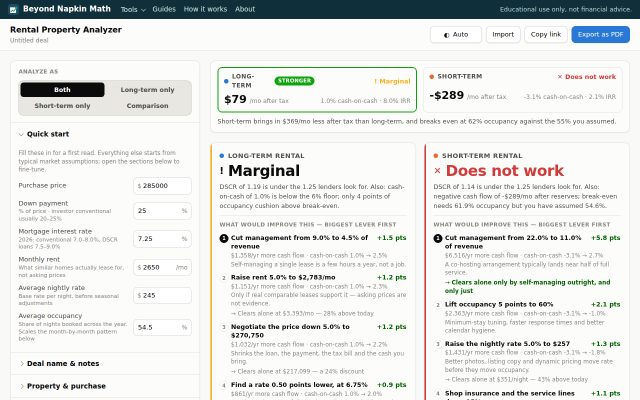
Open House A or House B in the Rental Property Analyzer, then replace the numbers with a listing you're looking at. Its scorecard shows the rent-to-price ratio next to the numbers that matter, and its stress tests show what would break the deal. It runs in your browser and we don't store your numbers.
These are made-up examples, not real listings. Your taxes, insurance and costs will differ.
 Run your own numbers
Rental Property Analyzer
Long-term vs short-term rental: cash flow, returns and taxes, side by side.
Open the tool →
Run your own numbers
Rental Property Analyzer
Long-term vs short-term rental: cash flow, returns and taxes, side by side.
Open the tool →