Is a balance transfer worth it? Fees, promo deadlines and the day it expires
A 0% balance transfer can cut the interest on credit card debt to almost nothing, for a fee of 3% to 5%. It pays off when you clear the balance before the promotion ends. It backfires when the deadline passes with most of the debt still there, now at a regular card rate. The whole decision comes down to one number: the monthly payment that clears it in time.
1. The example
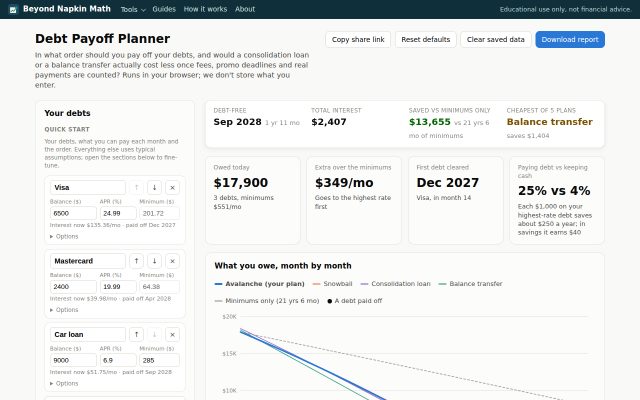
A Visa at $6,500 and 24.99%, a Mastercard at $2,400 and 19.99%, and a car loan at $9,000 with a $285 payment. The household has $900 a month for debts. The offer is a card with 0% for 15 months, a 3% transfer fee, a $10,000 limit, and 23.99% after the promotion.
2. What it saves
- Moved: both cards, $8,900, for a $267 fee.
- Without the transfer (highest rate first): debt-free in 1 year 11 months, $2,407 of interest.
- With the transfer: debt-free in 1 year 10 months, $1,004 in interest and fees.
It saves about $1,400, and the transferred balance is fully paid before the promotion ends.
3. The payment that clears it in time
Divide the transferred balance, including the fee, by the months at 0%: $9,167 ÷ 15 = about $611 a month. In the example, $900 less the $285 car payment leaves $615, just enough.
When that doesn't fit, the picture changes. With $600 a month instead of $900:
- The transfer still helps: $2,052 of interest and fees, against $5,032 without it.
- But it isn't cleared in time: about $4,440 is still owed when the promo ends, and starts building interest at 23.99%.
With a 12-month promotion and $600 a month, about $5,390 is left at the deadline.
4. What changes the answer
| Change from the example | Interest and fees |
|---|---|
| The example (15 months at 0%, 3% fee) | $1,004 |
| 5% fee instead of 3% | $1,193 |
| 12 months at 0% instead of 15 | $1,081 ($1,787 still owed when it ends) |
| No transfer, highest rate first | $2,407 |
The fee matters less than people fear. Running out of time matters more.
5. Rules that catch people out
- The fee is charged on day one and added to the balance.
- New purchases on the transfer card may not get the 0% rate. Keep the card for the transfer only.
- Deferred interest is different. Some store cards say "no interest if paid in full" and charge all the back interest if any balance is left at the end. A true 0% balance transfer only starts charging interest from the day the promo ends.
- A missed payment can end the promotional rate early. Set up automatic payments.
- The limit can be lower than you hoped. If only part of the debt fits, transfer the highest-rate balance first.
6. When to skip it
- You can't pay at least the "balance ÷ promo months" amount, and you don't have a plan for what's left.
- You'd keep using the old cards and end up with debt on both.
- The debt is small enough to clear in a few months anyway, so the fee is most of the saving.
Try it with your numbers
The Debt Payoff Planner opens with this example. Enter your debts and the offer's promo length, fee, limit and later rate. It compares the transfer with paying the cards directly and with a consolidation loan, shows what's left when the promo ends, and tests what happens if you're three months late clearing it. See also when a consolidation loan saves money. It runs in your browser and we don't store your numbers.
More guides for this tool
- A debt consolidation loan: when it saves money and when it costs more
- Avalanche vs snowball vs consolidation: which debt payoff plan costs least
- Pay off debt or build an emergency fund first?
- What paying only the minimum on a credit card costs
 Run your own numbers
Debt Payoff Planner
Avalanche, snowball, consolidation or a balance transfer: which costs least?
Open the tool →
Run your own numbers
Debt Payoff Planner
Avalanche, snowball, consolidation or a balance transfer: which costs least?
Open the tool →