What paying only the minimum on a credit card costs
The minimum payment on a credit card is designed to keep you current, not to pay the card off. Because it shrinks as the balance shrinks, paying only the minimum can stretch a few thousand dollars of debt across decades. The fix is simple: pick a payment and keep paying it, even as the minimum falls.
1. How the minimum is set
Most issuers use one of these rules, with a floor of about $25 to $40:
- 1% of the balance plus that month's interest, the most common rule today.
- A percentage of the balance, such as 2%.
- A fixed amount on some store cards.
Your statement shows a "minimum payment warning": how long paying only the minimum would take, and what it would cost. Few people read it.
2. A $6,500 balance at 24.99%
With the "1% plus interest" rule, the first minimum is about $202. Then:
| What you pay each month | Paid off in | Total interest |
|---|---|---|
| Only the minimum, as it falls | 21 years 6 months | $12,160 |
| $150, fixed | 6 years 11 months | $6,658 |
| $202, today's minimum, kept fixed | 4 years 6 months | $4,369 |
| $300, fixed | 2 years 6 months | $2,234 |
| $500, fixed | 1 year 4 months | $1,160 |
Keeping the payment at the first month's minimum, instead of letting it fall, cuts 17 years and about $7,800 of interest. The minimum only shrinks because the balance shrinks, so following it down gives up the progress you've made.
In the first year of minimum payments, $1,536 of the payments goes to interest, and the balance falls only from $6,500 to about $5,750.
3. When the minimum doesn't even cover interest
At 24.99%, a month's interest is about 2.08% of the balance. A card whose minimum was a flat 2% of the balance would never be paid off: each minimum would be less than the interest added. That's why most issuers now include the month's interest in the minimum. It's also why a card with a high rate and a low percentage minimum deserves a careful look at your statement.
4. How to get out faster
- Fix the payment. Set up an automatic payment for a fixed amount, at least this month's minimum, and leave it there.
- Add extra to the highest-rate card and pay the minimum on the rest (the avalanche method).
- Stop new charges on the card you're paying down. The calculator assumes no new spending.
- Consider a 0% balance transfer if the fee and timeline work; see is a balance transfer worth it?
Try it with your numbers
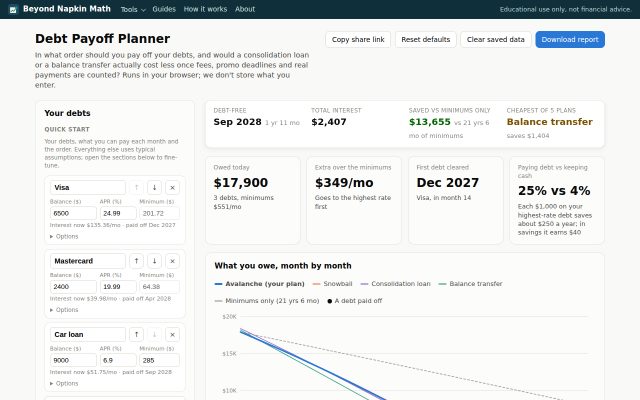
The Debt Payoff Planner opens with this card. Enter your balance, rate and minimum rule from your statement, then your monthly budget. It shows the "minimums only" path next to your plan, and the date each debt is gone. Our guide to avalanche, snowball and consolidation covers several debts at once. It runs in your browser and we don't store your numbers.
More guides for this tool
- A debt consolidation loan: when it saves money and when it costs more
- Avalanche vs snowball vs consolidation: which debt payoff plan costs least
- Is a balance transfer worth it? Fees, promo deadlines and the day it expires
- Pay off debt or build an emergency fund first?
 Run your own numbers
Debt Payoff Planner
Avalanche, snowball, consolidation or a balance transfer: which costs least?
Open the tool →
Run your own numbers
Debt Payoff Planner
Avalanche, snowball, consolidation or a balance transfer: which costs least?
Open the tool →