A debt consolidation loan: when it saves money and when it costs more
A consolidation loan replaces several credit card balances with one fixed-rate loan and one payment. It saves money when its rate, counting the origination fee, is clearly below what your cards charge. It costs more when the rate isn't low enough, and it can backfire if the cleared cards fill up again.
1. The example
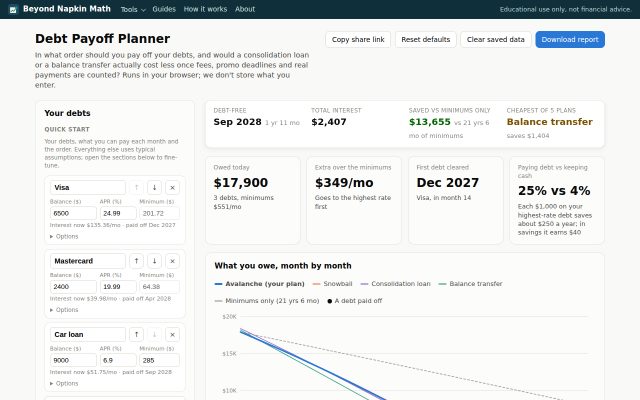
A Visa at $6,500 and 24.99%, a Mastercard at $2,400 and 19.99%, and a car loan at $9,000 that stays as it is. The budget for debts is $900 a month. A lender offers a 36-month loan at 12% with a 5% origination fee taken from the proceeds. To pay off $8,900 of cards, the loan has to be $9,368. The $468 fee is the difference.
2. What it saves, and what decides it
| Option | Debt-free in | Interest and fees |
|---|---|---|
| No loan: pay the cards, highest rate first | 1 year 11 months | $2,407 |
| Loan at 12%, 5% fee | 1 year 11 months | $2,090 |
| Loan at 12%, no fee | 1 year 10 months | $1,519 |
| Loan at 8%, 3% fee | 1 year 10 months | $1,555 |
| Loan at 18%, 5% fee | 1 year 11 months | $2,608: costs more |
| 0% balance transfer for 15 months, 3% fee | 1 year 10 months | $1,004 |
At 12% with a 5% fee, the loan saves only about $317. The fee eats much of the rate advantage, because a household paying $900 a month would clear the cards in under two years anyway. At 18% the loan costs more than just paying the cards. A good fee-free rate, or a low rate with a small fee, is where consolidation clearly wins.
3. The monthly payment can mislead
The loan's required payment is $311 a month, below what the two cards' minimums plus a serious extra would be. A lower payment feels like progress. But stretching a loan over more years means more interest, unless you keep paying extra. Choosing a 60-month term lowers the required payment to $208, and costs the same here only because the household keeps sending the full $900.
4. When consolidation helps most
- The rate is well below your cards, after counting the fee. Compare the loan's APR, which includes the fee, rather than its interest rate.
- You want a fixed end date. A 36-month loan is paid off in 36 months; card minimums can drag on for decades.
- The debt is too big for a balance transfer to clear before its promo ends.
5. The real risk: the cards fill up again
Consolidation empties the cards but doesn't close them. Running the balances back up leaves you with the loan and new card debt. If that's a risk, put the cards away, lower their limits, or close the newest ones (closing old cards can lower your credit score).
6. Before you sign
- Check how the fee is charged: deducted from the money you receive (you borrow more to cover it) or added on top.
- Check for a prepayment penalty. Most personal loans have none.
- Compare at least two offers on APR and total cost, not monthly payment.
Try it with your numbers
The Debt Payoff Planner opens with this example. Enter your debts, your budget and the loan offer: APR, term, fee and whether it's deducted or added. It compares the loan with paying the cards directly and with a balance transfer, after fees. See also is a balance transfer worth it? It runs in your browser and we don't store your numbers.
More guides for this tool
- Avalanche vs snowball vs consolidation: which debt payoff plan costs least
- Is a balance transfer worth it? Fees, promo deadlines and the day it expires
- Pay off debt or build an emergency fund first?
- What paying only the minimum on a credit card costs
 Run your own numbers
Debt Payoff Planner
Avalanche, snowball, consolidation or a balance transfer: which costs least?
Open the tool →
Run your own numbers
Debt Payoff Planner
Avalanche, snowball, consolidation or a balance transfer: which costs least?
Open the tool →