Pay off debt or build an emergency fund first?
Every dollar in a savings account earning 4% while a credit card charges 25% looks like a mistake. On paper it is: paying the card saves about $250 a year per $1,000, against $40 of taxable interest in savings. But a household with no cash at all is one car repair away from putting it straight back on the card, or worse. The answer is a small buffer first, then everything at the debt.
1. The example
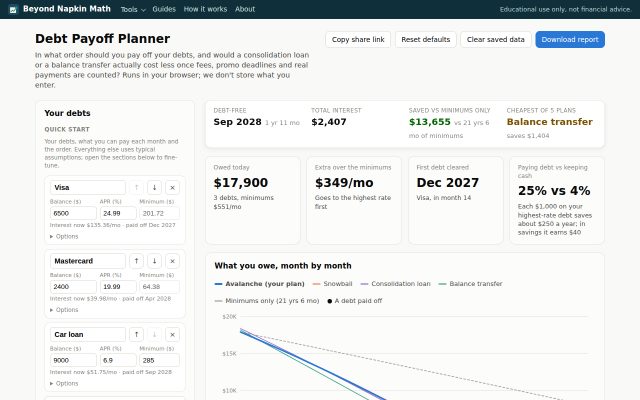
A household with three debts and $900 a month to put toward them:
- A Visa card: $6,500 at 24.99%.
- A Mastercard: $2,400 at 19.99%.
- A car loan: $9,000 at 6.9%, with a $285 payment.
They also have $2,000 in savings. Paying highest rate first (the avalanche method), they're debt-free in 1 year 11 months and pay $2,407 of interest.
2. Buffer or no buffer: the numbers
| What they do | What happens | Debt-free in | Interest paid |
|---|---|---|---|
| Put the $2,000 on the Visa today | No emergency | 1 year 8 months | $1,659 |
| Keep the $2,000 as a buffer | No emergency (they keep the $2,000) | 1 year 11 months | $2,407 |
| Put the $2,000 on the Visa today | A $2,000 emergency in month 6 goes back on the card | 1 year 11 months | $2,181 |
| Keep the $2,000 as a buffer | The emergency is paid from the buffer | 1 year 11 months | $2,407 |
| No savings at all | The emergency goes on the card | 2 years 2 months | $3,156 |
If nothing goes wrong, putting the savings on the card saves about $750 of interest. Over two years, the buffer would have earned about $150, so keeping it costs roughly $600, or $25 a month. Even when an emergency hits, sending the cash to the card first comes out slightly ahead, as long as the card is still there to borrow on again.
3. Why keep the buffer anyway
That last condition is the catch. The $25 a month buys protection against things the math above doesn't count:
- The credit line can shrink. Issuers can cut limits or close accounts, often when times are hard for everyone. A paid-down card isn't guaranteed to be there.
- Missed payments are expensive. Late fees, penalty rates and credit damage follow if a surprise bill means a missed minimum.
- Worse borrowing. Without a card to fall back on, the next option is often a payday loan or overdraft fees.
- Momentum. A plan that keeps getting knocked back by new charges is easy to abandon.
Think of the buffer as insurance: a small, known cost to avoid a large, uncertain one.
4. A practical order
- A starter buffer: often $1,000 to $2,000, or about a month of essential costs. Keep it in a separate savings account.
- Any employer 401(k) match. It's an instant return that beats even a 25% card.
- High-rate debt, highest rate first. Every spare dollar, plus any windfalls.
- A full emergency fund, commonly three to six months of essential costs, once the high-rate debt is gone. The money that went to card payments now goes here.
- Lower-rate debt and investing, weighing each loan's rate against what you'd expect to earn.
If your job is unstable or you have dependents, a bigger buffer before attacking the debt is reasonable. The cost is small next to the risk.
Try it with your numbers
The Debt Payoff Planner opens with this example. Enter your own debts and budget. It shows your debt-free date, what a $2,000 emergency would do, and the rate on your highest debt next to what your savings earn. You can add a one-time lump sum to see what putting savings toward the debt would change. Our guide to avalanche, snowball and consolidation covers the order to pay. It runs in your browser and we don't store your numbers.
More guides for this tool
- A debt consolidation loan: when it saves money and when it costs more
- Avalanche vs snowball vs consolidation: which debt payoff plan costs least
- Is a balance transfer worth it? Fees, promo deadlines and the day it expires
- What paying only the minimum on a credit card costs
 Run your own numbers
Debt Payoff Planner
Avalanche, snowball, consolidation or a balance transfer: which costs least?
Open the tool →
Run your own numbers
Debt Payoff Planner
Avalanche, snowball, consolidation or a balance transfer: which costs least?
Open the tool →