DTI explained: the debt-to-income limits mortgage lenders use
Your debt-to-income ratio (DTI) is the main number a mortgage lender uses to decide how much you can borrow. It's simple: monthly debt payments divided by monthly income before tax. What surprises people is how much house a high limit allows, and how much a car payment takes away.
1. Two ratios
- Housing ratio ("front-end"): the new housing payment, meaning principal, interest, property tax, insurance, HOA dues and mortgage insurance, divided by gross monthly income.
- Total ratio ("back-end"): the housing payment plus every other monthly debt payment (car loans, student loans, credit card minimums, child support), divided by gross monthly income.
Living costs like groceries, utilities, childcare and taxes aren't in either ratio. That's why a payment that passes a lender's test can still be hard to live on.
2. The limits by loan type
| Loan type | Housing limit | Total limit |
|---|---|---|
| Conventional | None | 45% (36% for manual underwriting without compensating factors; up to 50% through automated approval) |
| FHA (manual underwriting, no compensating factors) | 31% | 43% |
| VA | None | 41% guideline |
| The "28/36" rule of thumb (not a lending rule) | 28% | 36% |
Automated underwriting often approves higher ratios when other factors are strong, such as a high credit score, cash reserves or a larger down payment.
3. What each limit buys
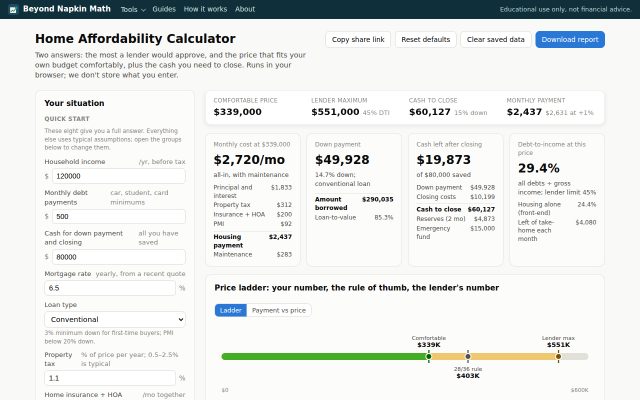
A household earning $120,000 a year ($10,000 a month before tax), with $500 a month of other debt payments, $80,000 of cash and a 6.5% rate. The tool's example:
| Limit | Highest housing payment | Highest price | What stops it |
|---|---|---|---|
| Conventional (45% total) | $4,000 | about $551,000 | Total ratio |
| VA (41% total) | $3,600 | about $514,000 | Total ratio |
| FHA (31% housing) | $3,100 | about $427,000 | Housing ratio |
| 28/36 rule of thumb | $2,800 | about $403,000 | Housing ratio |
| A comfortable budget (40% of take-home pay after debts and savings) | $2,720 including upkeep | about $339,000 | Your budget |
The conventional limit allows a home about $210,000 more expensive than the comfortable budget. At that maximum, 45% of gross income goes to debts before taxes, savings or living costs. Our guide to how much house you can afford explains how to find your own number.
4. What a car payment costs you in house
Every dollar of other debt counts against the same total limit. In the example:
- With no other debts, the conventional maximum rises to about $605,000.
- With $500 a month of debts, it's about $551,000.
- With $1,000 a month, such as a car loan plus student loans, it's about $488,000.
Each $100 a month of debt payments cuts the maximum by roughly $10,700 to $12,700. So pay down or pay off small loans before you apply, and don't take on a new car loan in the months before buying.
5. Getting the numbers right
- Income: lenders count stable, documented income, usually averaged over two years for bonuses, commissions and self-employment.
- Credit cards: the minimum payment on your statement counts even if you pay the balance in full.
- Student loans: lenders use a set payment even if yours is deferred. The rule depends on the loan type.
- The new payment includes everything: property tax, insurance, HOA and mortgage insurance, not just principal and interest.
Try it with your numbers
The Home Affordability Calculator opens with this example. Enter your income, debts and cash, pick a loan type, and it shows the lender's maximum, the 28/36 price and the price that fits your budget, plus which limit binds. You can also set your own DTI limits if a lender quotes different ones. It runs in your browser and we don't store your numbers.
More guides for this tool
- FHA vs conventional: which costs less on a small down payment?
- How much down payment do you need? 3%, 5%, 10% or 20%
- How much house can I afford? The lender's number vs. your number
- What a 1-point change in mortgage rates does to the house you can afford
 Run your own numbers
Home Affordability Calculator
The lender's number vs. your number, with the cash you need to close.
Open the tool →
Run your own numbers
Home Affordability Calculator
The lender's number vs. your number, with the cash you need to close.
Open the tool →