How much down payment do you need? 3%, 5%, 10% or 20%
You don't need 20% down to buy a home. Conventional loans go as low as 3% for first-time buyers, FHA loans 3.5%, and VA loans zero. Putting less down gets you in sooner. It also brings mortgage insurance, a bigger loan and a higher payment for years. Here's what each choice costs on the same house.
1. The minimums
| Loan type | Smallest down payment | Mortgage insurance |
|---|---|---|
| Conventional | 3% (first-time buyers; 5% otherwise is typical) | PMI if you put down less than 20%. It ends on its own at 78% of the original value, and you can ask to cancel at 80% |
| FHA | 3.5%, with a credit score of 580 or more | A 1.75% upfront premium plus a yearly premium. With under 10% down, it lasts the life of the loan |
| VA (eligible service members and veterans) | 0% | No monthly mortgage insurance. A one-time funding fee instead, unless you're exempt |
2. Same house, five down payments
A $400,000 home with a conventional loan at 6.5% for 30 years, a 720 credit score, property tax of 1.1% a year, $200 a month for insurance and HOA dues, and closing costs of 3%:
| Down payment | Cash to close | Principal and interest | PMI | Monthly total | PMI lasts | PMI paid in all |
|---|---|---|---|---|---|---|
| 3% ($12,000) | $24,000 | $2,452 | $243 | $3,262 | 12 years | $34,920 |
| 5% ($20,000) | $32,000 | $2,402 | $174 | $3,143 | 12 years | $23,513 |
| 10% ($40,000) | $52,000 | $2,275 | $114 | $2,956 | 10 years | $12,426 |
| 15% ($60,000) | $72,000 | $2,149 | $71 | $2,787 | 7 years | $5,313 |
| 20% ($80,000) | $92,000 | $2,023 | none | $2,589 | – | $0 |
"PMI lasts" is the automatic end on the original schedule. Asking to cancel at 80%, or paying extra, ends it sooner; see how to get rid of PMI. With FHA at 3.5% down, the monthly total is $3,226, but the yearly premium lasts the life of the loan: about $42,600 over 30 years if you never refinance.
3. Why the money between 5% and 20% works hard
Each extra $20,000 down cuts the monthly total by roughly $170 to $200 while PMI applies: from 5% to 10% it saves $187 a month, from 15% to 20% it saves $198. That's $2,000 to $2,400 a year on $20,000, a return of roughly 10–12% a year in the early years, partly because the PMI rate itself drops as your down payment grows. Once PMI ends, the extra down payment earns just the mortgage rate.
That's a strong guaranteed return. The catch is the cash itself: every extra dollar down is a dollar not in your emergency fund.
4. Don't spend your last dollar on the down payment
- Closing costs are extra, often 2–5% of the price. In the example that's $12,000 on top of any down payment.
- Lenders may want reserves: a couple of months of payments left in the bank after closing.
- The first year brings surprises: a water heater, a roof leak, furniture, moving costs. Keep an emergency fund the down payment can't touch.
A reasonable order is to keep the emergency fund, cover closing costs, then put down as much as you can up to 20%. If that's under 20%, a smaller down payment with PMI is fine. Plan to cancel PMI as soon as you reach 80%.
5. Credit score matters as much as down payment
PMI is priced by credit score. At 5% down on the same house, the calculator's PMI estimate is $127 a month with a 760 score, $174 with 720, $253 with 680 and $364 with 620. A better score can save as much as a bigger down payment. With a lower score, an FHA loan can be the cheaper route; see FHA vs conventional.
Try it with your numbers
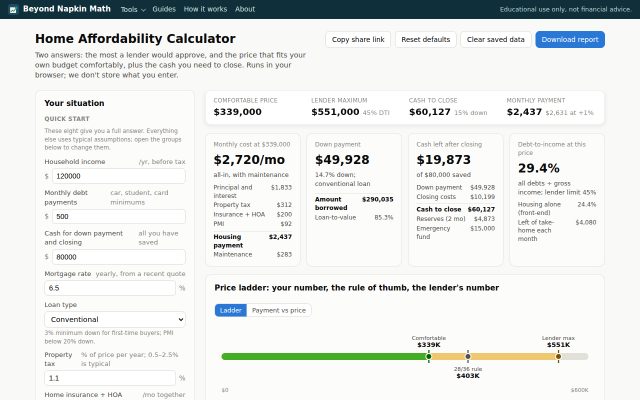
The Home Affordability Calculator opens with an example household putting 5% down. Change "Largest down payment" and the cash you have, and it shows how your price range, payment and cash to close move. The chart of monthly cost against price shows what a specific home would cost. The PMI figures are estimates by credit band, not quotes. It runs in your browser and we don't store your numbers.
More guides for this tool
- DTI explained: the debt-to-income limits mortgage lenders use
- FHA vs conventional: which costs less on a small down payment?
- How much house can I afford? The lender's number vs. your number
- What a 1-point change in mortgage rates does to the house you can afford
 Run your own numbers
Home Affordability Calculator
The lender's number vs. your number, with the cash you need to close.
Open the tool →
Run your own numbers
Home Affordability Calculator
The lender's number vs. your number, with the cash you need to close.
Open the tool →