What a 1-point change in mortgage rates does to the house you can afford
When mortgage rates move by a point, headlines talk about payments. For a buyer, the better question is what happens to the price you can afford. The answer: about 5% of your budget per point for this example household. The lender's maximum moves more, and the first month's payment on a home you've already picked moves by about $200.
1. The example
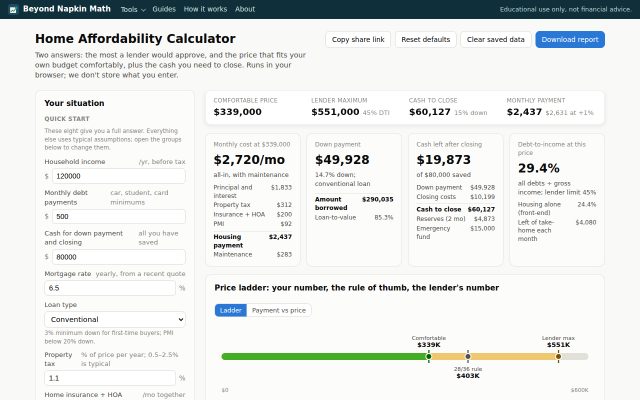
A household earning $120,000 a year, with $7,800 a month of take-home pay, $500 a month of other debts and $80,000 of cash. They have a 720 credit score, a conventional loan, 1.1% property tax and $200 a month for insurance and HOA dues. The "comfortable" price keeps housing, including upkeep, to 40% of take-home pay after debts and savings.
2. Price you can afford, by rate
| Mortgage rate | Comfortable price | Lender's maximum | 28/36 rule of thumb |
|---|---|---|---|
| 5.5% | $363,519 | $586,130 | $429,554 |
| 6.0% | $351,407 | $563,803 | $413,797 |
| 6.5% | $339,963 | $551,763 | $403,813 |
| 7.0% | $332,585 | $531,387 | $389,596 |
| 7.5% | $322,122 | $512,299 | $376,294 |
From 6.5% to 7.5%, the comfortable price falls by about $17,800 (5%) and the lender's maximum by about $39,500 (7%). From 6.5% down to 5.5%, the comfortable price rises by about $23,600. The steps aren't perfectly even, because mortgage insurance rates jump at certain down-payment levels and the cash you have caps the down payment.
3. Why the lender's number moves more
A lender holds your payment fixed, here $4,000 a month at 45% of income, and asks how big a loan it supports. When the rate rises, more of that payment goes to interest, so the loan shrinks. Your own comfortable budget includes things that don't change with the rate (property tax, insurance, upkeep), so a smaller share of it is affected.
4. If rates rise after you've found the house
At the comfortable price of about $340,000, a 1-point rise before you lock adds about $195 a month: from $2,720 to $2,915 including upkeep. The calculator flags that as over budget.
Ways to handle it:
- Lock your rate once you're under contract. Ask how long the lock lasts and what an extension costs.
- Leave room in your budget. Shopping at the bottom of your range absorbs a rate move.
- Points buy the rate down for cash at closing. Whether they pay off depends on how long you'll keep the loan.
- Refinance later if rates fall, but don't count on it. Refinancing has costs; see when refinancing pays off.
5. The tool's other stress tests
At the same price, the calculator also checks:
- a property tax bill 25% higher after the sale reassesses the home (+$78 a month here);
- insurance and HOA dues 30% higher (+$60 a month);
- a $15,000 repair in the first year, against the cash left after closing;
- if two people earn the income, losing the second income.
A rate move is often not the biggest risk. Property tax and insurance can rise every year after you buy.
Try it with your numbers
The Home Affordability Calculator opens with this example at 6.5%. Change the mortgage rate to today's quote and to a point higher, and watch your three prices move. The stress tests show what a rate rise before locking would do to your payment. It runs in your browser and we don't store your numbers.
More guides for this tool
- DTI explained: the debt-to-income limits mortgage lenders use
- FHA vs conventional: which costs less on a small down payment?
- How much down payment do you need? 3%, 5%, 10% or 20%
- How much house can I afford? The lender's number vs. your number
 Run your own numbers
Home Affordability Calculator
The lender's number vs. your number, with the cash you need to close.
Open the tool →
Run your own numbers
Home Affordability Calculator
The lender's number vs. your number, with the cash you need to close.
Open the tool →